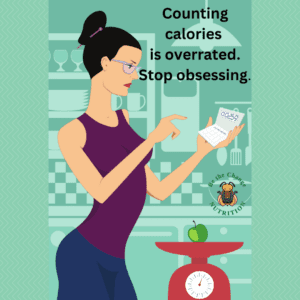
Counting calories was something I used to frequently recommend to clients for weight loss. But I have found myself doing this less and less often. In theory, the concept appears to make perfect sense: Calculate how many calories your body needs based on your current height, weight and activity level. Then simply consume less (and move more) and you will lose weight.
The only problem is– this approach of emphasizing a number of calories rather than the quality/type of calories usually doesn’t work and if it does, it only works short-term before you regain any lost weight. Can you relate?
Your body knows how many calories it needs better than any calculator or diet plan. We’ve been blessed with a handy built-in feature called appetite (we’ve got one called thirst too!); if only we would listen to this instead of trying to fight it and control it. It’s there to guide us. As a child we knew when to eat and when to stop eating because we were in sync with our internal messages. Somehow, somewhere along the path of life, this innate gift often gets lost (usually because of dieting!)
Calorie tracking websites and apps have become popular for weight loss. True, calorie counting can be helpful for some people. I suggest it as a tool in certain situations where I feel the person will benefit from temporarily tracking their foods and looking at the numbers to see where their calories are coming from. It can offer tremendous insight when you’re not in touch with what you are eating and the quantity you are eating. But it’s also good to know that the FDA allows food manufacturers to have up to a 20% margin of error— so the calorie info you see on food labels is not necessarily even accurate. 😜
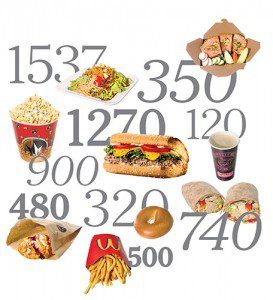
That being said, not only can logging everything you put into your mouth be a major time consumer and additional stress factor in your life, but counting calories can also lead to feelings of failure when you don’t meet that specific calorie number. This leaves you with a negative self-image– which then fuels unwanted eating habits.
What if the daily number of calories you are aiming for is not realistic or right for you? I’ve seen too many people enter their height, weight and weight goal into an online calorie tracking program, only for it to recommend they eat 1200 calories per day. This is actually the calorie recommendation for a toddler!😲
And guess what happens when you eat too little? Your metabolism naturally slows down to accommodate a lower food supply. After you under-eat (diet), no matter how much willpower you think you have, the pendulum swings back the other direction. This is the feast-famine or restrict-binge cycle. Over time this pattern leads to fat storage and weight gain. Hence all the folks who report how they dieted and then ended up gaining back the weight plus some.
🌟 Instead of focusing on eating LESS, at Be the Change Nutrition we talk about what to eat MORE of: Foods that will help balance your blood sugars and keep you feeling satiated! 🥰
The number of calories you eat tells you nothing about the quality of your diet. Nutritionally dense foods promote hormonal balance and lower inflammation, both of which are key players in disease prevention and maintenance of a healthy body weight. Highly processed foods contribute to hormone imbalances and promote inflammation, which in a sense is like gumming up your system so it’s not properly functioning and more susceptible to disease and weight gain.
You can eat 2000 calories worth of bagels, Special K bars, pretzels, processed lunch meat sandwiches and canned soup with crackers… or that 2000 calories can be from wholesome foods like eggs, strawberries, walnuts, sweet potato, avocado, chicken, spinach and black beans. There can be a major difference in nutrients. You are going to feel greater satisfaction and overall well-being eating whole foods versus highly processed products. When you give your body the nutrients it needs, things run smoothly. Food is much more than just calories. If you want to feel good, you’ve got to eat in accordance with that goal.
🤔 If you’re calorie counting and finding yourself always hungry, could this be a signal that your body needs to eat more?
🤔 Could those feelings be because you are trying to eat a 200 calorie meal when what you really need is at least twice that?
🤔 Or maybe your meals are not properly balanced with fat, fiber, protein and carbohydrates leaving you feeling as if something is missing.
🤔 Could you be relying on too many diet products to keep your calories as low as possible?
🤔Perhaps your body isn’t getting the nutrients it needs and you’re experiencing hunger as a result.
If you’re not feeling satisfied by what you’re eating then there is something going on that needs some investigation.🕵🏼
What ever happened to trusting our internal signals? When did we lose touch with our hunger and satiety messages that let us know when to eat and when we have had enough? Honor your hunger; don’t suppress it through calorie restriction. Look at your appetite as your friend rather than your enemy. You cannot hate yourself into a healthy state or a smaller body. You can only love yourself into good health. Learn to check in with your body, feed it when it needs fuel and not when you are bored … and stop when you are satisfied, not stuffed. Listen. Trust.
And everything will be ok. 🙂
Please don’t judge your self-worth on how well you succeed in meeting a calorie goal. It’s just a number and who is to say that it’s the number for YOU? Better yet, forget counting calories and switch your focus to eating the best quality foods you can to nourish your body, mind and soul. Practice paying attention to what you need to feel your best and you may be pleasantly surprised how weight loss naturally falls into place as a side effect of this self-trust and self-love.