person trapped in all or nothing thinking

If you’ve ever said “I’ll start fresh Monday,” “I already messed up, so today’s a wash,” or “If I can’t do it perfectly, what’s the point,” congratulations — you’ve met the All‑or‑Nothing Trap.

It’s sneaky, persuasive and incredibly common. And it’s one of the biggest reasons people feel stuck, frustrated or inconsistent with their nutrition.

But here’s the good news: this trap isn’t a personal flaw. It’s a pattern. And patterns can be understood, softened and rewritten.


What the All‑or‑Nothing Trap Actually Is

At its core, all‑or‑nothing thinking is a brain shortcut. It loves clean lines, clear rules and the illusion of control. It says:

“Healthy” or “unhealthy”

“Good day” or “bad day”

“On track” or “off track”

It feels productive because it gives you a sense of direction. But it’s actually a trap because real life — and real bodies — don’t operate in extremes. They operate in gradients, flexibility and context.


Why This Mindset Feels So Powerful

All‑or‑nothing thinking sticks around because it offers:

1. A sense of certainty

Perfection feels safe. It feels like a plan. It feels like you’re doing something “right.”

2. A dopamine hit

The “fresh start” high is real. New rules, new routines, new promises — your brain loves the novelty.

3. A way to avoid discomfort

If you’re “starting Monday,” you don’t have to sit in the messy middle today. You get temporary relief.

But the relief is short‑lived. And the cycle repeats.


How the Trap Shows Up in Everyday Nutrition

You might notice it in moments like:

  • Skipping breakfast because you overslept, then deciding the whole day is ruined.
  • Eating one cookie and thinking, “Well, I blew it,” so you might as well keep going.
  • Feeling like you need the perfect grocery haul or meal prep to be “healthy.”
  • Believing that if you can’t work out for 45 minutes, it’s not worth doing at all.

These patterns don’t reflect a lack of willpower. They reflect a lack of flexibility — something most of us were never taught.


The Middle Ground: Where Real Progress Happens

The antidote to all‑or‑nothing thinking isn’t “trying harder.” It’s learning to live in the middle — the land of “good enough,” “better than nothing” and “this still counts.”

Here’s what that looks like in practice:

1. Shrinking the goal instead of abandoning it

Didn’t have time for a full workout? A 10‑minute walk still supports your body.

2. Adding instead of restricting

Had a meal that felt less balanced? Cool. Add a source of protein or fiber to the next one.

3. Letting one moment be one moment

A single choice doesn’t define your day. Your day is made of dozens of choices.

4. Rewriting the narrative

Instead of “I blew it,” try:

“I’m still allowed to care for myself right now.”

“One choice doesn’t erase my progress.”

“I can pivot without punishing myself.”


Why the Middle Ground Works

Because it’s sustainable. It’s human. It honors the reality that your energy, schedule, emotions and needs shift — sometimes daily.

Consistency doesn’t come from perfection.

It comes from the ability to return to supportive habits without shame, urgency or punishment.


A Few Gentle Prompts to Try This Week

  • What’s the smallest version of this habit I can still do today?
  • What would “good enough” look like right now?
  • How can I support myself without swinging to an extreme?
  • If I wasn’t judging myself, what choice would I make next?

The Bottom Line

The All‑or‑Nothing Trap convinces you that perfection is the only path to progress.

But the truth is the opposite: progress lives in the middle.

In the flexible, compassionate, imperfect choices that add up over time.

You don’t need a perfect day. You need a kinder one.

step into spring and let go of the food fear quote picturing a happy bee and some flowers

March is the season of in‑between. The light is returning, the air is almost warm and your brain is waking up from its winter nap with the energy of a houseplant that’s just been rotated toward the sun. It’s a natural moment for fresh starts—but not the punishing January kind. The gentler, wiser kind.

And while many people use spring to declutter closets or scrub baseboards, there’s another space that deserves a little clearing out: Your nutrition beliefs.

Because over the winter (and let’s be honest, over the last decade of the internet), most of us have collected a surprising amount of nutrition clutter—half‑truths, TikTok fears, rigid rules and outdated ideas that quietly shape how we eat and how we feel about eating.

This is the perfect time to sweep out what’s not serving you and make room for something more grounded, flexible and supportive.


🌞 Why Spring Is the Best Time to Rethink Food Rules

As daylight increases, your circadian rhythm shifts. Mood lifts. Motivation returns. Your brain becomes more receptive to change. This isn’t “willpower”—it’s biology.

Spring gives you:

  • A natural sense of renewal
  • More access to colorful, fresh foods
  • A psychological “fresh start effect” that actually sticks better than January
  • A chance to reset without the pressure of resolutions

So instead of reorganizing your pantry (again), let’s reorganize the beliefs that shape how you nourish yourself.


🌾 Seed Oils: Exhibit A in Nutrition Clutter

Seed oils have become the internet’s favorite villain—canola, soybean, sunflower, safflower, grapeseed, corn. You’ve seen the claims: “toxic,” “inflammatory,” “poison.”

But the research is far more nuanced.

What we do know:

  • Omega‑6 fats aren’t inherently inflammatory; the issue is the ratio of omega‑6 to omega‑3 in the overall diet.
  • Replacing saturated fats with polyunsaturated fats (like those in seed oils) is still supported by major health organizations.
  • Fear‑based messaging spreads faster than nuance, especially in winter when people feel depleted and want something to “fix.”

A more grounded spring approach:

  • Add omega‑3s (flax, chia, walnuts, salmon).
  • Use a variety of fats (olive oil, avocado oil, butter, sesame oil).
  • Cook more at home when you can.
  • Stop letting your salad dressing feel like a moral dilemma.

Seed oils aren’t the only belief worth sweeping out—but they’re a great place to start.


🌸 Nutrition Beliefs Worth Sweeping Out This Spring

1. “Carbs are the enemy.”

Spring reframe:

Carbohydrates are your brain’s primary fuel source and play a meaningful role in serotonin production, digestion and overall energy regulation. As your body transitions out of winter mode, steady carbohydrate intake actually supports a more stable mood and metabolism. Plus, carbs are where you find FIBER! Carbs themselves aren’t the problem; but timing, pairing, quality and portions matter.  Balanced carbs = steady energy.


2. “I need to earn or burn my food.”

Spring reframe:

This belief stems from learned associations between eating and self‑control, not from human physiology. The body doesn’t interpret food as something that must be offset or “worked off”—it uses incoming energy continuously to support metabolism, cognition, and nervous‑system stability. Most of the calories you consume in a day go towards basic survival functions, not workouts. Your body is “burning” energy right now reading this. You could lie in bed all day and still need nourishment. Movement is great for health. But it’s not a payment method.


3. “Healthy eating has to be perfect.”

Spring reframe:

Perfectionism is one of the biggest barriers to sustainable nutrition. It creates rigidity, guilt and all‑or‑nothing cycles that make eating harder than it needs to be. Aim for small, consistent improvements—incremental progress is far more effective than perfection. Flexibility supports sustainability in a way rigid standards rarely do. You actually function better when you’re nourished consistently, not perfectly. There is no such thing as perfect eating anyway.


4. “Processed = bad.”

Spring reframe:

Processing exists on a spectrum. Some processing improves safety, digestibility or nutrient availability. The goal isn’t to eliminate all processed foods—it’s to understand their role. Choose foods based on function, satisfaction and context. Frozen vegetables are still vegetables. A rotisserie chicken is still high‑quality protein and a practical support for busy days. And yes, a cookie can even be part of a balanced meal.


5. “Clean eating is the gold standard.”

Spring reframe:

“Clean” is vague, moralizing and often rooted in anxiety rather than evidence. It tends to contract your choices rather than help you build a more flexible, trusting approach to food. Shift from “clean” to aligned with my needs. From “good vs. bad” to context matters. Clean eating sounds simple until you try to define it. Is bread clean? What about protein bars? Frozen veggies? Canned beans? Every “clean eating” list contradicts the next one. If the gold standard changes depending on who you ask, it’s not a standard — it’s a trend.


6.“Cravings mean I’m failing.”

Spring reframe:

Cravings are a form of communication—your body’s way of signaling needs, shifts or imbalances. They’re not a personal flaw. People with the most peaceful, stable eating patterns still have cravings. They just don’t panic about them. They respond, adjust and move on. Cravings aren’t a red flag — they’re a normal part of being alive.


7. “More restriction = more weight loss.”

Spring reframe:

Restriction increases stress, slows metabolism, disrupts appetite cues, ramps up cravings and often leads to rebound eating. It rarely produces the long‑term outcomes people hope for. Balanced eating routines create stability, resilience and long‑term health.  Add before you subtract. Spring naturally brings more color, fiber, and freshness—let that expansion guide you.


😵‍💫 How to Evaluate Nutrition Claims Without Spiraling

A few grounding questions help cut through the noise:

  • Does this claim explain how something works, or does it rely on fear‑based language?
  • Who benefits from me believing this?
  • Is this coming from a credentialed expert or a viral soundbite?
  • Does this advice support a fuller, more flexible relationship with food or does it narrow my options?

If it makes your world feel smaller, it’s likely just mental clutter—not wisdom you need to keep.


🌈 A Fresh Start for Your Food Mindset

Spring is a good time to clear out the fear‑mongering that’s crept into your nutrition beliefs—the rules that make eating feel like a threat instead of a normal human need. When you sweep away the noise, what’s left is a more practical, curious approach to food: noticing what supports your energy and mood, what feels sustainable and what actually works for your life. That’s the kind of “spring cleaning” that helps you make food choices from clarity, not fear.
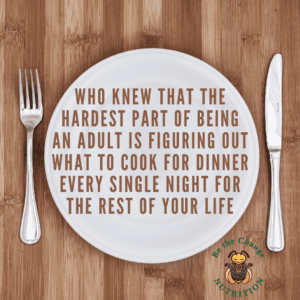
Plate with quote: Who knew that the hardest part of being an adult is figuring out what to cook for dinner every single night for the rest of your life.

Let’s demystify and simplify this.🪄

Meal planning does not have to be stressful.
Or rigid. Or time‑consuming. Or a second job.

When you understand the basics of how a balanced plate works, you already have everything you need to meal plan with confidence. 🍴

At its core, most satisfying meals come from a familiar formula:

Protein+Carb+Fat+Produce

🍗+🍠+🧀+🥦

(or any close variation that fits your real life)

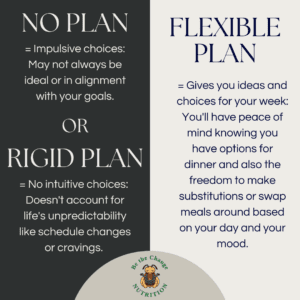
Instead of treating a meal plan like a strict script you must follow, change your definition to: Flexible Meal Planning.


Comparison between having no plan or a rigid plan and having a flexible plan.


Tips & Tools:

✅ Take inventory.  Start by checking your fridge, freezer and pantry. Notice what needs to be used up and what you can combine to create a couple of easy meals. This alone can spark half your plan.

📆 Look at your schedule. Glance at your week and note late work nights, kids’ activities, classes or anything that affects dinner time. On busier nights, choose meals that require minimal time, effort or cleanup.

🍽️ Factor in restaurant night(s).  If you enjoy dining out or grabbing take‑out, build it into your plan intentionally. Choose the night(s) that make the most sense for your energy and schedule.

🌮Try theme nights.  Themes simplify decisions and keep things fun. Ex. Mon: breakfast for dinner, Tues: Mexican, Wed: sheet pan meal, Thurs: snack plate night, Fri: seafood, Sat: take-out, Sun: vegetarian.

👩🏼‍🍳 Keep it mostly familiar.  Build your plan around tried and true meals that you know and like.  Maybe add in one new idea a week, but don’t try to make a whole week of unfamiliar recipes.

🔪 Prep ahead when you can.  Thaw meat in advance, cook a starch (wild rice, quinoa, potatoes) to reheat later or chop veggies for a quick stir‑fry. Small steps make weeknights smoother.

🛒 Shop and stock up.  A well‑stocked kitchen makes meal planning so much easier. Keep pantry and freezer staples on hand and shop regularly for fresh items so you always have options.

📃 Make a list.  When you’re low or out of something, write it down immediately.

📚 Build a recipe collection.  A visual library helps create ideas. You likely have dozens of meals you’d happily make again—you just forget about them. Brainstorm with your family, print favorites and “want‑to‑try” recipes and keep them in one place.  Use a folder or binder like this  to flip through when you need inspiration.

📝 Get your ideas out of your head and onto paper.  Meal planning comes together quickly once you can see it. A dry‑erase menu board (like the one on my fridge) makes it easy to map out your week and adjust as needed. You’ll be surprised how easy meal planning comes together when you do this.

🤸🏼‍♂️ Stay flexible. Remember, you don’t have to follow a meal plan exactly– That can be stressful and unrealistic. Have ideas and options, but keep things flexible.

🌞 One day at a time approach. If planning a full week feels overwhelming, shorten the window. Keep ingredients for several meals on hand, then decide the night before or that morning what you’ll make.

😃 Need help? I sit down with clients all the time and help them flexible meal plan for their week.  We’ll take your goals, your schedule, your obstacles and your taste preferences into consideration.  I won’t hand you a meal plan (and here’s why) but I will teach you how easy it is to plan out your own meals for yourself.


🤔Is meal planning for everybody?

Not necessarily.

Many people genuinely do well deciding what to eat in the moment. They can scan the fridge, pull a few things together, and end up with something balanced without much thought. For others, that skill develops over time—just like learning to cook, lift weights or budget.
Even the most spontaneous eaters still rely on a few systems:
• Grocery shopping so there’s something to choose from
• A handful of go‑to meals they can make on autopilot
• Basic ingredients that mix and match easily

That’s planning… just not the rigid, color‑coded kind.


Meal planning isn’t about perfection or predicting every craving. It’s about reducing the nightly “What the heck do I make?” stress spiral. When you build even a light structure around meals, you get:
• Less decision fatigue at the end of the day
• More balanced meals without micromanaging
• A smoother grocery routine
• More confidence that you can feed yourself well, even on chaotic weeks

It’s a skill that supports your life—not one that takes it over.

title for blog post on insulin resistance with graphics of healthy habits for metabolic health

WHAT IS INSULIN RESISTANCE?
Insulin is a hormone produced by the pancreas that helps move sugar (glucose) from your blood into your cells for energy.
When your cells stop responding well to insulin, your body makes more of it to compensate.
Over time, this can lead to higher blood sugar and increase your risk for:

Prediabetes
Type 2 diabetes
PCOS (Polycystic Ovary Syndrome)
Fatty liver disease

The good news? With the right lifestyle support, insulin resistance can often be reversed.

🚦 COMMON SIGNS TO WATCH FOR

Fatigue after meals
Cravings for carbs or sweets
Weight gain around the belly
Skin changes (dark patches or skin tags)
Difficulty losing weight
Irregular periods (in women)
Increased thirst or urination

🔍 WHAT CAUSES IT?

Insulin resistance can be influenced by:
Diets high in refined sugar and ultra-processed foods
Low physical activity
Chronic stress and poor sleep
Genetics and family history
Hormonal shifts and aging
Certain health conditions (ex. PCOS, fatty liver)


💪 HOW TO SUPPORT YOUR BODY

🥗 NUTRITION
Focus on whole foods: veggies, fruits, proteins, healthy fats, whole grains
Reduce sugary drinks and ultra-processed snacks
Add fiber-rich foods like beans, oats, chia seeds, avocado, nuts

🚲MOVEMENT
Aim for 20–30 minutes of activity most days
Walking after meals is especially effective
Include strength training 2x/week

😴 SLEEP & STRESS
Get 7–9 hours of sleep
Practice stress-reducing habits: deep breathing, journaling, gentle movement
Remember: your nervous system and blood sugar are closely connected

❤️ WHY IT MATTERS
Supporting insulin sensitivity can help you:
Feel more energized
Reduce cravings
Balance hormones
Improve mood and focus
Protect your heart and metabolism

✨ QUICK WINS TO TRY THIS WEEK
Walk for 10 minutes after dinner
(Helps lower blood sugar naturally)

Swap soda for sparkling water with lemon
(Cuts sugar without sacrificing flavor)

Add avocado or olive oil to meals
(Supports blood sugar and keeps you full)

Go to bed 30 minutes earlier
(Helps regulate hunger and insulin)

💬 FINAL THOUGHT
Insulin resistance is your body’s way of asking for support—not punishment.
You don’t need to change everything overnight.
Start small. Stay curious. Celebrate progress.
Every step you take is a step toward feeling better.

You deserve support that’s personalized, evidence‑based, and free from overwhelm. Partnering with an RD gives you a teammate who can help you stabilize blood sugars, boost energy, and build habits that last.

👤 Practice Being the Future You

Embrace the mindset of the person you aspire to be once you achieve your weight loss goals.

Instead of waiting to become him or her, start being that person now. Identify with the version of yourself that you envision– someone who feels confident, energized and at peace with food. Let this alignment guide your thoughts and actions.

This approach differs from the common tendency to focus on what you lack or who you are not. Instead, imagine that you’ve already reached your goal. This shift in perspective helps align your thoughts with the feelings you desire. You tune into the future you and begin to live in harmony with that person.


🧭 Your Inner GPS: Align with What You Want

Most people unknowingly align with what they don’t want.

They rehearse thoughts like:

“I’m not good enough.”

“This is never going to work.”

These recycled beliefs keep you stuck in the past.

But here’s the wild truth: you can think anything you want. About your body. About your future. About yourself.

And no one– not even your inner critic– can tell you you’re wrong.

So concentrate on what you do want. This positive focus acts as your personal GPS, steering you toward your goals. Release your attachment to specific outcomes and prioritize the feelings associated with your journey– such as peace with food, confidence in your body and increased energy. When you align with those feelings, your body begins to follow. It’s not magic– it’s mindset. And it’s available to you right now.


🌱 Focus on the Feeling, Not the Outcome

Let go of obsessing over the number on the scale. Instead, focus on the feeling:

The peace you crave around food.

The confidence of being fully present in your body.

The energy that fuels your day.

By focusing on these emotions, your body will naturally align with your aspirations.

It’s not about chasing a thinner body– it’s about cultivating a life that feels lighter, freer and more empowered.


🧠 When You’re Out of Alignment…

Check in with your thoughts. Are they rooted in fear or in possibility? Are they dragging you back to an old story or helping you write a new one?

Often, they may echo old beliefs like “I’m not good enough” or “I can’t do this.” But here’s the empowering truth: You have the power to choose your thoughts. You can think positively about yourself and no one can dispute your self-perception. You have the freedom to envision a bright future– even if your mind tries to resist that vision.

So embrace this power. Let it guide you. Be the change you’re waiting for.

You don’t have to overhaul your life.

You don’t need a perfect plan.

You just need one aligned action that says, “This is who I’m becoming.”

When you practice the habits your future self already loves– the ones that feel supportive, kind and realistic– your body begins to trust you.

And trust creates momentum.

This is what “being the change” looks like in real life:
💖 Small choices. Repeated often.
💖 Identity first. Outcomes second.
💖 A gentle reset that actually sticks.

If you’re craving a shift, start with one tiny vote for your future self today.

Weight loss may still be part of your journey and that’s ok. But it doesn’t have to be the compass. When you lead with self-respect, curiosity and care, your body often follows. Be the change. Not just in your habits– but in how you speak to yourself, how you show up and how you define success.

healthful snack board with various fruits, veggies, shrimp, cheese, nuts, etc.

Whether you’re hosting a cozy gathering or prepping a solo snack board for movie night, a healthful grazing board is a delicious reminder:

Nourishment can be festive, flavorful and full of joy!


🎄 Healthful Holiday Grazing Boards:  Nourishing, Satisfying and Gratifying

The holidays are a time for gathering, grazing and gifting your taste buds a little extra pleasure.

But indulgence doesn’t have to mean derailment.

Enter: the healthful holiday grazing board—a vibrant, balanced spread that celebrates flavor, color and nutrients.


✨ What Makes It “Healthful”?

A nourishing grazing board isn’t about restriction—it’s about intention.

Here’s how…

Think variety and balance:

💚 Colorful produce: Rainbow carrots, pomegranate seeds, berries, red pepper slices, citrus, grape tomatoes and crisp cucumber rounds add micronutrients, fiber, antioxidants and visual pop.

❤️ Protein-rich bites: Hard-boiled eggs, smoked salmon, shrimp cocktail, unique cheeses, roasted edamame or marinated tofu cubes offer satisfying staying power.

💙 Whole-grain nibbles: Seeded crackers, whole wheat mini pita wedges, corn chips or popcorn bring fiber, crunch and texture.

💛 Fats and flavors: Olives, pickled veggies, seasoned nuts, hummus, guacamole, salsa, etc keep things exciting.


🎁 Tips for Building Your Board

🍇 Anchor with abundance: Start with a few generous piles—grapes, nuts, veggie sticks—and build outward.

🌿 Play with height and shape: Use ramekins, jars and fresh herbs to create dimension and flow.

🍫  Include a sweet note: Dark chocolate squares, dried figs, dates with goat cheese or cinnamon-dusted apple slices add a sweet finish.

🛒 Create a shopping list of items you want to include, keep it simple and let your board evolve with your creativity.


Every wholesome choice you add is a win worth celebrating—proof that healthy can be both satisfying and fun.

Because when your board is balanced, your body and spirit feel it too. 🥰

Banana with sunglasses saying late night carbs do not cause weight gain.

🌙 Late-Night Carbs Don’t Automatically Cause Weight Gain

Let’s bust a myth that’s been haunting snack lovers for years: Eating late at night—especially carbs—does not automatically lead to weight gain. Yep, even if it’s a banana at 11pm.


🍌 A Banana at 8am vs. 11pm: Same Fruit, Same Fuel

Picture this:

You eat a banana at 8am. It has about 100 calories and 25g of carbs.

You eat that same banana at 11pm. Still 100 calories, still 25g of carbs.

The banana didn’t suddenly become a villain just because the sun went down. Your body doesn’t have a “carb curfew.” What truly matters for weight management is your total calorie intake over the course of the day—not the timestamp on your snack.


🔥 Your Metabolism Doesn’t Clock Out

Here’s the real deal:

🙅‍♀️ Your metabolism doesn’t shut down at night.

👎 Carbs don’t magically become more fattening after dark.

🕛 Your body is a 24/7 calorie-burning machine.

If you’re genuinely hungry at 11pm and haven’t exceeded your daily calorie needs, a small snack won’t sabotage your progress. In fact, honoring your hunger can help prevent overeating the next day.


⚖️ Weight Fluctuations ≠ Fat Gain

Noticed the scale creeping up after a high-carb day? That’s likely water retention, not fat gain. Carbs help your body store glycogen, which holds onto water. It’s temporary and totally normal.

And just for context: to gain a pound of body fat, you’d need to eat about 3,500 calories more than your body needs. One late-night banana isn’t going to do that.


🧠 The Bigger Picture: Mindset Matters

While calories are key for weight management, they’re not the only thing that matters. Your relationship with food plays a huge role in your overall health.

Setting rigid rules like “no eating after 7pm” or “carbs are bad at night” can backfire:

They increase stress and guilt around food.

They disrupt your natural hunger cues.

They can mess with your hormones and sleep quality.


Instead, focus on balance and flexibility. Ask yourself:

🤔 Am I truly hungry?

😴 Will this snack help me feel satisfied and sleep better?

🥰 Am I honoring my body’s needs?


💯 Bottom Line: Food Is Not the Enemy

Late-night eating doesn’t automatically equal weight gain. What matters most is your overall intake, your mindset and your ability to listen to your body. So if you’re hungry at night, and you know you’ll feel better if you eat something—go ahead and enjoy that banana (or whatever snack feels good).

Let’s stop fearing food and start embracing nourishment.

Your body—and your mind—will thank you.💗

Binge eating isn’t just about food—it’s often a response to unmet needs, chaotic routines, or a lingering scarcity mindset. One powerful way to begin healing is by creating and maintaining a consistent eating routine. When your body knows that food is available and reliable, it stops bracing for restriction. You’re no longer sending the message that food is scarce or conditional. You’re telling yourself: I’m safe. I’m nourished. I’m allowed.

🧘‍♀️ Build Mindful Habits

Stick to regular meal times. Eat every 3-5 waking hours. Predictability calms the nervous system and reduces impulsive eating.

Plate your food—even snacks. It helps you see what you’re eating and reinforces intentionality.

Sit down when you can. This simple act invites mindfulness and slows the pace.

These small rituals send a powerful message: I’m caring for myself.

🔍 If a Binge Happens… Reflect, Don’t Judge

Instead of spiraling into shame, get curious:

What thoughts came up before or during?

What emotions were present?

Were there unmet needs—emotional or physical?

Is there a pattern you’re beginning to notice?

Every binge holds information. The more you learn, the closer you get to healing. Compassionate reflection turns setbacks into stepping stones.

🙂 Reframe Your Identity

Rather than saying, “I want to stop binge eating,” try:
“I’m the type of person who wants to feel peaceful around food.”
“I’m becoming someone who listens to his/her body.”
“I’m learning to nourish myself with care.”

Who do you want to become? How does that version of you behave? What choices does he/she make?

🌟 Focus Forward

Shift your attention from what you don’t want to what you do want. That clarity becomes your compass. It shows you where to grow, what to practice, and how to show up for yourself—one meal, one moment at a time.

You’re not lazy. You’re just stuck—and that’s okay. It doesn’t mean you’re broken. It means you’re human. These quotes are here to meet you where you are and help you take that first small step.

Let’s get you moving again.


Neuroscience says ACTION creates motivation—not the other way around. These quotes are your cognitive cue to get moving, even if it’s just a tiny step. Motivation’s overrated. Movement’s where the magic lives.

✨Don’t wait for inspiration. Take action and inspiration will follow.✨

ASAP: allow space and pause

We live in a world that glorifies speed.

But what if ASAP wasn’t about rushing– but about nourishment?

ASAP: A new acronym for intentional wellness. 

Let’s explore what it means to move through change As Slow, Soft, Sustainable, Sincere and Steady As Possible. 

Let’s Allow Space And Pause.

Let’s make wellness feel like home, not a race.

ASAP doesn’t have to mean urgency. It can mean:

  • As Slow As Possible– Savor meals, honor hunger/fullness cues and give digestion time to do its thing. Slow is where satisfaction lives.
  • As Soft As Possible– Speak gently to yourself about food choices and your body. No harsh judgments—just curiosity, kindness and compassion.
  • As Sustainable As Possible– Choose habits and meals that fit your real life- not just your “ideal” week. Think long-term joy, not short-term restriction.
  • As Sincere As Possible– Eat in ways that reflect your values, preferences and cultural roots—not someone else’s rules.
  • As Steady As Possible– Build consistency through flexible routines. No need for extremes, just steady nourishment.
  • Allow Space And Pause– Make room for rest, reflection and pleasure in your eating experience. Pause before reacting to emotions, stress, food guilt or diet pressure.

💗In the pause, we find presence. In the space, we find choice.💗