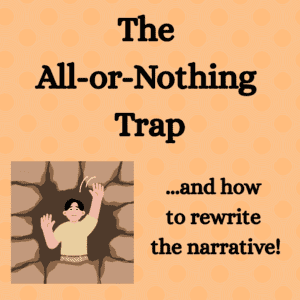
person trapped in all or nothing thinking

If you’ve ever said “I’ll start fresh Monday,” “I already messed up, so today’s a wash,” or “If I can’t do it perfectly, what’s the point,” congratulations — you’ve met the All‑or‑Nothing Trap.

It’s sneaky, persuasive and incredibly common. And it’s one of the biggest reasons people feel stuck, frustrated or inconsistent with their nutrition.

But here’s the good news: this trap isn’t a personal flaw. It’s a pattern. And patterns can be understood, softened and rewritten.


What the All‑or‑Nothing Trap Actually Is

At its core, all‑or‑nothing thinking is a brain shortcut. It loves clean lines, clear rules and the illusion of control. It says:

“Healthy” or “unhealthy”

“Good day” or “bad day”

“On track” or “off track”

It feels productive because it gives you a sense of direction. But it’s actually a trap because real life — and real bodies — don’t operate in extremes. They operate in gradients, flexibility and context.


Why This Mindset Feels So Powerful

All‑or‑nothing thinking sticks around because it offers:

1. A sense of certainty

Perfection feels safe. It feels like a plan. It feels like you’re doing something “right.”

2. A dopamine hit

The “fresh start” high is real. New rules, new routines, new promises — your brain loves the novelty.

3. A way to avoid discomfort

If you’re “starting Monday,” you don’t have to sit in the messy middle today. You get temporary relief.

But the relief is short‑lived. And the cycle repeats.


How the Trap Shows Up in Everyday Nutrition

You might notice it in moments like:

  • Skipping breakfast because you overslept, then deciding the whole day is ruined.
  • Eating one cookie and thinking, “Well, I blew it,” so you might as well keep going.
  • Feeling like you need the perfect grocery haul or meal prep to be “healthy.”
  • Believing that if you can’t work out for 45 minutes, it’s not worth doing at all.

These patterns don’t reflect a lack of willpower. They reflect a lack of flexibility — something most of us were never taught.


The Middle Ground: Where Real Progress Happens

The antidote to all‑or‑nothing thinking isn’t “trying harder.” It’s learning to live in the middle — the land of “good enough,” “better than nothing” and “this still counts.”

Here’s what that looks like in practice:

1. Shrinking the goal instead of abandoning it

Didn’t have time for a full workout? A 10‑minute walk still supports your body.

2. Adding instead of restricting

Had a meal that felt less balanced? Cool. Add a source of protein or fiber to the next one.

3. Letting one moment be one moment

A single choice doesn’t define your day. Your day is made of dozens of choices.

4. Rewriting the narrative

Instead of “I blew it,” try:

“I’m still allowed to care for myself right now.”

“One choice doesn’t erase my progress.”

“I can pivot without punishing myself.”


Why the Middle Ground Works

Because it’s sustainable. It’s human. It honors the reality that your energy, schedule, emotions and needs shift — sometimes daily.

Consistency doesn’t come from perfection.

It comes from the ability to return to supportive habits without shame, urgency or punishment.


A Few Gentle Prompts to Try This Week

  • What’s the smallest version of this habit I can still do today?
  • What would “good enough” look like right now?
  • How can I support myself without swinging to an extreme?
  • If I wasn’t judging myself, what choice would I make next?

The Bottom Line

The All‑or‑Nothing Trap convinces you that perfection is the only path to progress.

But the truth is the opposite: progress lives in the middle.

In the flexible, compassionate, imperfect choices that add up over time.

You don’t need a perfect day. You need a kinder one.

step into spring and let go of the food fear quote picturing a happy bee and some flowers

March is the season of in‑between. The light is returning, the air is almost warm and your brain is waking up from its winter nap with the energy of a houseplant that’s just been rotated toward the sun. It’s a natural moment for fresh starts—but not the punishing January kind. The gentler, wiser kind.

And while many people use spring to declutter closets or scrub baseboards, there’s another space that deserves a little clearing out: Your nutrition beliefs.

Because over the winter (and let’s be honest, over the last decade of the internet), most of us have collected a surprising amount of nutrition clutter—half‑truths, TikTok fears, rigid rules and outdated ideas that quietly shape how we eat and how we feel about eating.

This is the perfect time to sweep out what’s not serving you and make room for something more grounded, flexible and supportive.


🌞 Why Spring Is the Best Time to Rethink Food Rules

As daylight increases, your circadian rhythm shifts. Mood lifts. Motivation returns. Your brain becomes more receptive to change. This isn’t “willpower”—it’s biology.

Spring gives you:

  • A natural sense of renewal
  • More access to colorful, fresh foods
  • A psychological “fresh start effect” that actually sticks better than January
  • A chance to reset without the pressure of resolutions

So instead of reorganizing your pantry (again), let’s reorganize the beliefs that shape how you nourish yourself.


🌾 Seed Oils: Exhibit A in Nutrition Clutter

Seed oils have become the internet’s favorite villain—canola, soybean, sunflower, safflower, grapeseed, corn. You’ve seen the claims: “toxic,” “inflammatory,” “poison.”

But the research is far more nuanced.

What we do know:

  • Omega‑6 fats aren’t inherently inflammatory; the issue is the ratio of omega‑6 to omega‑3 in the overall diet.
  • Replacing saturated fats with polyunsaturated fats (like those in seed oils) is still supported by major health organizations.
  • Fear‑based messaging spreads faster than nuance, especially in winter when people feel depleted and want something to “fix.”

A more grounded spring approach:

  • Add omega‑3s (flax, chia, walnuts, salmon).
  • Use a variety of fats (olive oil, avocado oil, butter, sesame oil).
  • Cook more at home when you can.
  • Stop letting your salad dressing feel like a moral dilemma.

Seed oils aren’t the only belief worth sweeping out—but they’re a great place to start.


🌸 Nutrition Beliefs Worth Sweeping Out This Spring

1. “Carbs are the enemy.”

Spring reframe:

Carbohydrates are your brain’s primary fuel source and play a meaningful role in serotonin production, digestion and overall energy regulation. As your body transitions out of winter mode, steady carbohydrate intake actually supports a more stable mood and metabolism. Plus, carbs are where you find FIBER! Carbs themselves aren’t the problem; but timing, pairing, quality and portions matter.  Balanced carbs = steady energy.


2. “I need to earn or burn my food.”

Spring reframe:

This belief stems from learned associations between eating and self‑control, not from human physiology. The body doesn’t interpret food as something that must be offset or “worked off”—it uses incoming energy continuously to support metabolism, cognition, and nervous‑system stability. Most of the calories you consume in a day go towards basic survival functions, not workouts. Your body is “burning” energy right now reading this. You could lie in bed all day and still need nourishment. Movement is great for health. But it’s not a payment method.


3. “Healthy eating has to be perfect.”

Spring reframe:

Perfectionism is one of the biggest barriers to sustainable nutrition. It creates rigidity, guilt and all‑or‑nothing cycles that make eating harder than it needs to be. Aim for small, consistent improvements—incremental progress is far more effective than perfection. Flexibility supports sustainability in a way rigid standards rarely do. You actually function better when you’re nourished consistently, not perfectly. There is no such thing as perfect eating anyway.


4. “Processed = bad.”

Spring reframe:

Processing exists on a spectrum. Some processing improves safety, digestibility or nutrient availability. The goal isn’t to eliminate all processed foods—it’s to understand their role. Choose foods based on function, satisfaction and context. Frozen vegetables are still vegetables. A rotisserie chicken is still high‑quality protein and a practical support for busy days. And yes, a cookie can even be part of a balanced meal.


5. “Clean eating is the gold standard.”

Spring reframe:

“Clean” is vague, moralizing and often rooted in anxiety rather than evidence. It tends to contract your choices rather than help you build a more flexible, trusting approach to food. Shift from “clean” to aligned with my needs. From “good vs. bad” to context matters. Clean eating sounds simple until you try to define it. Is bread clean? What about protein bars? Frozen veggies? Canned beans? Every “clean eating” list contradicts the next one. If the gold standard changes depending on who you ask, it’s not a standard — it’s a trend.


6.“Cravings mean I’m failing.”

Spring reframe:

Cravings are a form of communication—your body’s way of signaling needs, shifts or imbalances. They’re not a personal flaw. People with the most peaceful, stable eating patterns still have cravings. They just don’t panic about them. They respond, adjust and move on. Cravings aren’t a red flag — they’re a normal part of being alive.


7. “More restriction = more weight loss.”

Spring reframe:

Restriction increases stress, slows metabolism, disrupts appetite cues, ramps up cravings and often leads to rebound eating. It rarely produces the long‑term outcomes people hope for. Balanced eating routines create stability, resilience and long‑term health.  Add before you subtract. Spring naturally brings more color, fiber, and freshness—let that expansion guide you.


😵‍💫 How to Evaluate Nutrition Claims Without Spiraling

A few grounding questions help cut through the noise:

  • Does this claim explain how something works, or does it rely on fear‑based language?
  • Who benefits from me believing this?
  • Is this coming from a credentialed expert or a viral soundbite?
  • Does this advice support a fuller, more flexible relationship with food or does it narrow my options?

If it makes your world feel smaller, it’s likely just mental clutter—not wisdom you need to keep.


🌈 A Fresh Start for Your Food Mindset

Spring is a good time to clear out the fear‑mongering that’s crept into your nutrition beliefs—the rules that make eating feel like a threat instead of a normal human need. When you sweep away the noise, what’s left is a more practical, curious approach to food: noticing what supports your energy and mood, what feels sustainable and what actually works for your life. That’s the kind of “spring cleaning” that helps you make food choices from clarity, not fear.
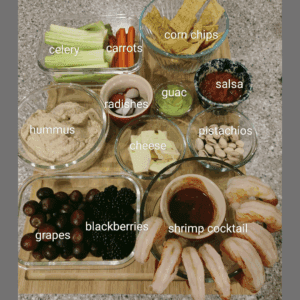
healthful snack board with various fruits, veggies, shrimp, cheese, nuts, etc.

Whether you’re hosting a cozy gathering or prepping a solo snack board for movie night, a healthful grazing board is a delicious reminder:

Nourishment can be festive, flavorful and full of joy!


🎄 Healthful Holiday Grazing Boards:  Nourishing, Satisfying and Gratifying

The holidays are a time for gathering, grazing and gifting your taste buds a little extra pleasure.

But indulgence doesn’t have to mean derailment.

Enter: the healthful holiday grazing board—a vibrant, balanced spread that celebrates flavor, color and nutrients.


✨ What Makes It “Healthful”?

A nourishing grazing board isn’t about restriction—it’s about intention.

Here’s how…

Think variety and balance:

💚 Colorful produce: Rainbow carrots, pomegranate seeds, berries, red pepper slices, citrus, grape tomatoes and crisp cucumber rounds add micronutrients, fiber, antioxidants and visual pop.

❤️ Protein-rich bites: Hard-boiled eggs, smoked salmon, shrimp cocktail, unique cheeses, roasted edamame or marinated tofu cubes offer satisfying staying power.

💙 Whole-grain nibbles: Seeded crackers, whole wheat mini pita wedges, corn chips or popcorn bring fiber, crunch and texture.

💛 Fats and flavors: Olives, pickled veggies, seasoned nuts, hummus, guacamole, salsa, etc keep things exciting.


🎁 Tips for Building Your Board

🍇 Anchor with abundance: Start with a few generous piles—grapes, nuts, veggie sticks—and build outward.

🌿 Play with height and shape: Use ramekins, jars and fresh herbs to create dimension and flow.

🍫  Include a sweet note: Dark chocolate squares, dried figs, dates with goat cheese or cinnamon-dusted apple slices add a sweet finish.

🛒 Create a shopping list of items you want to include, keep it simple and let your board evolve with your creativity.


Every wholesome choice you add is a win worth celebrating—proof that healthy can be both satisfying and fun.

Because when your board is balanced, your body and spirit feel it too. 🥰

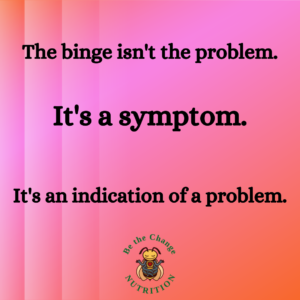
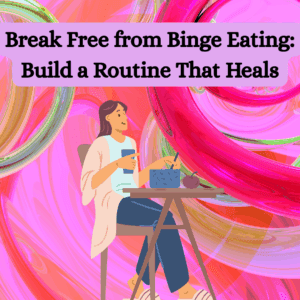
Binge eating isn’t just about food—it’s often a response to unmet needs, chaotic routines, or a lingering scarcity mindset. One powerful way to begin healing is by creating and maintaining a consistent eating routine. When your body knows that food is available and reliable, it stops bracing for restriction. You’re no longer sending the message that food is scarce or conditional. You’re telling yourself: I’m safe. I’m nourished. I’m allowed.

🧘‍♀️ Build Mindful Habits

Stick to regular meal times. Eat every 3-5 waking hours. Predictability calms the nervous system and reduces impulsive eating.

Plate your food—even snacks. It helps you see what you’re eating and reinforces intentionality.

Sit down when you can. This simple act invites mindfulness and slows the pace.

These small rituals send a powerful message: I’m caring for myself.

🔍 If a Binge Happens… Reflect, Don’t Judge

Instead of spiraling into shame, get curious:

What thoughts came up before or during?

What emotions were present?

Were there unmet needs—emotional or physical?

Is there a pattern you’re beginning to notice?

Every binge holds information. The more you learn, the closer you get to healing. Compassionate reflection turns setbacks into stepping stones.

🙂 Reframe Your Identity

Rather than saying, “I want to stop binge eating,” try:
“I’m the type of person who wants to feel peaceful around food.”
“I’m becoming someone who listens to his/her body.”
“I’m learning to nourish myself with care.”

Who do you want to become? How does that version of you behave? What choices does he/she make?

🌟 Focus Forward

Shift your attention from what you don’t want to what you do want. That clarity becomes your compass. It shows you where to grow, what to practice, and how to show up for yourself—one meal, one moment at a time.

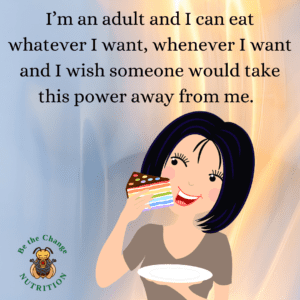
Woman eating cake with quote: I'm an adult and I can eat whatever I want, whenever I want and I wish someone would take this power away from me.

Let’s be honest: that quote is both hilarious and heartbreakingly accurate.

As a registered dietitian, I meet people every day who feel overwhelmed by their own freedom. The fridge beckons. The snacks whisper. Suddenly, dinner is popcorn with a side of ice cream.

🔓 Adulting: Where You’re the Boss and the Boss Is Tired

Most adults don’t lack food access—they lack bandwidth. Between work emails, late-night scrolling, and existential dread, cooking feels like a chore and eating becomes reactive instead of intentional.

We’re not hungry. We’re scattered.

🧠 Unlimited Choice Can Feel Like Unstructured Chaos

Without some gentle guardrails, “freedom” starts looking like an endless buffet of nutritional confusion. Decision fatigue sets in. Our brains crave predictability, especially around food. And those tiny choices—what to eat, when, how much—start stacking up like unread emails until we hit decision burnout.

This is where mindful eating comes in.

🥢 Mindful Eating: Reclaiming Peace at the Plate

Mindful eating isn’t a diet. It’s awareness. It’s noticing your food, your hunger cues, and your emotions—without judgment and without the TV blaring reruns of chaos.

Here’s why it matters:

✔️ Slows down the frenzy: When you eat slower, you notice satisfaction earlier.

✔️ Reduces autopilot munching: Goodbye, mindless cracker attacks. Hello, intentional bites.

✔️ Builds connection: You tune into your body, emotions, and even gratitude.

You don’t need to lock up your snacks. You need a moment to pause and ask:

Am I hungry, or just tired?

Is this delicious, or just there?

🌿 A Few Mindful Practices to Try:

👉 Put the phone down. (Yes, even mid-scroll.)

👉 Sit down to eat—even snacks.

👉 Check in with hunger before and after.

👉 Appreciate textures, flavors, even memories tied to your food.

Mindful eating gives structure to freedom—and makes that cereal-for-dinner moment feel a little less like chaos, and a little more like choice.

📆 Structured Freedom: Dietitian-Approved Adulting

You don’t need someone to take the power away—you need someone to help wield it wisely. My motto? Structure without shame. Here’s what that might look like:

⭐ “Default meals” you love and that nourish you (think: go-to lunches you don’t overthink)

⭐ Snack boundaries, not bans (i.e., “fruit first, then chips” vs. “no snacks ever”)

⭐ Self-check-ins, not guilt spirals (asking: “How do I want to feel after this?”)

This isn’t a diet. It’s adult snacktime…with a blueprint.

✨ Final Thoughts from Your Friendly RD

You can eat whatever you want. That’s the blessing and the curse of being an adult. But you deserve to feel good, too—physically, emotionally, energetically.

If you’re craving a little help navigating all this, know this: structure isn’t control. It’s compassion. And it’s okay to want a little guidance. That’s what dietitians are for…

…with the ultimate goal of YOU cultivating the inner trust and confidence to be at peace with making your own eating decisions!

The 'ber months and some tasty food graphics to go along with each.

🍂 I’m Ready for the ’Ber Months: A Dietitian’s Cozy Guide to Seasonal Wellness

September. October. November. December.

The ’ber months are here—and I’m ready.

Ready for cooler, crisper weather. For cozy hoodies, UGGs and comfort food. For the shift from iced matcha to warm chai. But also? I’m ready to help you feel nourished, grounded and joyful through it all.

Because let’s be real: the ’ber months can be a whirlwind of celebrations, stress and abundant goodies. And while pumpkin spice gets all the hype, your wellness deserves a little seasonal spotlight too.

🍁 What Does “Ready” Look Like?

Being ready doesn’t mean being perfect. It means being intentional. Here’s how I help clients embrace the ’ber months with balance and delight:

🤗 Comfort Food, Reimagined
Nachos for dinner? Yes, please. But let’s layer them with fiber-rich beans, roasted squash and a sprinkle of cheese. Or cozy soups that sneak in veggies without sacrificing flavor. Comfort and nutrition can absolutely coexist.

🎃 Mindful Indulgence, Not Restriction
You don’t need to “earn” your holiday treats. We focus on tuning into hunger cues, savoring flavors and ditching the guilt.

📅 Planning Ahead (Without the Pressure)
From navigating potlucks to flexible meal planning for your workweek, I help you prep with confidence—not overwhelm.

✨ ’Ber Month Magic: More Than Just Food

Wellness isn’t just what’s on your plate. It’s how you feel in your body, your schedule and your relationships. So this season, I invite you to:

🤗 Catch and replace self-critical phrases with neutral or compassionate ones.

🚲 Move in ways that feel joyful, not punishing.

📖 Say yes to rest, even when the calendar says go-go-go.

 Let’s Make This Season Nourishing

If you’re craving support, seasonal recipes, or just someone to help you navigate the chaos with a little more calm—I’m here. The ’ber months are a beautiful time to reconnect with what makes you feel good. Let’s make it delicious.

Girl holding tummy with title: 5 Gut Health Mistakes You Might Be Making (Without Realizing It)

Gut feeling off?

A dietitian can help decode the signals your digestive system is sending.

From bloating to irregularity to food sensitivities and microbiome support, we translate science into simple sustainable strategies so your gut can thrive, not just survive.


🧠 5 Gut Health Mistakes You Might Be Making (Without Even Realizing It)

Gut health isn’t just about kombucha and probiotics—it’s about the everyday habits that quietly shape how we feel, digest, and thrive. If your belly’s been feeling off, your energy’s dipping, or your mood’s riding a rollercoaster, your gut might be waving a little white flag.

Let’s unpack five common gut health missteps that even the wellness-savvy can fall into—and how to gently course-correct without spiraling into perfectionism.


1. 🥢 Eating Too Fast (Your Gut’s Not a Drive-Thru)

I get it—life’s busy, and scarfing down lunch between meetings or while wrangling kids feels efficient. But your gut? It prefers a slow dance over a speed date.

  • Why it matters: Eating quickly can lead to poor digestion, bloating, and missed satiety cues. Your brain and gut need time to sync up.
  • Try this: Pause before eating. Take a few deep breaths. Chew slowly. Bonus points for putting your fork down between bites—it’s not just grandma’s advice, it’s legit gut wisdom.

2. ☕ Coffee on an Empty Stomach (A Morning Ritual with a Hidden Cost)

Coffee lovers, don’t panic—I’m not taking away your sacred brew. But sipping it solo, before food, might be stirring up more than just energy.

  • Why it matters: Coffee is acidic and can stimulate stomach acid production. Without food to buffer it, this can irritate your gut lining and spike cortisol (hello, stress).
  • Try this: Pair your coffee with a small breakfast—think a banana with nut butter or a slice of toast with avocado. Your gut will thank you, and your energy might feel more stable too.

3. 🥤 Skimping on Fiber or Water (Your Gut’s Dynamic Duo)

Fiber gets all the gut health glory, but without water? It’s like trying to run a smoothie shop with no blender.

  • Why it matters: Fiber feeds your good gut bacteria and keeps things moving. But without enough water, it can backfire—leading to constipation and discomfort.
  • Try this: Aim for a mix of soluble and insoluble fiber (think oats, berries, leafy greens), and drink water consistently throughout the day. Your gut flora will throw a party.

4. 🍬 Artificial Sweeteners (Sneaky Saboteurs)

They promise sweetness without the sugar crash—but some artificial sweeteners might be messing with your microbiome.

  • Why it matters: Certain sweeteners (like sucralose or aspartame) can disrupt gut bacteria balance and may even contribute to bloating or cravings.
  • Try this: Opt for natural sweeteners like honey, maple syrup, or monk fruit in moderation. And read labels—“sugar-free” doesn’t always mean gut-friendly.

5. 😵‍💫 Chronic Stress (The Gut-Brain Connection is Real)

Stress isn’t just a mental game—it’s a full-body experience, and your gut feels it deeply.

  • Why it matters: Ongoing stress can alter gut motility, increase inflammation, and throw off your microbiome. It’s like your gut’s living in fight-or-flight mode.
  • Try this: Build in micro-moments of calm—walks, breathwork, journaling, or even dancing in your kitchen. Your nervous system and gut are in constant conversation, so speak kindly.

💡 Final Thoughts: Progress Over Perfection

Gut health isn’t about rigid rules—it’s about tuning in, making small shifts, and noticing what helps you feel more like you. If you’ve been making one (or all) of these mistakes, no shame—just awareness. Your gut is resilient, and every gentle change adds up.


girl enjoying chocolate just because and another girl saying no thanks.

Sometimes eating isn’t about hunger. And that’s completely fine.

Are you confused yet?

Let me try to clear the air:
🍫 Eating when you’re *not* hungry can be OK.
🥗 Not eating when you *are* hungry can also be OK.

Wait… what?

Yup. While we often hear “listen to your hunger cues,” real-life eating isn’t always a straightforward, one-size-fits-all situation. Just like most rules in life, there are exceptions—and getting in touch with those gray areas can actually help you feel *more* confident about your eating decisions, not less.

🔍 Eating When You’re Not Hungry: Practical, Not Problematic

Welcome to the world of “practical” or “preventive” hunger—aka eating based on what your body *might* need, rather than what it’s yelling for in the moment.

Here’s what that might look like:
– Grabbing a snack before running errands so you’re not hangry in aisle 4.
– Eating lunch early because you’re heading into a meeting marathon.
– Refueling with protein and carbs post-workout—because your muscles are cheering for repair.
– Having dessert after dinner simply because… chocolate. Need I say more?

It’s not about ignoring your hunger cues; it’s about *anticipating* them. Choosing to eat in these moments helps you feel grounded, prepared, and well-fueled—not reactive and ravenous.

🤔 Slightly Hungry but Choosing Not to Eat: Also Valid

Now let’s flip it.

Sometimes you feel a nudge to nibble—but decide to wait. That doesn’t make you bad at “intuitive eating”—it makes you intentional. I’m talking about a very low level of hunger or a craving here.  Obviously if you’re truly hungry and in need of food you should EAT.  You always have the right to eat whenever you want to, but it’s also OK to sit with an urge and not respond to it.

For example:
– Skipping the candy dish because lunch is coming and you want to nourish yourself with higher quality food. (And deciding you’ll have some candy after you eat if you still want it.)
– Not eating right before bed because you are so tired and aren’t even sure if you are really hungry or just really tired.
– Passing on the bread the server put on the table because although you’re getting hungry, you want to fully enjoy the meal you ordered and you know if comes with a more enjoyable carbohydrate source.

In all these cases, it’s not about restriction—it’s about preference, self-awareness, and honoring how you want to feel afterwards.

🧠 The Sweet Spot: Pairing Knowledge with Intent

Whether it’s eating without physical hunger or pausing even when you feel a bit peckish, you’re blending nutrition wisdom with real-life nuance.

You’re allowed to enjoy food purely for taste. You’re allowed to pause and check in before acting on a craving. You’re allowed to eat proactively to avoid a slump later.

It’s not “right” or “wrong”—it’s about what feels aligned *for you* in that moment.

🥄 Final Thought: You’re In Charge

You always have the right to eat—and the right to wait. The goal isn’t perfection, it’s self-awareness.

So next time you find yourself asking, *“Should I eat this even though I’m not hungry?”*
Or, *“I’m kind of hungry but do I need something now?”*

Just know that either path can be valid. And that’s a pretty freeing way to live.


woman talking with a dietitian

In the moment, all you may feel is that you’re spiraling out of control. 

And then the shame sets in. You vow you’ll never do that again. 

You promise yourself, “Next time will be different.” And yet, the cycle continues.

But here’s the gentle truth:

If we only focus on resisting the behavior without understanding the ‘why’ behind it, we’re missing the message. These patterns aren’t random. They’re messengers– signals pointing to unmet needs or unhealed parts of ourselves.

So instead of restricting, what if we paused? What if we got curious?

Ask yourself:
– Was I running on empty– physically or emotionally?
– Was I looking for comfort, distraction or relief?
– Was I denying myself something I truly enjoy, creating a sense of scarcity or rebellion?

These aren’t excuses. They’re clues to learning about yourself.

Every unwanted eating behavior holds a kind of brilliance.

Whether driven by biology (like blood sugar dips or chronic hunger) or by psychology (like stress, loneliness or perfectionism)– it’s all worthy of compassion and reflection.

Instead of beating yourself up, try asking: What was I needing in that moment?

Because behind every behavior is a need.  And every need deserves to be met with kindness.

Unless you address the root cause of unwanted eating behaviors, they will tend to repeat themselves.

You don’t have to decode it all on your own.

Nutrition counseling creates a nonjudgmental space to explore your patterns, rebuild trust with your body and reconnect with your inner wisdom.

So let’s get curious and reflect rather than restrict and resist. 

Figuring out the reason will help you find a solution.

There is freedom in understanding, not in trying to control.

“Nothing ever goes away until it teaches us what we need to know.” -Pema Chödrön

Full vs satisfied emojis

Eating is not just about feeling FULL.

It’s about feeling SATISFIED! 😄

🌟There’s a difference.

Full = a physical sensation.
Your belly could feel full but you may not be satisfied.

Satisfied = a mental sensation.
It’s about feeling GOOD after eating! You feel nourished. You may or may not feel full, but you do feel satisfied and are not feeling like you still need something more.

💫 Shooting for satisfaction means you’re less likely to overeat or be preoccupied with food between meals.

👇Tips for feeling satisfaction after eating:

🍽️ Eat a combo of protein, carbs and fat…
Not necessarily all the time, but it does promote satiety and satisfaction.

🍽️ Ask yourself what would really taste good to you…
Maybe you have a “balanced” meal that would fill you up but to make it more satisfying you decide to add some flavors like goat cheese, salsa, guacamole, fresh herbs or butter.
Or you decide some chocolate or a brownie would really round out the meal. Have it! 😋

🙂 Allowing pleasure with food = Satisfaction = Nourishment =
A healthy relationship with eating!

We need both NUTRIENTS AND PLEASURE with our food choices…
Aim for a combo/balance of BOTH! ⚖️