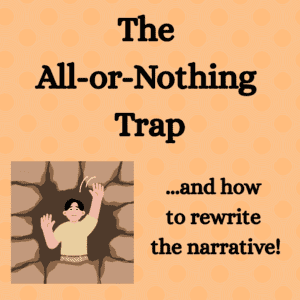
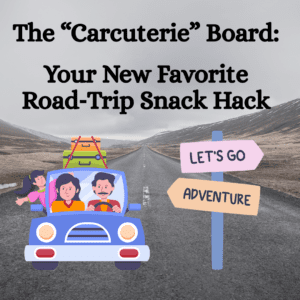
person trapped in all or nothing thinking

If you’ve ever said “I’ll start fresh Monday,” “I already messed up, so today’s a wash,” or “If I can’t do it perfectly, what’s the point,” congratulations — you’ve met the All‑or‑Nothing Trap.

It’s sneaky, persuasive and incredibly common. And it’s one of the biggest reasons people feel stuck, frustrated or inconsistent with their nutrition.

But here’s the good news: this trap isn’t a personal flaw. It’s a pattern. And patterns can be understood, softened and rewritten.


What the All‑or‑Nothing Trap Actually Is

At its core, all‑or‑nothing thinking is a brain shortcut. It loves clean lines, clear rules and the illusion of control. It says:

“Healthy” or “unhealthy”

“Good day” or “bad day”

“On track” or “off track”

It feels productive because it gives you a sense of direction. But it’s actually a trap because real life — and real bodies — don’t operate in extremes. They operate in gradients, flexibility and context.


Why This Mindset Feels So Powerful

All‑or‑nothing thinking sticks around because it offers:

1. A sense of certainty

Perfection feels safe. It feels like a plan. It feels like you’re doing something “right.”

2. A dopamine hit

The “fresh start” high is real. New rules, new routines, new promises — your brain loves the novelty.

3. A way to avoid discomfort

If you’re “starting Monday,” you don’t have to sit in the messy middle today. You get temporary relief.

But the relief is short‑lived. And the cycle repeats.


How the Trap Shows Up in Everyday Nutrition

You might notice it in moments like:

  • Skipping breakfast because you overslept, then deciding the whole day is ruined.
  • Eating one cookie and thinking, “Well, I blew it,” so you might as well keep going.
  • Feeling like you need the perfect grocery haul or meal prep to be “healthy.”
  • Believing that if you can’t work out for 45 minutes, it’s not worth doing at all.

These patterns don’t reflect a lack of willpower. They reflect a lack of flexibility — something most of us were never taught.


The Middle Ground: Where Real Progress Happens

The antidote to all‑or‑nothing thinking isn’t “trying harder.” It’s learning to live in the middle — the land of “good enough,” “better than nothing” and “this still counts.”

Here’s what that looks like in practice:

1. Shrinking the goal instead of abandoning it

Didn’t have time for a full workout? A 10‑minute walk still supports your body.

2. Adding instead of restricting

Had a meal that felt less balanced? Cool. Add a source of protein or fiber to the next one.

3. Letting one moment be one moment

A single choice doesn’t define your day. Your day is made of dozens of choices.

4. Rewriting the narrative

Instead of “I blew it,” try:

“I’m still allowed to care for myself right now.”

“One choice doesn’t erase my progress.”

“I can pivot without punishing myself.”


Why the Middle Ground Works

Because it’s sustainable. It’s human. It honors the reality that your energy, schedule, emotions and needs shift — sometimes daily.
Consistency doesn’t come from perfection.

It comes from the ability to return to supportive habits without shame, urgency or punishment.


A Few Gentle Prompts to Try This Week

  • What’s the smallest version of this habit I can still do today?
  • What would “good enough” look like right now?
  • How can I support myself without swinging to an extreme?
  • If I wasn’t judging myself, what choice would I make next?

The Bottom Line

The All‑or‑Nothing Trap convinces you that perfection is the only path to progress.

But the truth is the opposite: progress lives in the middle.

In the flexible, compassionate, imperfect choices that add up over time.

You don’t need a perfect day. You need a kinder one.
Plate with quote: Who knew that the hardest part of being an adult is figuring out what to cook for dinner every single night for the rest of your life.

Let’s demystify and simplify this.🪄

Meal planning does not have to be stressful.
Or rigid. Or time‑consuming. Or a second job.

When you understand the basics of how a balanced plate works, you already have everything you need to meal plan with confidence. 🍴

At its core, most satisfying meals come from a familiar formula:

Protein+Carb+Fat+Produce

🍗+🍠+🧀+🥦

(or any close variation that fits your real life)

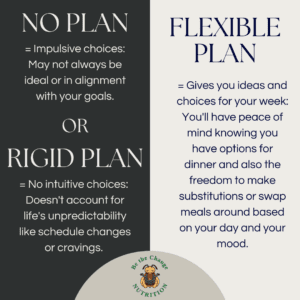
Instead of treating a meal plan like a strict script you must follow, change your definition to: Flexible Meal Planning.


Comparison between having no plan or a rigid plan and having a flexible plan.


Tips & Tools:

✅ Take inventory.  Start by checking your fridge, freezer and pantry. Notice what needs to be used up and what you can combine to create a couple of easy meals. This alone can spark half your plan.

📆 Look at your schedule. Glance at your week and note late work nights, kids’ activities, classes or anything that affects dinner time. On busier nights, choose meals that require minimal time, effort or cleanup.

🍽️ Factor in restaurant night(s).  If you enjoy dining out or grabbing take‑out, build it into your plan intentionally. Choose the night(s) that make the most sense for your energy and schedule.

🌮Try theme nights.  Themes simplify decisions and keep things fun. Ex. Mon: breakfast for dinner, Tues: Mexican, Wed: sheet pan meal, Thurs: snack plate night, Fri: seafood, Sat: take-out, Sun: vegetarian.

👩🏼‍🍳 Keep it mostly familiar.  Build your plan around tried and true meals that you know and like.  Maybe add in one new idea a week, but don’t try to make a whole week of unfamiliar recipes.

🔪 Prep ahead when you can.  Thaw meat in advance, cook a starch (wild rice, quinoa, potatoes) to reheat later or chop veggies for a quick stir‑fry. Small steps make weeknights smoother.

🛒 Shop and stock up.  A well‑stocked kitchen makes meal planning so much easier. Keep pantry and freezer staples on hand and shop regularly for fresh items so you always have options.

📃 Make a list.  When you’re low or out of something, write it down immediately.

📚 Build a recipe collection.  A visual library helps create ideas. You likely have dozens of meals you’d happily make again—you just forget about them. Brainstorm with your family, print favorites and “want‑to‑try” recipes and keep them in one place.  Use a folder or binder like this  to flip through when you need inspiration.

📝 Get your ideas out of your head and onto paper.  Meal planning comes together quickly once you can see it. A dry‑erase menu board (like the one on my fridge) makes it easy to map out your week and adjust as needed. You’ll be surprised how easy meal planning comes together when you do this.

🤸🏼‍♂️ Stay flexible. Remember, you don’t have to follow a meal plan exactly– That can be stressful and unrealistic. Have ideas and options, but keep things flexible.

🌞 One day at a time approach. If planning a full week feels overwhelming, shorten the window. Keep ingredients for several meals on hand, then decide the night before or that morning what you’ll make.

😃 Need help? I sit down with clients all the time and help them flexible meal plan for their week.  We’ll take your goals, your schedule, your obstacles and your taste preferences into consideration.  I won’t hand you a meal plan (and here’s why) but I will teach you how easy it is to plan out your own meals for yourself.


🤔Is meal planning for everybody?

Not necessarily.

Many people genuinely do well deciding what to eat in the moment. They can scan the fridge, pull a few things together, and end up with something balanced without much thought. For others, that skill develops over time—just like learning to cook, lift weights or budget.
Even the most spontaneous eaters still rely on a few systems:
• Grocery shopping so there’s something to choose from
• A handful of go‑to meals they can make on autopilot
• Basic ingredients that mix and match easily

That’s planning… just not the rigid, color‑coded kind.


Meal planning isn’t about perfection or predicting every craving. It’s about reducing the nightly “What the heck do I make?” stress spiral. When you build even a light structure around meals, you get:
• Less decision fatigue at the end of the day
• More balanced meals without micromanaging
• A smoother grocery routine
• More confidence that you can feed yourself well, even on chaotic weeks

It’s a skill that supports your life—not one that takes it over.

👤 Practice Being the Future You

Embrace the mindset of the person you aspire to be once you achieve your weight loss goals.

Instead of waiting to become him or her, start being that person now. Identify with the version of yourself that you envision– someone who feels confident, energized and at peace with food. Let this alignment guide your thoughts and actions.

This approach differs from the common tendency to focus on what you lack or who you are not. Instead, imagine that you’ve already reached your goal. This shift in perspective helps align your thoughts with the feelings you desire. You tune into the future you and begin to live in harmony with that person.


🧭 Your Inner GPS: Align with What You Want

Most people unknowingly align with what they don’t want.

They rehearse thoughts like:

“I’m not good enough.”

“This is never going to work.”

These recycled beliefs keep you stuck in the past.

But here’s the wild truth: you can think anything you want. About your body. About your future. About yourself.

And no one– not even your inner critic– can tell you you’re wrong.

So concentrate on what you do want. This positive focus acts as your personal GPS, steering you toward your goals. Release your attachment to specific outcomes and prioritize the feelings associated with your journey– such as peace with food, confidence in your body and increased energy. When you align with those feelings, your body begins to follow. It’s not magic– it’s mindset. And it’s available to you right now.


🌱 Focus on the Feeling, Not the Outcome

Let go of obsessing over the number on the scale. Instead, focus on the feeling:

The peace you crave around food.

The confidence of being fully present in your body.

The energy that fuels your day.

By focusing on these emotions, your body will naturally align with your aspirations.

It’s not about chasing a thinner body– it’s about cultivating a life that feels lighter, freer and more empowered.


🧠 When You’re Out of Alignment…

Check in with your thoughts. Are they rooted in fear or in possibility? Are they dragging you back to an old story or helping you write a new one?

Often, they may echo old beliefs like “I’m not good enough” or “I can’t do this.” But here’s the empowering truth: You have the power to choose your thoughts. You can think positively about yourself and no one can dispute your self-perception. You have the freedom to envision a bright future– even if your mind tries to resist that vision.

So embrace this power. Let it guide you. Be the change you’re waiting for.

You don’t have to overhaul your life.

You don’t need a perfect plan.

You just need one aligned action that says, “This is who I’m becoming.”

When you practice the habits your future self already loves– the ones that feel supportive, kind and realistic– your body begins to trust you.

And trust creates momentum.

This is what “being the change” looks like in real life:
💖 Small choices. Repeated often.
💖 Identity first. Outcomes second.
💖 A gentle reset that actually sticks.

If you’re craving a shift, start with one tiny vote for your future self today.

Weight loss may still be part of your journey and that’s ok. But it doesn’t have to be the compass. When you lead with self-respect, curiosity and care, your body often follows. Be the change. Not just in your habits– but in how you speak to yourself, how you show up and how you define success.

You’re not lazy. You’re just stuck—and that’s okay. It doesn’t mean you’re broken. It means you’re human. These quotes are here to meet you where you are and help you take that first small step.

Let’s get you moving again.


Neuroscience says ACTION creates motivation—not the other way around. These quotes are your cognitive cue to get moving, even if it’s just a tiny step. Motivation’s overrated. Movement’s where the magic lives.

✨Don’t wait for inspiration. Take action and inspiration will follow.✨

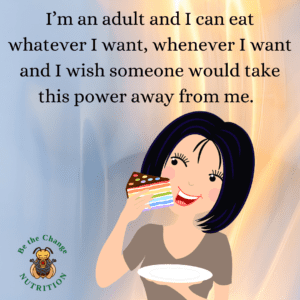
Woman eating cake with quote: I'm an adult and I can eat whatever I want, whenever I want and I wish someone would take this power away from me.

Let’s be honest: that quote is both hilarious and heartbreakingly accurate.

As a registered dietitian, I meet people every day who feel overwhelmed by their own freedom. The fridge beckons. The snacks whisper. Suddenly, dinner is popcorn with a side of ice cream.

🔓 Adulting: Where You’re the Boss and the Boss Is Tired

Most adults don’t lack food access—they lack bandwidth. Between work emails, late-night scrolling, and existential dread, cooking feels like a chore and eating becomes reactive instead of intentional.

We’re not hungry. We’re scattered.

🧠 Unlimited Choice Can Feel Like Unstructured Chaos

Without some gentle guardrails, “freedom” starts looking like an endless buffet of nutritional confusion. Decision fatigue sets in. Our brains crave predictability, especially around food. And those tiny choices—what to eat, when, how much—start stacking up like unread emails until we hit decision burnout.

This is where mindful eating comes in.

🥢 Mindful Eating: Reclaiming Peace at the Plate

Mindful eating isn’t a diet. It’s awareness. It’s noticing your food, your hunger cues, and your emotions—without judgment and without the TV blaring reruns of chaos.

Here’s why it matters:

✔️ Slows down the frenzy: When you eat slower, you notice satisfaction earlier.

✔️ Reduces autopilot munching: Goodbye, mindless cracker attacks. Hello, intentional bites.

✔️ Builds connection: You tune into your body, emotions, and even gratitude.

You don’t need to lock up your snacks. You need a moment to pause and ask:

Am I hungry, or just tired?

Is this delicious, or just there?

🌿 A Few Mindful Practices to Try:

👉 Put the phone down. (Yes, even mid-scroll.)

👉 Sit down to eat—even snacks.

👉 Check in with hunger before and after.

👉 Appreciate textures, flavors, even memories tied to your food.

Mindful eating gives structure to freedom—and makes that cereal-for-dinner moment feel a little less like chaos, and a little more like choice.

📆 Structured Freedom: Dietitian-Approved Adulting

You don’t need someone to take the power away—you need someone to help wield it wisely. My motto? Structure without shame. Here’s what that might look like:

⭐ “Default meals” you love and that nourish you (think: go-to lunches you don’t overthink)

⭐ Snack boundaries, not bans (i.e., “fruit first, then chips” vs. “no snacks ever”)

⭐ Self-check-ins, not guilt spirals (asking: “How do I want to feel after this?”)

This isn’t a diet. It’s adult snacktime…with a blueprint.

✨ Final Thoughts from Your Friendly RD

You can eat whatever you want. That’s the blessing and the curse of being an adult. But you deserve to feel good, too—physically, emotionally, energetically.

If you’re craving a little help navigating all this, know this: structure isn’t control. It’s compassion. And it’s okay to want a little guidance. That’s what dietitians are for…

…with the ultimate goal of YOU cultivating the inner trust and confidence to be at peace with making your own eating decisions!

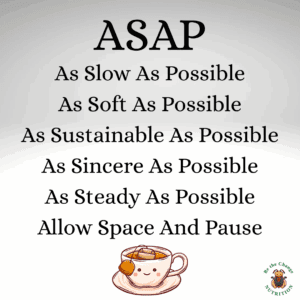
ASAP: allow space and pause

We live in a world that glorifies speed.

But what if ASAP wasn’t about rushing– but about nourishment?

ASAP: A new acronym for intentional wellness. 

Let’s explore what it means to move through change As Slow, Soft, Sustainable, Sincere and Steady As Possible. 

Let’s Allow Space And Pause.

Let’s make wellness feel like home, not a race.

ASAP doesn’t have to mean urgency. It can mean:

  • As Slow As Possible– Savor meals, honor hunger/fullness cues and give digestion time to do its thing. Slow is where satisfaction lives.
  • As Soft As Possible– Speak gently to yourself about food choices and your body. No harsh judgments—just curiosity, kindness and compassion.
  • As Sustainable As Possible– Choose habits and meals that fit your real life- not just your “ideal” week. Think long-term joy, not short-term restriction.
  • As Sincere As Possible– Eat in ways that reflect your values, preferences and cultural roots—not someone else’s rules.
  • As Steady As Possible– Build consistency through flexible routines. No need for extremes, just steady nourishment.
  • Allow Space And Pause– Make room for rest, reflection and pleasure in your eating experience. Pause before reacting to emotions, stress, food guilt or diet pressure.

💗In the pause, we find presence. In the space, we find choice.💗

Body image blues?
We’ve all been there.

 You might need a pep talk from your wisest, sassiest inner friend—the one who never lets you forget how fabulous you are and that your worth was never up for debate.

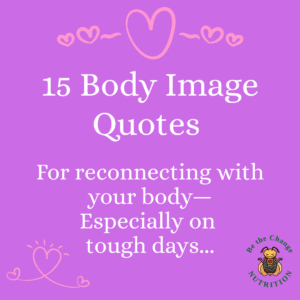
These quotes aren’t here to fix your body—they’re here to challenge the voice that says it needs fixing. On tough days, they offer a kinder script to borrow until your own feels strong again.

 You don’t have to believe every quote right away. Let them plant seeds. Let them sit. Let them soften the edges of a hard day.

 These aren’t toxic positivity soundbites. They’re permission slips—to feel what you feel, to opt out of shame, and to choose kindness even when it’s hard.

Share with someone who might need a fresh perspective, some compassion and a gentle nudge back to self-acceptance.💞

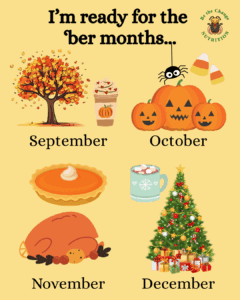
The 'ber months and some tasty food graphics to go along with each.

🍂 I’m Ready for the ’Ber Months: A Dietitian’s Cozy Guide to Seasonal Wellness

September. October. November. December.

The ’ber months are here—and I’m ready.

Ready for cooler, crisper weather. For cozy hoodies, UGGs and comfort food. For the shift from iced matcha to warm chai. But also? I’m ready to help you feel nourished, grounded and joyful through it all.

Because let’s be real: the ’ber months can be a whirlwind of celebrations, stress and abundant goodies. And while pumpkin spice gets all the hype, your wellness deserves a little seasonal spotlight too.

🍁 What Does “Ready” Look Like?

Being ready doesn’t mean being perfect. It means being intentional. Here’s how I help clients embrace the ’ber months with balance and delight:

🤗 Comfort Food, Reimagined
Nachos for dinner? Yes, please. But let’s layer them with fiber-rich beans, roasted squash and a sprinkle of cheese. Or cozy soups that sneak in veggies without sacrificing flavor. Comfort and nutrition can absolutely coexist.

🎃 Mindful Indulgence, Not Restriction
You don’t need to “earn” your holiday treats. We focus on tuning into hunger cues, savoring flavors and ditching the guilt.

📅 Planning Ahead (Without the Pressure)
From navigating potlucks to flexible meal planning for your workweek, I help you prep with confidence—not overwhelm.

✨ ’Ber Month Magic: More Than Just Food

Wellness isn’t just what’s on your plate. It’s how you feel in your body, your schedule and your relationships. So this season, I invite you to:

🤗 Catch and replace self-critical phrases with neutral or compassionate ones.

🚲 Move in ways that feel joyful, not punishing.

📖 Say yes to rest, even when the calendar says go-go-go.

 Let’s Make This Season Nourishing

If you’re craving support, seasonal recipes, or just someone to help you navigate the chaos with a little more calm—I’m here. The ’ber months are a beautiful time to reconnect with what makes you feel good. Let’s make it delicious.

girl enjoying chocolate just because and another girl saying no thanks.

Sometimes eating isn’t about hunger. And that’s completely fine.

Are you confused yet?

Let me try to clear the air:
🍫 Eating when you’re *not* hungry can be OK.
🥗 Not eating when you *are* hungry can also be OK.

Wait… what?

Yup. While we often hear “listen to your hunger cues,” real-life eating isn’t always a straightforward, one-size-fits-all situation. Just like most rules in life, there are exceptions—and getting in touch with those gray areas can actually help you feel *more* confident about your eating decisions, not less.

🔍 Eating When You’re Not Hungry: Practical, Not Problematic

Welcome to the world of “practical” or “preventive” hunger—aka eating based on what your body *might* need, rather than what it’s yelling for in the moment.

Here’s what that might look like:
– Grabbing a snack before running errands so you’re not hangry in aisle 4.
– Eating lunch early because you’re heading into a meeting marathon.
– Refueling with protein and carbs post-workout—because your muscles are cheering for repair.
– Having dessert after dinner simply because… chocolate. Need I say more?

It’s not about ignoring your hunger cues; it’s about *anticipating* them. Choosing to eat in these moments helps you feel grounded, prepared, and well-fueled—not reactive and ravenous.

🤔 Slightly Hungry but Choosing Not to Eat: Also Valid

Now let’s flip it.

Sometimes you feel a nudge to nibble—but decide to wait. That doesn’t make you bad at “intuitive eating”—it makes you intentional. I’m talking about a very low level of hunger or a craving here.  Obviously if you’re truly hungry and in need of food you should EAT.  You always have the right to eat whenever you want to, but it’s also OK to sit with an urge and not respond to it.

For example:
– Skipping the candy dish because lunch is coming and you want to nourish yourself with higher quality food. (And deciding you’ll have some candy after you eat if you still want it.)
– Not eating right before bed because you are so tired and aren’t even sure if you are really hungry or just really tired.
– Passing on the bread the server put on the table because although you’re getting hungry, you want to fully enjoy the meal you ordered and you know if comes with a more enjoyable carbohydrate source.

In all these cases, it’s not about restriction—it’s about preference, self-awareness, and honoring how you want to feel afterwards.

🧠 The Sweet Spot: Pairing Knowledge with Intent

Whether it’s eating without physical hunger or pausing even when you feel a bit peckish, you’re blending nutrition wisdom with real-life nuance.

You’re allowed to enjoy food purely for taste. You’re allowed to pause and check in before acting on a craving. You’re allowed to eat proactively to avoid a slump later.

It’s not “right” or “wrong”—it’s about what feels aligned *for you* in that moment.

🥄 Final Thought: You’re In Charge

You always have the right to eat—and the right to wait. The goal isn’t perfection, it’s self-awareness.

So next time you find yourself asking, *“Should I eat this even though I’m not hungry?”*
Or, *“I’m kind of hungry but do I need something now?”*

Just know that either path can be valid. And that’s a pretty freeing way to live.


woman talking with a dietitian

In the moment, all you may feel is that you’re spiraling out of control. 

And then the shame sets in. You vow you’ll never do that again. 

You promise yourself, “Next time will be different.” And yet, the cycle continues.

But here’s the gentle truth:

If we only focus on resisting the behavior without understanding the ‘why’ behind it, we’re missing the message. These patterns aren’t random. They’re messengers– signals pointing to unmet needs or unhealed parts of ourselves.

So instead of restricting, what if we paused? What if we got curious?

Ask yourself:
– Was I running on empty– physically or emotionally?
– Was I looking for comfort, distraction or relief?
– Was I denying myself something I truly enjoy, creating a sense of scarcity or rebellion?

These aren’t excuses. They’re clues to learning about yourself.

Every unwanted eating behavior holds a kind of brilliance.

Whether driven by biology (like blood sugar dips or chronic hunger) or by psychology (like stress, loneliness or perfectionism)– it’s all worthy of compassion and reflection.

Instead of beating yourself up, try asking: What was I needing in that moment?

Because behind every behavior is a need.  And every need deserves to be met with kindness.

Unless you address the root cause of unwanted eating behaviors, they will tend to repeat themselves.

You don’t have to decode it all on your own.

Nutrition counseling creates a nonjudgmental space to explore your patterns, rebuild trust with your body and reconnect with your inner wisdom.

So let’s get curious and reflect rather than restrict and resist. 

Figuring out the reason will help you find a solution.

There is freedom in understanding, not in trying to control.

“Nothing ever goes away until it teaches us what we need to know.” -Pema Chödrön