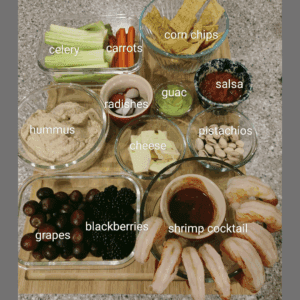
healthful snack board with various fruits, veggies, shrimp, cheese, nuts, etc.

Whether you’re hosting a cozy gathering or prepping a solo snack board for movie night, a healthful grazing board is a delicious reminder:

Nourishment can be festive, flavorful and full of joy!


🎄 Healthful Holiday Grazing Boards:  Nourishing, Satisfying and Gratifying

The holidays are a time for gathering, grazing and gifting your taste buds a little extra pleasure.

But indulgence doesn’t have to mean derailment.

Enter: the healthful holiday grazing board—a vibrant, balanced spread that celebrates flavor, color and nutrients.


✨ What Makes It “Healthful”?

A nourishing grazing board isn’t about restriction—it’s about intention.

Here’s how…

Think variety and balance:

💚 Colorful produce: Rainbow carrots, pomegranate seeds, berries, red pepper slices, citrus, grape tomatoes and crisp cucumber rounds add micronutrients, fiber, antioxidants and visual pop.

❤️ Protein-rich bites: Hard-boiled eggs, smoked salmon, shrimp cocktail, unique cheeses, roasted edamame or marinated tofu cubes offer satisfying staying power.

💙 Whole-grain nibbles: Seeded crackers, whole wheat mini pita wedges, corn chips or popcorn bring fiber, crunch and texture.

💛 Fats and flavors: Olives, pickled veggies, seasoned nuts, hummus, guacamole, salsa, etc keep things exciting.


🎁 Tips for Building Your Board

🍇 Anchor with abundance: Start with a few generous piles—grapes, nuts, veggie sticks—and build outward.

🌿 Play with height and shape: Use ramekins, jars and fresh herbs to create dimension and flow.

🍫  Include a sweet note: Dark chocolate squares, dried figs, dates with goat cheese or cinnamon-dusted apple slices add a sweet finish.

🛒 Create a shopping list of items you want to include, keep it simple and let your board evolve with your creativity.


Every wholesome choice you add is a win worth celebrating—proof that healthy can be both satisfying and fun.

Because when your board is balanced, your body and spirit feel it too. 🥰

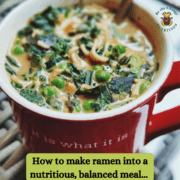
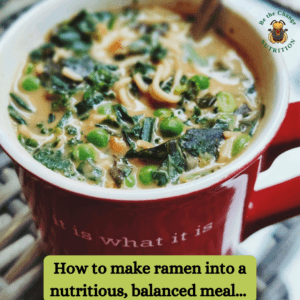
Mug of ramen noodles with spinach, peas and peanut butter.

 There are always ways to nutritionally improve any of your favorite foods– even ramen!

🍜 Tips to Making a Healthier, Balanced Ramen Noodle Soup:

🍤🫘 Add a protein source like chicken, tofu, tempeh, edamame, shrimp or hard boiled eggs. Consider black beans, chickpeas, lentils, cannellini beans or peas too– while these aren’t quite as high in protein, they still provide health promoting plant-based protein plus the benefits of fiber.

🥬🍄 Mix in some frozen spinach for antioxidants and additional vitamins, minerals and fiber. Thaw first by rinsing in a colander– or add it frozen to your hot soup to cool it quicker. Try cauliflower rice, peppers, mushrooms, carrots or mixed veggies for additional nutrients.

🥄🥜 Stir in a big spoonful of peanut butter, almond butter, cashew butter or sunflower seed butter for healthy fats and satiety– this makes your soup creamier and absolutely delicious.

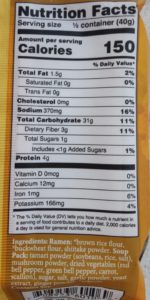
🧂🤏 Use less of the seasoning packet if you’re looking to reduce sodium in your diet. Ramen seasonings vary in sodium content so check your label. If it’s got 20% or more of the recommended daily value it’s considered high-sodium. You can still use the whole packet; it’s just smart to be aware of how many high-sodium foods you’re eating over the course of your day.

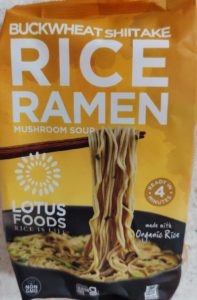
🔎 👀 Read the ingredients to see what you’re getting. I like the Lotus brand that makes ramen from whole grains like brown rice, millet and buckwheat vs enriched wheat flour and oil, so you get a little more fiber…

Rice ramen noodle packet by Lotus FoodsNutrition facts panel for Lotus Foods ramen noodles.

🤫 They’re at Job Lot now for $1!

 Remember: Protein, fat and fiber help keep you full longer. If satiety is a goal, add these to your carb-rich meals and snacks to turn down your hunger hormones.


    Fun fact about me: I was vegan for over 12 years! 😲

    It’s been more than 10 years now since I returned to being omnivorous, but I am supportive of anyone who chooses to follow a vegan diet and wants to learn how to do it in a healthy way. 💓

    Here are a few important nutrients you want to ensure you are getting adequate amounts of in a vegan diet:

    ✔️ B12 (you will need a supplement)
    ✔️ Iron
    ✔️ Zinc
    ✔️ Omega-3 fatty acids
    ✔️ Protein
    ✔️ Calcium & D

    You may wonder… What do vegans eat?

    In a nutshell, anything not containing animal products. Vegans eat 100% plants!

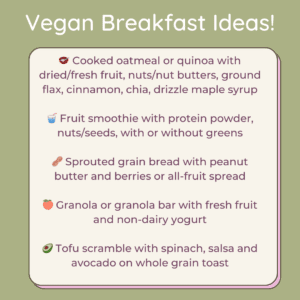
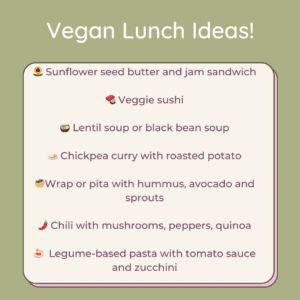
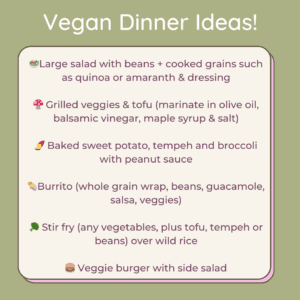
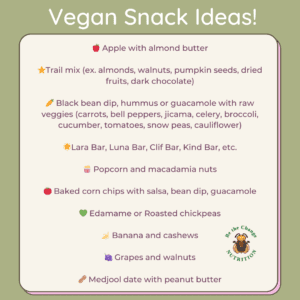
    Here are a few examples of some balanced, nutrient-rich vegan breakfasts, lunches, dinners and snacks:

    List of vegan breakfast ideas


    list of vegan lunch ideas.


    List of vegan dinner ideas.


    List of vegan snack ideas.

    👉🏻 Vegan does not necessarily equal healthier.

    There are high-nutrient vegan diets as well as low-nutrient vegan diets. 😊

    (Just like there are high-nutrient omnivore diets and low-nutrient omnivore diets.)

    And just like with any way of eating…

    ✨Variety and balance are key!✨

    Oats, peanut butter & dates fuel your body with nutrition it can use.  💪🏻

    🌟 Oats provide fiber to help maintain balanced blood sugars and cholesterol levels as well as promote optimal digestion.

    🌟 Peanut butter contains protein & healthy fats that keep you full.

    🌟 Dates offer natural sweetness along with minerals, antioxidants and fiber.


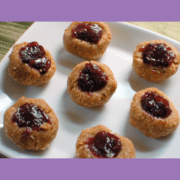
    No-Bake PB&J Thumbprint Cookies:

    Ingredients:
    💗 1 cup rolled oats
    💗 1/2 cup medjool dates (pitted)
    💗 1/2 cup peanut butter
    💗 2 Tablespoons maple syrup

    …and your favorite jam for topping the cookies.


    Directions:
    💗 Add all ingredients (except jam) to food processor and blend until a dough forms. 
    💗 If the dough is too dry (not sticking to form balls) add a bit more maple syrup.  
    💗 Roll into balls and slightly flatten.
    💗 Make a thumbprint and spoon in some jam.  No baking.

    💗 Store them in the fridge or freezer. Enjoy!


    A balanced diet is a cookie in each hand.  ~Author Unknown

    Is this you? 👇🏻

    You’re hungry.

    You enjoy a delicious dinner.

    You finish your plate.

    You refill your plate with more food.

    You’re FULL.

    Man feeling too full.

    You wonder why you ate so much…

    AGAIN. 🙄

    Let me introduce you to a little tip that can help.

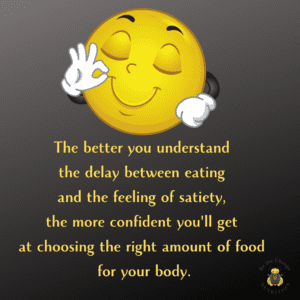
    Quote: The better you understand the delay between eating and the feeling of satiety, the more confident you'll get at choosing the right amount of food for your body.

    Doesn’t it feel nice when you eat just the right amount of food?

    When you reach that point where you’re no longer hungry, yet you’re not uncomfortably overfull.

    It’s easier said than done.

    Most of us have eyes bigger than our stomachs.

    Let’s face it, food is delicious and brings us great pleasure.

    We are extremely fortunate to have access to such abundance.

    But the problem with this is:

    Our waistlines are expanding and we have astronomically high rates of diet-related diseases because of overeating.

    The key is to be able to enjoy enough food to satisfy without going overboard. ⚖️ (Balance!)

    This is not easy for most people, but with some appetite awareness and mindful practice it can be an achievable goal.


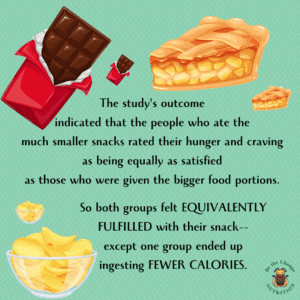
    Check out this study where subjects were given snacks in either a small portion or a much larger portion size.

    The snacks included chocolate, apple pie and potato chips.

    These are all very tasty foods that are also easy to overeat.

    We’ve all been there!

    Study outcome showing that both groups felt equally fulfilled with different sized snacks.

    Something to think about, hmmm? 🤔

    Each group ate their snack and then waited 15 minutes. ⏰

    ✨There is a delay of about 15-20 minutes for your brain to register that your body has had enough.✨

      ➡️This is good to know because if you are aware of this you can consciously decide to stop eating before it’s too late.

    We all know that feeling of wanting to continue eating, thinking we need more, or maybe simply just wanting more, only to realize later that we overdid it and should have stopped eating much earlier.

    ✨We can feel satisfied after eating less food than we think we need.✨

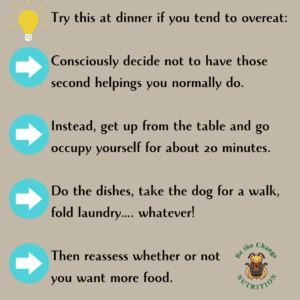
    Strategy for overeating.

    👉🏻 Chances are good that by then your stomach will have sent the signal to your brain that it’s had plenty & the desire for eating more will have faded.

    ✨You may be surprised to learn that you didn’t need as much as you thought you did.✨


    You can also try this if you tend to over-snack in between meals!

    Consciously decide to have a smaller snack than you normally would.

    Give yourself 15-20 minutes to begin to digest and metabolize your food.

    Then reassess your need for more food. 🤔


    Be patient with yourself because like learning anything else new, this takes practice.

    You’re essentially trying to change a habit (overeating) and that’s not easy to do.

    You might find it tremendously hard to stop eating until you get that too-full feeling if that’s what your body is used to experiencing.

    But each time that you are able to eat a little bit less, you are reinforcing the fact that you really do not need such large quantities of food to feel satisfied.   You will gain confidence.  It WILL become easier and easier with each success you have. 💪🏻

    We never repent of having eaten too little. – Thomas Jefferson

    Snacking has gotten an undeserved bad reputation– I think mainly because what most of us consider “snack foods” are the packaged, ultra-processed  flour and sugar-based items lining store shelves.

    But all snacking really means is eating.  And if you’re hungry you should eat and that’s not a bad thing.

    It’s what you choose to snack on that counts.

    What do you want to look for in a snack?

    1.  Balance.  Think of a snack as a mini version of a meal.  Aim for a mix of protein, fat and carbohydrate.  This combination helps promote the satisfaction, balanced blood sugars and sustained energy that you are looking for from a snack.  Produce (fruit or veg) plus a protein/fat source is a winning combo.  Or you can combine a carb like a whole grain with a protein and/or fat.  I’ll translate that into some examples below!

    2.  More Whole Foods, Less Highly Processed.  Choose mainly nutrient-dense foods.  Snacks made primarily from white flour and/or sugar (candies, pretzels, cookies, crackers, etc) aren’t going to do a lot as far as providing nutrition, satiety and balanced energy, especially when eaten alone.

    3.  Enjoyment and Pleasure!  Eating foods you love will resonate with your body as more fulfilling.  Even though I’ve listed balance and whole foods as what to think about when snacking, don’t totally restrict yourself from your favorite foods, even if they may not be the most healthful.  Try pairing them up in a way that gives you balance and promotes satiety.  Enjoy yogurt with a cookie, add almond butter to some crackers or use a collard green leaf to roll up deli meat.

    1208161058-2

    Probably my all-time favorite snack.

    Apple with peanut butter! 🍎➕🥜

    My Favorite Snack Ideas:

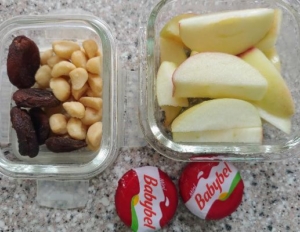
    • Fruit + nuts or nut butters (apple with peanut butter, banana with almond butter, orange with pistachios, grapes with walnuts, figs with macadamia nuts)
    • Trail mix (dried fruit, nuts, seed, chocolate chips)
    • Pitted dates with goat cheese or nut butter
    • Lentil soup, black bean soup or chili
    • Roasted chickpeas with baby carrots
    • Raw veggies + hummus  (carrots, bell peppers, cucumber, cauliflower, broccoli, jicama, snow peas, tomatoes, celery)
    • Yogurt with granola and berries
    • Bars (RX, Lara, Aloha, Kind, Health Warrior, GoMacro, Perfect Bar)
    • Smoothie (frozen fruit, yogurt, nut butter, cocoa powder, almond milk)
    • Hard-boiled eggs Try hummus deviled eggs by mixing the yolks with hummus
    • Avocado toast with egg and salsa
    • Oatmeal with peanut butter and/or yogurt
    • Apple slices with chicken salad
    • Jerky with a fruit (or raw veggies)
    • Bean salad (garbanzos, black beans, kidney beans, Italian dressing)
    • Cheese with fruit (grapes, apple, pear, strawberries, mango, melon)
    • Cottage cheese with fruit (pineapple, blueberries, raspberries)
    • Whole grain crackers with cream cheese and sliced tomato
    • Tuna pouch on cucumber slices, whole-grain crackers or toast
    • Deli meat rolled in a collard or romaine leaf
    • Green tea with dark chocolate or red wine with dark chocolate.   Ok, so there always has to be one that breaks the rules, right?  🙂

    1210161208-2-2


    This one just makes you feel good.  🥰

    And think of all the antioxidants….


    Final Tip:  Take a moment to relax before you eat.  A good way to do this is to take a few deep inhales and exhales which will help you slow down.  Put away your phone.  Notice your food.  Chew well.  Feel gratitude for the food you have to nourish you.  Don’t forget that how you eat matters in addition to what you eat.  As I encourage everyone to do every time they eat, practice eating slowly, mindfully and enjoy every bite.


    I’m taking it easy today and this weekend after having some dental surgery yesterday.  Once I arrived home, I knew I would be thinking about food very soon and needed something nourishing but also soft since I can’t chew and disturb my stitches!

    Hmmm, I have this big box of beautiful butternuts….what could I make?

    1002161222-2-2

    Not only is it squash season, it’s quickly becoming SOUP season.

    What I decided to do was whip up a delicious thick, creamy, pureed soup made from my stash of butternut squash and just a few other simple ingredients.

    Almost everyone I talk to tells me they love butternut squash so I wanted to share this idea that is so simple to create, healthy and tastes incredible.


    You’ll need:

    • Butternut squash (Cooked and yes, you can cheat and buy the frozen chunks or pre-cut chunks in the produce section.)
    • Broth or stock (I used my homemade bone broth that I had stored in the freezer.)
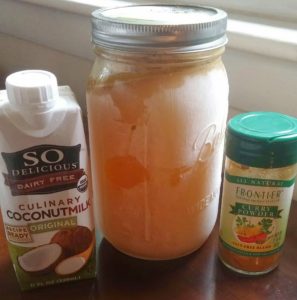
    • Coconut milk
    • Curry powder (The main ingredient is TURMERIC which has awesome anti-inflammatory properties– PERFECT for healing ASAP!)

    The coconut milk adds a creaminess that I love, plus you get the nutritional benefits of coconut, not to mention the FAT makes the soup more satisfying so you’re going to stay full longer.  But you could also make this with only the squash and broth blended up if you wanted to keep it lighter.  Curry is optional as well.  I love the flavor but if you don’t, leave it out and make your butternut squash soup with whatever seasonings you like.

    As is usually the case with my cooking, be warned that this is not an exact recipe but rather an idea.  I don’t measure, I just cook.  The more you get in your kitchen and prepare your own food, the more comfortable you will be with following your instincts– and the more creative ideas you’ll find you have inside of you that you never knew about!

    Here’s how to make this soup:

    Bake your butternut squash.  These are minis.  Feel free to use a couple of large ones.  They all taste similar.  🙂

    1027161420-2-2-1


    450 degrees for 45 minutes.  Larger squash may take longer.  Test with a fork and when they’re tender and soft they’re done.


    Let them cool until they are comfortable to touch.   Scoop out the squash and place in a blender with your broth, coconut milk  and curry powder.

    1027161354-2-2


    I used about 3 cups of broth (thawed and reheated), about 1 cup of coconut milk and LOTS of curry powder (maybe two big tablespoons).

    Blend everything together until smooth, adding more liquid (broth or coconut milk) as needed to reach the consistency you want.


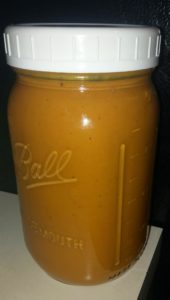
    Enjoy this nutritious and delicious soup!  I like to use glass jars for storing leftovers in the fridge.  If you plan to freeze some, glass jars are perfect for this as well– just be sure to leave some room at the top for the liquid to expand.

    1027161515a-2-2

    You want to know something funny?  Before I had this surgery I was thinking to myself, “I’m not going to be able to eat many of my regular foods for a while so what a great time to get some ice cream to enjoy.”  🍨 Interestingly enough, I have no desire for ice cream.  What I want is to heal and regain my health as quickly as possible and I know that what I put in my body will affect this.  Nutrient-dense, anti-inflammatory, antioxidant-rich foods are what will get me where I want to go.  And while ice-cream won’t kill me, I know it’s not going to contribute to the recuperation process.  When you are clear about what is truly important to you, your actions follow suit.

    1027161505a-2-2-2-2