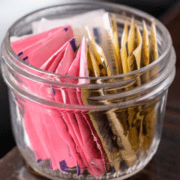
This post is for you if you regularly consume artificially sweetened foods and beverages!

For many of you this time between Thanksgiving and Christmas means major anxiety about staying on track with your health goals.  It often brings up fears of losing willpower around sugary temptations and constant stress about weight gain.  And if you’re a diet soda junkie it means slurping down these beverages in an attempt to satisfy cravings and tame your appetite– but could this habit be doing more harm than you realize?

I want to help you feel good about yourself and your life.   I want you to have a healthy relationship with food and eating.  It’s really tough to do this with artificial sweeteners interfering with the natural rhythms of your appetite.

If you have been relying on diet products in hopes of losing weight or controlling your hunger and you have not noticed any positive results– you have to question why you continue to use them.

Be open to the concept that they may be making it even harder for you to lose weight.

Thanks to clever marketing, so many people believe that consuming artificially sweetened beverages or foods will help with appetite control and weight loss.  Hmmmm….yet since their introduction into our food supply and despite millions of people eating and drinking them, obesity is more out of control than ever.

These fake foods fuel the ridiculous myth that to lose weight you must eat as few calories as possible and you must try to suppress your appetite, like it’s a bad thing.  It’s not.  Your appetite is there for a reason and until you make friends with it you’re not going to be at peace.  You respect your body’s urge to breathe, sleep and urinate, right?  You should pay attention to your hunger as well.

Ask yourself this:  Have sugar-free products helped me?  Who am I to tell you something doesn’t work for you if it has?  BUT I am going with what I’ve noticed in everyone I’ve met so far and I have yet to meet someone who has achieved and maintained a healthy body weight through diet products.

What if you got them out of your system and let your body reset itself through nutrition from real foods?  If you’re regularly putting fake sweeteners in your body you can bet that your appetite and taste buds are confused about this ingestion of sweetness without the accompaniment of expected energy (calories).  You can’t trick your body.  Instead you’re only encouraging your sweet cravings to haunt you.

I want you to consider testing out a new approach:

Get artificial sweeteners out of your diet in order to rebalance and regulate your appetite.


I love a good n=1 experiment.  It’s the best way to see how a change will work for you!  Cut out all artificial sweeteners for one month and see what you notice.  What I like about self-experimentation is the idea that you can look at it as a trial period for something new where you can always go back to your old habit if you want to.  You won’t know what will happen unless you try.

I’m not saying to replace artificially sweetened products with those containing corn syrup and white sugar either.  The idea is to learn to not need to taste intense sweetness in everything you eat and drink.

Check out some of this information:

Why Artificial Sweeteners Can Increase Appetite

  • “After chronic exposure to a diet that contained the artificial sweetener sucralose, we saw that animals began eating a lot more,” said lead researcher Associate Professor Greg Neely from the University of Sydney’s Faculty of Science.
  • “These findings further reinforce the idea that ‘sugar-free’ varieties of processed food and drink may not be as inert as we anticipated. Artificial sweeteners can actually change how animals perceive the sweetness of their food, with a discrepancy between sweetness and energy levels prompting an increase in caloric consumption,” Professor Herzog said.

Gain Weight While “Going Diet?  ”  Artificial Sweeteners and the Neurobiology of Sugar Cravings

  • But do artificial sweeteners actually help reduce weight?  Surprisingly, epidemiologic data suggest the contrary. Several large scale prospective cohort studies found positive correlation between artificial sweetener use and weight gain.

  • Preload experiments generally have found that sweet taste, whether delivered by sugar or artificial sweeteners, enhanced human appetite. Aspartame-sweetened water, but not aspartame capsule, increased subjective appetite rating in normal weight adult males.

Artificial Sweeteners Produce the Counterintuitive Effect of Inducing Metabolic Derangements

  • Taken together, data from these recent studies suggest a link between consumption of ASB (artificially sweetened beverages) and a variety of negative health outcomes, including increased risk of being overweight and obesity, T2D, metabolic syndrome, and cardiovascular events, especially in adults.

If you’re diabetic and thinking artificial sweeteners are helpful, you may want to reconsider that:

Artificial Sweetener May Do More Than Sweeten: It Can Affect How the Body Reacts to Glucose


All science aside, simply based on my observations alone, the fake stuff doesn’t help anyone lose weight or improve their health in any way.  Looking around, who do you see drinking Diet Coke and eating sugar-free Jello?  And I don’t mean the models in the advertisements who are there to make you think they look that way because they use artificial sweeteners.  In real life you’ll notice that it is typically those struggling with their weight who consume these artificial products.

Having a healthy relationship with food isn’t about eating and drinking artificially made food-like substances that taste disgusting.  If something doesn’t work and is likely causing more harm than good, it’s time for a change.  A healthy relationship with food has to involve real foods that provide nourishment.

If you’re looking to rediscover and honor your true appetite, come see me and I will help you get rid of these fake foods and into eating the wholesome foods that your metabolism will thrive on.

You don’t need diet products; you need to get back in touch with your natural appetite instead of battling with it.

💗

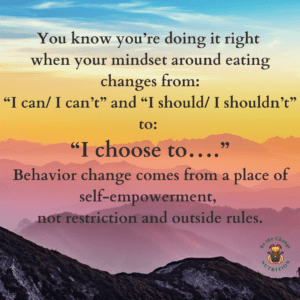
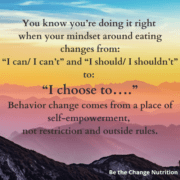
motivational quote that says: You know you're doing it right when your mindset around eating changes from I can/can't and I should/shouldn't to I choose to.

Does this sound like a familiar scenario?:  You’ve just finished eating a delicious, satisfying meal and you’re now faced with the temptation to eat yet more food– maybe an invitation to the local ice cream shop, perhaps a chocolate bar in your desk drawer or whatever it may be that sounds like something you want to eat but also something that you know isn’t exactly what your body needs at the moment.

A typical thought process may go something like this:  I MUST eat this NOW and I will begin my diet again tomorrow.  This is my only chance.  It’s now or never.  There’s a sense of urgency and lack of control.  So you eat it, only to feel overstuffed and guilty….again.

How does that work for you?  I’m guessing not great.

Keep reading for a little tip that was recently shared by a client who is struggling with overeating.  I wanted to talk about it because when something really clicks for someone, chances are good that it will resonate with somebody else.

Instead of her predictable dieting mentality which revolved around “can’t” and “shouldn’t,” she tried a fresh approach.

This involved slowing down, taking a few moments to relax and checking in with her body:

“I am actually feeling pretty satiated right now with what I just ate.  The ice cream that I was tempted to go out for… I can have it tomorrow!” This was a completely novel way of thinking for someone whose chronic dieting messages sounded more like “I better eat it now (and lots of it) because I start being “good” tomorrow.”

I was really proud of her for changing her internal dialogue!  And you know what– tomorrow came and the craving was gone. When she realized that she could always have that food the next day, it diminished its power over her and gave her a newfound sense of freedom.

How you think about food (your mindset), plays a huge part in what, when and how much you eat.  Changing an unwanted eating habit is less about increasing your willpower and more about changing your attitude towards eating and food.

For many people, food is seen as the enemy.  It’s often viewed as something to limit or a cause of weight gain.  It could be feared because it is something associated with a lack of control.  This all-too-common viewpoint won’t ever lead you to where you want to go.  Learning to see food as your friend and an essential source of nourishment and pleasure is absolutely key if you’re looking to establish a healthier relationship with eating.

Remember:  You can have it tomorrow.  Know that you have a choice and stop looking at food as something that you “can” or “can’t” have.  You can have anything you want.  Just take that pause and slow down to decide if you really do want it.  Consider the concept of possibly feeling even better by NOT having that treat right now!  See last year’s post But I Love to Go Out for Ice Cream in Summer….

Also, think of cravings like waves that come and go.  If you’re not sure what you want to do, try waiting it out for 20 minutes as an experiment.  If you can pause between the thought and the action… you may be surprised at what you learn.  This is different from trying to suppress true hunger signals.  If you’re hungry– you need to EAT, not fight it!

If you’ve been at war with food and with your body, you must change how you have been thinking.  You aren’t going to win any battles with self-loathing and negative thoughts.  Slow down, take a few deep, conscious breaths, trust yourself, accept who you are and love yourself to get going in the right direction.  I am always here to support you each and every step of the way.

Fish looking at a piece of pie saying: I can't eat another bite. Oh look pie!

I’m hearing from just about everybody how anxious they are feeling about Thanksgiving.  If you’re anticipating the holiday with stress and fretting that you’re going to “cheat” or “ruin your diet,” I want you to shift to a more positive perspective.  This is supposed to be a happy, family centered day– there is no reason to be stressed out.

My top 3 tips for a stress-free Thanksgiving:

1.  Remember this is only ONE meal!  It’s not what you do occasionally that is going to have a big impact on your health and body, but what you are doing on a day-to-day basis.  It is our everyday habits that carry importance.  Trust me:  You’re not going to erase all your healthy eating if you have some “extras” on Thanksgiving.  To help this sink in, turn the situation around:  If you normally ate junk food for all your meals, how much of an effect do you think eating one really nutritious meal is going to make if you go right back to your old pattern?  Right, not a lot.  Again, it’s your daily habits that count.

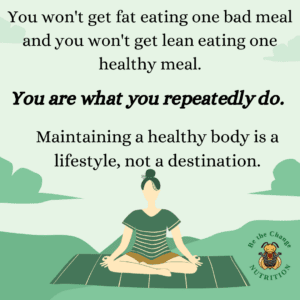
quote reminding you that you won't get fat eating one bad meal and you won't get lean eating one healthy meal. you are what you repeatedly do.


2.  Savor your food, eat slowly and be grateful.  Try not to rush through your plate with  thoughts of what you’re going to get seconds of.  Slow down and enjoy every bite of what you have.  Then, once you’ve given your stomach some time to get the message to your brain whether you’ve had enough, you can decide what you want to do.  Pause here and you just might find that you feel good and don’t need more just because it’s there.  This isn’t a day to see how much food you can put down; it’s a chance to be with people you care about and be thankful for the abundance that we all have in our lives.

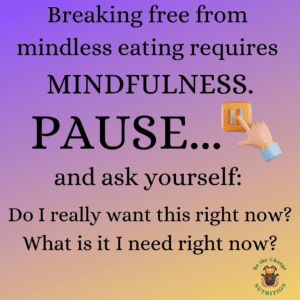
quote about mindless eating. Breaking free from mindless eating requires mindfulness. Pause and ask yourself: Do I really want this right now? What is it I need right now?


3.  This one is for those of you who want some sort of guidance to follow.  When you’re building your Thanksgiving plate, think this:  Make sure at least half your plate is a variety of vegetable-based dishes.  There are always lots of these at Thanksgiving– butternut squash, sweet potatoes, green beans, turnips, carrots and salad just to name a few.  Load up on these fiber-rich, colorful, antioxidant and vitamin-filled goodies.  Save about 1/4 of your plate for your turkey and the last quarter for the more processed stuff like breads or pies.  That’s a pretty good balance to aim for.

Wishing you a very Happy Thanksgiving!💞

cereal

Keep boxed cereal or bottled soda on your counter?🥤 How about cookies? 🍪

According to this study, you likely weigh more than your skinny neighbors who keep fruits on the counter. 🍎

“It’s your basic See-Food Diet — you eat what you see,” said lead author Brian Wansink, professor and director of the Cornell Food and Brand lab and author of Slim by Design: Mindless Eating Solutions for Everyday Life.

Look around your kitchen and see what you’ve got sitting out in plain sight.

Your habits may be impacting your health in a way you never realized.

If you see fruit– good for you! If you see highly processed foods– you may want to make some changes if you are trying to lose weight.

A random shot of my counter is going to definitely include a few types of fruit.  Right now I’ve got a full bowl of apples, a couple of oranges and a couple of asian pears. 🍎🍊🍐

1021150642-1

Bananas– always!  🍌

I also keep squash on the counter.  It wouldn’t be unusual to see a few potatoes and sweet potatoes too but I’m out.

1021150643b

Over here I’ve got some bone broth going in the slow cooker from the bones of the chicken I oven-roasted last night.  I let it cook for about 24 hours before jarring up the broth for the freezer.  More on bone broth in the future!

1021150645

What you won’t find on my counters is any soda, boxed cereals or packaged cookies.

➡️ If it’s not there, you won’t eat it (or less likely!)  Simple as that.

Make things easier for yourself by not keeping certain less-than-healthy foods where you see them every time you walk by the kitchen.

This one little change could make a big difference.

Create a new habit if you don’t already have it:  Buy some fresh fruit! 

🍇🍉🍊🍋🍎🥭🍌🍏🍐🍑🍈

A few ideas to consider include:  apples, bananas, cantaloupe, clementines, grapes, grapefruit, honeydew melon, kiwi, lemon, limes, mango, nectarines, oranges, papaya, peaches, pears, pineapple and pomegranate.

Fruits are gorgeous out on the counter (prettier than bags of processed carbs and plastic bottles of dyed sugar-water, right?)… and a nutrient-dense choice.

Surround yourself with the things that support your intentions and skip the stuff that doesn’t.

Counting calories was something I used to frequently recommend to clients for weight loss.  But I have found myself doing this less and less often.  In theory, the concept appears to make perfect sense:  Calculate how many calories your body needs based on your current height, weight and activity level.  Then simply consume less (and move more) and you will lose weight.

The only problem is– this approach of emphasizing a number of calories rather than the quality/type of calories usually doesn’t work and if it does, it only works short-term before you regain any lost weight. Can you relate?

Your body knows how many calories it needs better than any calculator or diet plan.  We’ve been blessed with a handy built-in feature called appetite (we’ve got one called thirst too!); if only we would listen to this instead of trying to fight it and control it.  It’s there to guide us.  As a child we knew when to eat and when to stop eating because we were in sync with our internal messages.  Somehow, somewhere along the path of life, this innate gift often gets lost (usually because of dieting!)

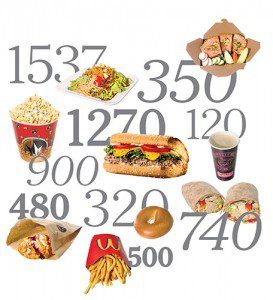
Calorie tracking websites and apps have become popular for weight loss.  True, calorie counting can be helpful for some people.  I suggest it as a tool in certain situations where I feel the person will benefit from temporarily tracking their foods and looking at the numbers to see where their calories are coming from.  It can offer tremendous insight when you’re not in touch with what you are eating and the quantity you are eating.  But it’s also good to know that the FDA allows food manufacturers to have up to a 20% margin of error— so the calorie info you see on food labels is not necessarily even accurate. 😜

HowManyCalories1

That being said, not only can logging everything you put into your mouth be a major time consumer and additional stress factor in your life, but counting calories can also lead to feelings of failure when you don’t meet that specific calorie number.  This leaves you with a negative self-image– which then fuels unwanted eating habits.

What if the daily number of calories you are aiming for is not realistic or right for you?  I’ve seen too many people enter their height, weight and weight goal into an online calorie tracking program, only for it to recommend they eat 1200 calories per day.  This is actually the calorie recommendation for a toddler!😲

And guess what happens when you eat too little?  Your metabolism naturally slows down to accommodate a lower food supply.  After you under-eat (diet),  no matter how much willpower you think you have, the pendulum swings back the other direction.  This is the feast-famine or restrict-binge cycle.  Over time this pattern leads to fat storage and weight gain. Hence all the folks who report how they dieted and then ended up gaining back the weight plus some.

🌟 Instead of focusing on eating LESS, at Be the Change Nutrition we talk about what to eat MORE of:  Foods that will help balance your blood sugars and keep you feeling satiated! 🥰

The number of calories you eat tells you nothing about the quality of your diet.   Nutritionally dense foods promote hormonal balance and lower inflammation, both of which are key players in disease prevention and maintenance of a healthy body weight.  Highly processed foods contribute to hormone imbalances and promote inflammation, which in a sense is like gumming up your system so it’s not properly functioning and more susceptible to disease and weight gain.

You can eat 2000 calories worth of bagels, Special K bars, pretzels, processed lunch meat sandwiches and canned soup with crackers… or that 2000 calories can be from wholesome foods like eggs, strawberries, walnuts, sweet potato, avocado, chicken, spinach and black beans.  There can be a major difference in nutrients.  You are going to feel greater satisfaction and overall well-being eating whole foods versus highly processed products.  When you give your body the nutrients it needs, things run smoothly.  Food is much more than just calories.  If you want to feel good, you’ve got to eat in accordance with that goal.

🤔 If you’re calorie counting and finding yourself always hungry, could this be a signal that your body needs to eat more?

🤔 Could those feelings be because you are trying to eat a 200 calorie meal when what you really need is at least twice that?

🤔 Or maybe your meals are not properly balanced with fat, fiber, protein and carbohydrates leaving you feeling as if something is missing.

🤔 Could you be relying on too many diet products to keep your calories as low as possible?

🤔Perhaps your body isn’t getting the nutrients it needs and you’re experiencing hunger as a result.

If you’re not feeling satisfied by what you’re eating then there is something going on that needs some investigation.🕵🏼

What ever happened to trusting our internal signals?  When did we lose touch with our hunger and satiety messages that let us know when to eat and when we have had enough?  Honor your hunger; don’t suppress it through calorie restriction.  Look at your appetite as your friend rather than your enemy.   You cannot hate yourself into a healthy state or a smaller body.  You can only love yourself into good health.  Learn to check in with your body, feed it when it needs fuel and not when you are bored … and stop when you are satisfied, not stuffed.  Listen.  Trust.

And everything will be ok. 🙂

Please don’t judge your self-worth on how well you succeed in meeting a calorie goal.  It’s just a number and who is to say that it’s the number for YOU?  Better yet, forget counting calories and switch your focus to eating the best quality foods you can to nourish your body, mind and soul.   Practice paying attention to what you need to feel your best and you may be pleasantly surprised how weight loss naturally falls into place as a side effect of this self-trust and self-love.


Weight loss.  It’s the #1 response I hear when I ask:

“What are you hoping to get out of our visits together?”

It’s a fine goal and you’re not alone if you are frustrated with a weight issue and not a clue as to what to do about it.

Another question I like to ask is:  “How many years have you been dieting?” 

It’s not uncommon to hear people in their 30’s, 40’s, 50’s and 60’s realize they have been dieting more than half their lives. 🤯

Okay then…. It is time for a change! 😁

You probably know by now that “diets” don’t work, at least not long-term.  Anyone can find one of the zillions of low-calorie meal plans and follow it for a brief period.  Nobody can follow them for life.

The reason:  We all have a built-in survival mechanism called an appetite.  We need to eat for both nourishment and pleasure.  Trying to starve yourself with too little food, eating things you don’t like or eating in response to a schedule or plan rather than your hunger signals and preferences tends to backfire.  You learned this the hard way, right?!  But now what?  If diets aren’t the answer then what is?

The answer is simple and logical, yet different for everybody.

The bottom line is:

You need to change your specific behaviors and mindset that have gotten you where you are today.

This involves investigating your habits and then figuring out which changes you are willing to make to see results.

You also need to honestly ask yourself questions like:

  • Why do I want to lose weight?
  • What will change about my life when I do lose weight?
  • What won’t change about my life when I lose weight?
  • Is losing weight more important to me than my current lifestyle?

When some people really think about these questions, they realize that they aren’t ready to make changes and that is okay too.

Here is how you can get started on your weight loss journey:

#1:  Pinpoint your problem.   Get curious. Take a close look at the types of foods you eat, how much you eat, why you eat and when you eat.  Examine how you eat too.  Do you eat in a stressed-out state?  Do you eat every time you feel lonely? Bored? Do you eat when you sit down to watch television regardless of whether you are even hungry or not?  Are you telling yourself you aren’t allowed to eat certain foods that you love?  This can be eye-opening!  Really paying attention will uncover clues about eating behaviors that relate to your weight.  Once you identify where things are out of balance you can devise a plan consisting of  habit changes to implement.

#2:  Start with one realistic change.  You don’t have to do a complete diet overhaul.  That is what many “weight loss diets” are and a big reason nobody can follow them for long.  Instead, once you have identified your problem areas, pick out just one thing to change.  It is crucial that your plan consist of a change that you are honestly ready and willing to put into action.  I want you to feel excited about it, not dread it.  A lot of time I find that people want certain results but don’t want to put forth the work to get them.  There usually IS going to be some degree of struggle involved when you leave your comfort zone, so make sure that you’re good with whatever means you choose to get there.   You’ve got to be consistent and patient with your change as well. Remind yourself of your WHY every single day.  What are you doing this for?  Keep that reason fresh in your head.

I’m no psychologist but I do find myself playing one at work as an RD!  Weight problems are often surprisingly not so much about the food.  The issue is usually deeper than merely a matter of lousy willpower.  Excess weight can be seen as a symptom that something is out of balance in your life.  The real question is why are you eating too much or choosing too many of the wrong foods and not enough nourishing food?  Is there an underlying something in your life that needs to be changed?  This could be anything:  not getting enough sleep, being stuck in a job you hate, not getting out in nature or being too sedentary/not enough physical activity, etc.  You may find that once you start dealing with whatever is not right in your life that your eating and weight issues work themselves out naturally.

Nutrition education certainly comes into play too! That’s why having a Registered Dietitian on your side to help guide you with ideas of what to eat, new strategies to try, encouragement and accountability can be a huge factor in your weight loss success. 💗