Flexible Meal Planning
Let’s demystify and simplify this.🪄
Meal planning does not have to be stressful.
Or rigid. Or time‑consuming. Or a second job.
When you understand the basics of how a balanced plate works, you already have everything you need to meal plan with confidence. 🍴
At its core, most satisfying meals come from a familiar formula:
Protein+Carb+Fat+Produce
🍗+🍠+🧀+🥦
(or any close variation that fits your real life)
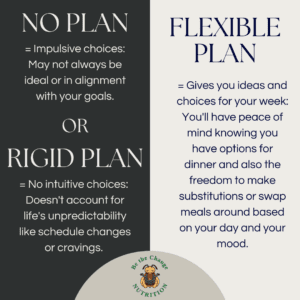
Instead of treating a meal plan like a strict script you must follow, change your definition to: Flexible Meal Planning.
Tips & Tools:
✅ Take inventory. Start by checking your fridge, freezer and pantry. Notice what needs to be used up and what you can combine to create a couple of easy meals. This alone can spark half your plan.
📆 Look at your schedule. Glance at your week and note late work nights, kids’ activities, classes or anything that affects dinner time. On busier nights, choose meals that require minimal time, effort or cleanup.
🍽️ Factor in restaurant night(s). If you enjoy dining out or grabbing take‑out, build it into your plan intentionally. Choose the night(s) that make the most sense for your energy and schedule.
🌮Try theme nights. Themes simplify decisions and keep things fun. Ex. Mon: breakfast for dinner, Tues: Mexican, Wed: sheet pan meal, Thurs: snack plate night, Fri: seafood, Sat: take-out, Sun: vegetarian.
👩🏼🍳 Keep it mostly familiar. Build your plan around tried and true meals that you know and like. Maybe add in one new idea a week, but don’t try to make a whole week of unfamiliar recipes.
🔪 Prep ahead when you can. Thaw meat in advance, cook a starch (wild rice, quinoa, potatoes) to reheat later or chop veggies for a quick stir‑fry. Small steps make weeknights smoother.
🛒 Shop and stock up. A well‑stocked kitchen makes meal planning so much easier. Keep pantry and freezer staples on hand and shop regularly for fresh items so you always have options.
📃 Make a list. When you’re low or out of something, write it down immediately.
📚 Build a recipe collection. A visual library helps create ideas. You likely have dozens of meals you’d happily make again—you just forget about them. Brainstorm with your family, print favorites and “want‑to‑try” recipes and keep them in one place. Use a folder or binder like this to flip through when you need inspiration.
📝 Get your ideas out of your head and onto paper. Meal planning comes together quickly once you can see it. A dry‑erase menu board (like the one on my fridge) makes it easy to map out your week and adjust as needed. You’ll be surprised how easy meal planning comes together when you do this.
🤸🏼♂️ Stay flexible. Remember, you don’t have to follow a meal plan exactly– That can be stressful and unrealistic. Have ideas and options, but keep things flexible.
🌞 One day at a time approach. If planning a full week feels overwhelming, shorten the window. Keep ingredients for several meals on hand, then decide the night before or that morning what you’ll make.
😃 Need help? I sit down with clients all the time and help them flexible meal plan for their week. We’ll take your goals, your schedule, your obstacles and your taste preferences into consideration. I won’t hand you a meal plan (and here’s why) but I will teach you how easy it is to plan out your own meals for yourself.
🤔Is meal planning for everybody?
Not necessarily.
Many people genuinely do well deciding what to eat in the moment. They can scan the fridge, pull a few things together, and end up with something balanced without much thought. For others, that skill develops over time—just like learning to cook, lift weights or budget.
Even the most spontaneous eaters still rely on a few systems:
• Grocery shopping so there’s something to choose from
• A handful of go‑to meals they can make on autopilot
• Basic ingredients that mix and match easily
That’s planning… just not the rigid, color‑coded kind.
Meal planning isn’t about perfection or predicting every craving. It’s about reducing the nightly “What the heck do I make?” stress spiral. When you build even a light structure around meals, you get:
• Less decision fatigue at the end of the day
• More balanced meals without micromanaging
• A smoother grocery routine
• More confidence that you can feed yourself well, even on chaotic weeks
It’s a skill that supports your life—not one that takes it over.


Leave a Reply
Want to join the discussion?Feel free to contribute!