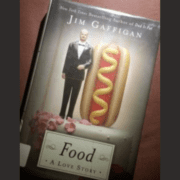

Food and laughing. 🍽️ 🤣 Two of my very favorite things in life. If you share similar interests I have a book you need to read.
I had never heard of Jim Gaffigan but he’s my new favorite comedian. Imagine Jerry Seinfeld going on about nothing but the intricacies of food and eating. This book is totally hilarious and leaves you wondering how someone thinks up this great stuff.
With all the seriousness and stress so often involved with eating right, this book is a breath of fresh air that WILL cause you to laugh out loud. We all need to lighten up a little and laugh more, don’t you think?
Sometimes when I don’t have a book on my reading list I go exploring for one. My favorite place is at the bottom of the staircase of my library where the “New” books are stocked. I know the precise section where the food/eating/nutrition/health/wellness/diet books are found and that’s where I check out what looks interesting. That’s how I came across Food: A Love Story by Jim Gaffigan. Not my usual type of reading but I like food and I like funny so I picked it up and am happy I did.
Jim writes about things like how prior to ranch dressing nobody had ever eaten a raw vegetable and how an outdoor barbecue to him just means “Let’s make the food more accessible to insects.” He’s got some incredibly funny insight into everything from McDonald’s to Whole Foods Market to Donuts to Chinese food. Just about anything to do with food takes on an entertaining spin in this book.
👍🏼👍🏼Two thumbs up from me- highly recommended for many giggle-out-loud moments.
The library is also an underused resource for education. I have gone to several fascinating talks on topics like Wickford History and Wild Animal Rehabilitation– where they brought in live owls and falcons. When I found out there was going to be a talk on Edible Wild Plants I signed right up. This talk was given by Brett Mayette who is amazing and has reminded me that there is another side to food that I don’t know enough about. As much as we have available to us, we have very low diversity in our diets compared to our ancestors who had to forage for food. There are so many wild plants growing in abundance all around us that are nutrient-dense but we just don’t eat them because we are simply used to buying our food from a store.
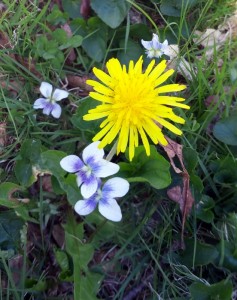 🌻 The idea of gathering nutritious foods right in my yard fascinates me. I have a memory of my stepmother telling my sister and I that dandelions are edible and she proceeded to pluck one from the lawn and eat it as we stood by grossed out. Well, apparently she knew exactly what she was talking about. (this is the same woman who drinks the water in the bottom of the pot after steaming or boiling veggies. Smart lady.) And there is a whole world of healthy seaweed too– they are rich in vitamins and trace minerals that can contribute to better health. Brett left me making a major note-to-self to read up on edible wild plants and seaweeds!
According to the University of Maryland Medical Center, dandelions are full of vitamins A,B,C and D and a source of minerals such as iron, potassium and zinc.
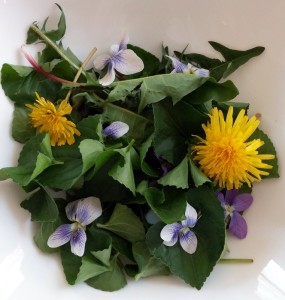
Throughout May, dandelions and violets were everywhere in my yard. I’ve tried a few. 🙂 Once I got over the initial fear of poisoning myself, I realized they taste pretty good. The violets are sweet. The dandelions have a slight honey taste. And the greens are bitter but in a good way and are supposed to be super for digestion. We don’t eat enough bitter anymore. Plus it feels primal to pick food, which (to me) is cool. I spent some time squatting down picking flowers and their leaves to make this little bowl and you know what? It’s work. It makes you appreciate how much effort is involved with food gathering. It’s kind of frightening if you think about the idea of something happening to our food supply and everyone having to figure out how to hunt and gather their own food.
Which reminds me of Mr. Gaffigan (who does NOT like fruits, vegetables or seafood) talking about blueberry picking: “Picking blueberries is not like picking pumpkins. It’s not like, “Hey I got one. Let’s get the hell out of here.” With blueberries you are never done. Even after three hours you tell yourself things like Uh, I got four. We could make a muffin. There’s got to be a machine to do this!”… 🙂
 I am desperately hoping my blueberry bushes actually produce blueberries this year!
I can’t find a website for Brett Mayette but I did find this article from last August called Where the Wild Things Are if you’d like to learn more about him and his wild plant walks and cooking demos. He’s clearly passionate for what he’s doing and you’ll catch that infectious energy just listening to him.
There is so much we can learn and benefit from by incorporating edible wild plants into our diets. Thanks for all you do Brett!