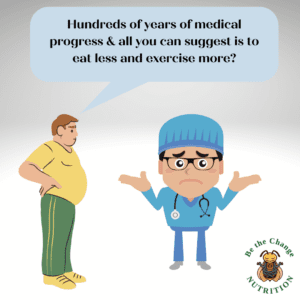
Sometimes a new client *thinks* they want a meal plan.

It’s easy to believe that if you have what, when and how much to eat all written out for you, you can just do it and reach your goals.

The concept makes perfect sense.

Except for that one part “do it.”

While intentions are there, in reality, people don’t follow meal plans.

And for the same reason that they don’t follow diets for long.

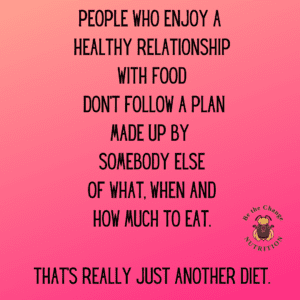
Meal plans are somebody else’s version of what to eat for each meal, when to eat and how much to eat.

They don’t address YOUR unique life routine, preferences, challenges and the reasons why you haven’t been able to achieve your health goals.

You’ll need guidance, but not a meal plan.

We’ll talk about planning out your meals, how to better balance them, ideas of when and what to eat, when and if to include snacks, how to listen to your body, eating to feel good and have energy, changing any unwanted eating habits, new recipes to try if you want them and whatever else you need to get you on the path towards your goals.


Take a look at how being given a meal plan differs from nutrition counseling:

Meal Plan

Nutrition Counseling

-Too much change too fast. It’s an entire diet overhaul which is far too much to change at once, overwhelming and not sustainable.

-Implements smaller changes to your diet and builds on those successes to keep you going for the long haul. No complete diet overhauls.

-3 new meals/day for the week equals 21 new meals to buy ingredients for, prepare and cook–all completely different from what you are used to eating. Yikes– not realistic.

We take your diet from where it is and plan out improvements. As your dietitian, I review your eating habits with you and we come up with strategic changes that are achievable and realistic.

Rigid and impersonal: No account for food likes/dislikes, daily routine/schedule, time and effort necessary for food shopping, prep, cooking, etc.

Flexible and customized:  Important factors such as what you enjoy eating, your work/life schedule and how to meal prep and cook all come into play.

-Doesn’t teach you how to eat.  What if you are out of an ingredient, have leftovers in the fridge that you want to use up, are out to eat or simply do not enjoy eating the specific food on your plan for that meal?

-Teaches you how to eat!  And how to trust yourself, create your own balanced meals, eat intuitively, choose what makes you feel satiated and allows the freedom to incorporate whatever foods you like into your life.

Can you see the difference between what nutrition counseling offers versus being given a meal plan?

In a sense we are coming up with a plan for your meals, only not in the way you might have envisioned.

Nutrition counseling is much more likely to result in a lifestyle change that you can feel good about and want to maintain.

Making healthy habit changes means starting where you are and going from there, at whatever pace is comfortable for you.

YOU have a say in what to change.

You’re more likely to implement changes when you are involved in making them, not being told what to do.

If you’re still feeling like you need a meal plan, you’re in luck! Thanks to the internet, you have your choice of millions to choose from right at your fingertips. 😂

Have at it but ask yourself if you really want to keep searching for meal plans (diets!) for the rest of your life… or would you rather become empowered and learn how to eat in a way that is nourishing, enjoyable and sustainable? 💞

News headlines pop up constantly about the increasing levels of depression and anxiety– Understandably so, and while the reasons are multi-factorial, the COVID situation has pushed many people over the line.

While there are many things we can’t control, thankfully what we eat IS something we do have our say about! When you’re struggling with uncomfortable feelings, food may not be something high on your priority list.

But what if it was? Could it help you feel better?

In case you weren’t aware:
Diet affects mood and mood affects diet.

There is a direct connection between your digestive system and your brain.  Many neurotransmitters and hormones required for healthy brain function are produced in the digestive tract.  Meaning– what you eat really does affect how your brain functions! Eating nutritious foods helps support production of these chemicals, which in turn helps regulate your mood.

Good Mood Food! 😊


Feelings of depression and anxiety can be related to various aspects of your eating habits.

The following are some of the areas I look at when assessing someone’s diet.

Any of these being out of whack can affect how you feel mentally:

  • Macronutrient balance (proteins, carbs, fats)
  • Food quality (vitamins, minerals, antioxidants, etc)
  • Eating structure/rhythm (when you eat)
  • Sugar, alcohol, caffeine and refined carbohydrate intake
  • Unwanted eating behaviors like overeating/binging

Here are some specific examples of how your diet can affect how you feel:

  • Waiting too long to eat can ➡️ irritability and anxiety (“hanger”) due to low blood sugars.
  • Low intake of essential fatty acids can ➡️ depression from hormone imbalances.
  • Excessive consumption of refined carbohydrates and fried foods can ➡️ depression and many other health issues related to inflammation.
  • Inadequate levels of iron can ➡️ low energy, depression and anxiety.
  • Binging and overeating can ➡️ feelings of depression and anxiety.
  • Stimulants like coffee, tea and chocolate can ➡️ anxiety in sensitive individuals or those who overconsume these.
  • These same stimulants can ➡️ improved mood in many people too! 

And… how you feel can contribute to how you eat as well!

Depression and anxiety can cause you to skip meals, overeat highly processed and fried foods, binge or consume excessive amounts of stimulants like coffee or chocolate. As you can see it can become a vicious cycle when your eating habits make you feel awful and feeling awful can make it hard to stick to healthy eating habits.

All that being said…

Also Good Mood Food! 😃

So, what is she trying to say here you ask?

The objective is not to eat the most perfect, healthy diet possible.

It’s about eating plenty of health-promoting foods but also enjoying the freedom to choose whatever you want to eat.

It’s about allowing a cupcake when you truly want to enjoy one and it’s about deciding to not have a cupcake because you know you’ll feel better with an apple and almond butter and perhaps you will eat a cupcake tomorrow instead.

It’s about making the time to plan out your meals and grocery shop because you know you will make better choices when you do this.

It’s about checking in with your body every few hours to see if you need to eat something because if you don’t you know you will end up binging when you get home later.

It’s about knowing when a certain amount of coffee goes from making you feel good to making you feel anxious and respecting this so you feel more balanced.

These are all parts of self-care.

When you’re dealing with depression and anxiety, taking actions to care for yourself is something you need more than ever in order to heal.

It is crucial to know what is and isn’t working for you when it comes to eating.

You’ve got to learn how your body feels with certain foods, without certain foods, when it needs food, when it needs something else, etc.

Knowing your body and how food affects you is key.

You truly are your own best nutritionist.

You may not know it yet and you may need some guidance to get to that place where you know yourself well enough and become confident enough to make food choices you feel good about but you will get there.

I’m not here to say that nutrition is the answer to all your mood problems because it’s not.

Obviously it is one piece of the mental wellness puzzle and other factors matter such as:

  • sleep
  • rest and relaxation
  • physical activity
  • mental stimulation
  • social relationships
  • laughter and joy
  • fresh air and sunlight
  • having a sense of purpose and meaning in your life
  • and love, love, love

I’m here to help you change the food part and encourage you and remind you to work on all the other parts too.

You can and you will feel better!!!


I love this quote.

I had it taped on the wall by my computer for the longest time because I found it so moving.  It serves as a reminder that we need to look inside ourselves to discover what excites us and brings us joy– and then make sure that we go and do those things!

Because everything is interconnected, when we do what makes us come alive, not only are we making ourselves better people, but we’re helping the world become a better place.

It is so incredibly inspiring when I meet someone possessing this kind of energy…

Betsy from Health Care without Harm and Erika from SecondsFirst invited members of RIAND (RI Academy of Nutrition and Dietetics) on a field trip last Thursday. Field trip– yahoo!

We had the opportunity to meet Erika, the founder of SecondsFirst, who is making her passion happen.  She is a woman who intensely cares about health, sustainable food consumption, reducing food waste, supporting local farming/fishing and helping those struggling with food insecurity.

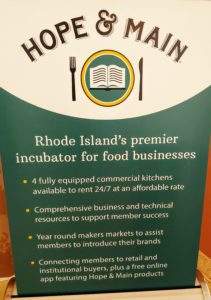
We met at Hope and Main in Warren where local food lovers and entrepreneurs can develop and expand their food business through the use of low-cost, shared-use commercial kitchens and other industry-specific resources.

There are over 50 small businesses working here creating products like: granola, toffee, cocktail mixers, butterscotch sauce, biscotti, dog treats, pickles, kimchi, bone broth, pimento cheese spread, gourmet chocolate and caramel dipped pretzels and sea salt (from the ocean in Newport!) I could go on but check out the member directory on Hope and Main’s website for the full list.

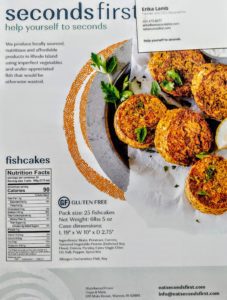
Erika’s specialty? Fishcakes!

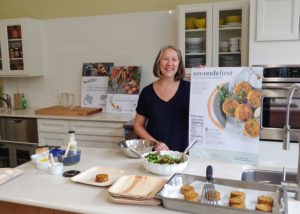
We dietitians were treated to a tour through the kitchen where we saw where the fishcakes are made, cooked and packaged.  Erika showed us all the ingredients and explained where she sources them and why.

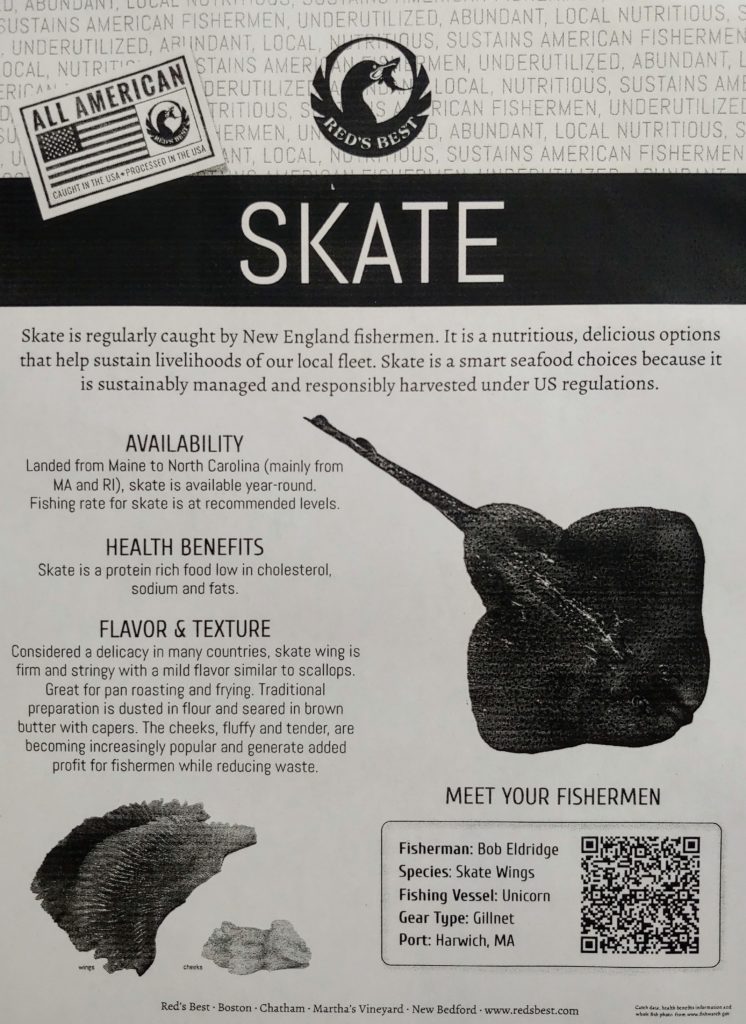
She uses skate as the main ingredient– which is caught locally, is sustainable, tastes amazing, and like all seafood is a rich source of protein and nutrients vital for health.

She also puts to good use locally grown, but misfit/cosmetically imperfect carrots and potatoes that would otherwise likely end up as food waste.

Ever try skate wings?

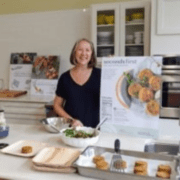
Erika in the kitchen about to serve us her tasty fishcakes along with a fresh salad!

Producing a delicious and nutritious ready-to-heat-and-eat food product like these fishcakes from “seconds” perfectly supports SecondsFirst’s 3 Pillars:

  • No Wasted Food
  • Proteins for All
  • Support Local

Not only is Erika putting her energy into something that’s meaningful to her, she’s positively impacting the environment and helping those who struggle with access to protein-rich nutritious foods.  Organizations like the Jonnycake Center buy her fishcakes and they will be available soon at the Dave’s Marketplace in East Greenwich.

Thank you Erika for all the good you are doing– you are quite an inspiration to me!

August is my birthday month.

Even though it falls in the final week, I start to think about it as soon as I turn the calendar over from July.  I appreciate those few weeks for reflection, mental preparation and the occasional mini-bursts of delight that upcoming birthdays can bring.  It may feel silly to admit it, but doesn’t that anticipation and thrill from childhood still live within our souls to some degree?

Birthdays can really make you think about life and how you got where you are.  Like how did I get to be 45?

I imagine life as this long timeline that goes up to 100.  You could live longer but truthfully most people die at some point before then.  I plot my current number and see how far along I’ve come and wonder what I might have left.   Remembering we aren’t here forever serves as a prompt to check in with ourselves and look at where we are and decide how we would like to take it from here.  If everything is good, then great– we can keep doing what we’ve been doing.  But if not– we can ask ourselves if there is anything that we’d like to change.

And so as the years pass, we live and we learn a few things about ourselves and about life, or so I like to think.

While many aspects of existence will always remain a huge mystery, I know I have acquired some valuable lessons that have helped me to become a happier, healthier person who has found peace with food and my body.

More importantly, this desire for a happy, healthy and peaceful relationship with food, eating and body image are very common themes that I see with my clients in my work.  It would be nice if l could just tell them what to eat and that would solve everything.  But there are beliefs and habits that need to be explored, mindsets to question and while nutrition IS about food, it’s also got a lot more to do with who we are as eaters.

3 Nutrition Lessons I Have Learned

1.  Let go of the idea that there is one right way to eat that applies to everyone. 

Please forget about your quest for the perfect diet.

As beautiful as this concept sounds, give up the search for an answer because it doesn’t exist.

I was on this pursuit for many years, believing that I would learn about the most healthful diet in the world and then educate as many people as I could.  It sounded simple enough.

Yet what I discovered was, as much as I’d like to think nutrition science has uncovered all the answers, it has not.  There are certainly a few agreed-upon fundamentals, but there is also a lot of disagreement among the experts.  And if you’re a nutrition-nut like me, you already know– the more you read the research (and how it’s actually done) and the various theories on which foods are going to prevent cancer and which are going to give you heart disease and kill you– that no one really knows.

Health is about so much more than just food– we’ve all heard about some little old lady who is 103 and eats bacon, ice cream and M&Ms every day.   And just as baffling are the sad stories of health-conscious eaters who exercise regularly but suffer a heart attack at 40.   This doesn’t mean you lose all hope though!

I still believe that a whole-foods diet with lots of fruits and vegetables and less sugar, fried foods and refined grains is the way to go.

But… I learned to lighten up on myself when I DID eat some ice-cream or bacon and stopped believing that I was damaging my health.

Quite possibly the stress and worry that I was eating something “not-good-for-me” was more harmful that actually eating that food.

Once I was able to accept that there is no magical formula for a perfect way of eating, I could turn inward and relax into figuring out which foods worked best for ME and my lifestyle.  Now I know what keeps me satisfied and feeling healthy and I eat to support that.  I learned how to keep myself balanced with a diet of mainly beneficial foods while leaving some room for less-healthful-but-oh-so-yummy foods– and it feels amazing to discard the idea of bad/good foods and to eat in the way that feels right to me.


2.  Be kinder to yourself and stop criticizing your body.

I don’t remember exactly when I learned this lesson but it wasn’t until sometime in my 30s.  That is later than ideal but what breaks my heart is that I see women in their 40s, 50s  and 60s who are still hating their bodies.   If you hate your body, do you think it’s going to be easy to eat in a way that’s nourishing and caring for yourself?

Once I shifted my focus from physical appearance to self-care, acceptance, respect and love, eating healthier became so much easier.

I had to learn that there are some things we cannot change, no matter how healthy we eat or how much we exercise.  Just like our height and our shoe size, we are born with genes for a specific body type and we only have a certain range of control over that.  What can really help is to practice transforming all the energy used disliking certain body parts into gratitude for all you have.

Quit doing the things that make you feel bad about yourself (staring at your thighs in the mirror?) and do more of what makes you feel good about who you are (wearing a favorite shirt or pair of shoes!)

Let go of the need to lose weight or change your body.

Also, I learned to forget about what other people think.  Because… they’re not.

As harsh as this sounds, they could care less if you or I don’t have a flawless body.  Humans are extremely self-absorbed. We tend to live in our own heads and largely stay preoccupied with our own stories (which revolve around us of course).  Know anyone like that?  It took me a while to realize that other people are far too wrapped-up with worrying about what other people think of them to be too concerned with me.  And that’s pretty freeing! 

Focus on doing what you want and being who you are.  Don’t be troubled with what you think other people think.


3.  If healthy eating is important to you, you have to make food a priority.

If it’s not, it’s going to be really difficult to eat well.  Everybody is busy with things to do–  I get it.  There are always excuses that can be conjured up to avoid healthy eating.  But recognize that all those items on your long to-do list have various degrees of priority– where is food and eating ranked?  Once you decide it’s got to take precedence and become a bigger focus, you will find the time you thought you didn’t have.  But you have to make that decision for yourself.

If it’s important enough to you, you will make time to do the planning, shopping, preparing, cooking and clean up.

I had to learn how to reprioritize and do all of these things too.  At first they were new and overwhelming, but they quickly became habits that now come naturally and that I even enjoy.

There was a time when I didn’t eat breakfast, rarely kept my kitchen well-stocked with good food and didn’t plan dinners which resulted in making some pretty poor choices for myself.  When I switched from vegan back to omnivore I had no idea how to cook any type of meat– but learning to do this was important to me and so I figured it out.  Start with something small and easy to accomplish and build from there once that one thing becomes a part of your routine.

When you make food a priority in your life you are putting yourself right at the top of your list and isn’t that where you should be?  

All that being said, there will be those “I just don’t care” attitude days when healthy food may not take precedence and this is OK and completely normal.  This absolutely happens to me too.  Some days are tougher than others (PMS, LOL?)   You haven’t made any mistakes or done anything wrong.  Know that there is always another opportunity to choose different foods right around the corner.

There is never going to be a certain moment in time when you’ll be ready to start.

It’s now.

There is no date in the future when you’ll get there.  It’s always now.

Healthy eating is an ongoing journey, not a destination that you reach one day and that’s it.  Keep your priorities clear, know what is important to you and you’ll be heading in the right direction.

 

This post is for you if you regularly consume artificially sweetened foods and beverages!

For many of you this time between Thanksgiving and Christmas means major anxiety about staying on track with your health goals.  It often brings up fears of losing willpower around sugary temptations and constant stress about weight gain.  And if you’re a diet soda junkie it means slurping down these beverages in an attempt to satisfy cravings and tame your appetite– but could this habit be doing more harm than you realize?

I want to help you feel good about yourself and your life.   I want you to have a healthy relationship with food and eating.  It’s really tough to do this with artificial sweeteners interfering with the natural rhythms of your appetite.

If you have been relying on diet products in hopes of losing weight or controlling your hunger and you have not noticed any positive results– you have to question why you continue to use them.

Be open to the concept that they may be making it even harder for you to lose weight.

Thanks to clever marketing, so many people believe that consuming artificially sweetened beverages or foods will help with appetite control and weight loss.  Hmmmm….yet since their introduction into our food supply and despite millions of people eating and drinking them, obesity is more out of control than ever.

These fake foods fuel the ridiculous myth that to lose weight you must eat as few calories as possible and you must try to suppress your appetite, like it’s a bad thing.  It’s not.  Your appetite is there for a reason and until you make friends with it you’re not going to be at peace.  You respect your body’s urge to breathe, sleep and urinate, right?  You should pay attention to your hunger as well.

Ask yourself this:  Have sugar-free products helped me?  Who am I to tell you something doesn’t work for you if it has?  BUT I am going with what I’ve noticed in everyone I’ve met so far and I have yet to meet someone who has achieved and maintained a healthy body weight through diet products.

What if you got them out of your system and let your body reset itself through nutrition from real foods?  If you’re regularly putting fake sweeteners in your body you can bet that your appetite and taste buds are confused about this ingestion of sweetness without the accompaniment of expected energy (calories).  You can’t trick your body.  Instead you’re only encouraging your sweet cravings to haunt you.

I want you to consider testing out a new approach:

Get artificial sweeteners out of your diet in order to rebalance and regulate your appetite.


I love a good n=1 experiment.  It’s the best way to see how a change will work for you!  Cut out all artificial sweeteners for one month and see what you notice.  What I like about self-experimentation is the idea that you can look at it as a trial period for something new where you can always go back to your old habit if you want to.  You won’t know what will happen unless you try.

I’m not saying to replace artificially sweetened products with those containing corn syrup and white sugar either.  The idea is to learn to not need to taste intense sweetness in everything you eat and drink.

Check out some of this information:

Why Artificial Sweeteners Can Increase Appetite

  • “After chronic exposure to a diet that contained the artificial sweetener sucralose, we saw that animals began eating a lot more,” said lead researcher Associate Professor Greg Neely from the University of Sydney’s Faculty of Science.
  • “These findings further reinforce the idea that ‘sugar-free’ varieties of processed food and drink may not be as inert as we anticipated. Artificial sweeteners can actually change how animals perceive the sweetness of their food, with a discrepancy between sweetness and energy levels prompting an increase in caloric consumption,” Professor Herzog said.

Gain Weight While “Going Diet?  ”  Artificial Sweeteners and the Neurobiology of Sugar Cravings

  • But do artificial sweeteners actually help reduce weight?  Surprisingly, epidemiologic data suggest the contrary. Several large scale prospective cohort studies found positive correlation between artificial sweetener use and weight gain.

  • Preload experiments generally have found that sweet taste, whether delivered by sugar or artificial sweeteners, enhanced human appetite. Aspartame-sweetened water, but not aspartame capsule, increased subjective appetite rating in normal weight adult males.

Artificial Sweeteners Produce the Counterintuitive Effect of Inducing Metabolic Derangements

  • Taken together, data from these recent studies suggest a link between consumption of ASB (artificially sweetened beverages) and a variety of negative health outcomes, including increased risk of being overweight and obesity, T2D, metabolic syndrome, and cardiovascular events, especially in adults.

If you’re diabetic and thinking artificial sweeteners are helpful, you may want to reconsider that:

Artificial Sweetener May Do More Than Sweeten: It Can Affect How the Body Reacts to Glucose


All science aside, simply based on my observations alone, the fake stuff doesn’t help anyone lose weight or improve their health in any way.  Looking around, who do you see drinking Diet Coke and eating sugar-free Jello?  And I don’t mean the models in the advertisements who are there to make you think they look that way because they use artificial sweeteners.  In real life you’ll notice that it is typically those struggling with their weight who consume these artificial products.

Having a healthy relationship with food isn’t about eating and drinking artificially made food-like substances that taste disgusting.  If something doesn’t work and is likely causing more harm than good, it’s time for a change.  A healthy relationship with food has to involve real foods that provide nourishment.

If you’re looking to rediscover and honor your true appetite, come see me and I will help you get rid of these fake foods and into eating the wholesome foods that your metabolism will thrive on.

You don’t need diet products; you need to get back in touch with your natural appetite instead of battling with it.

💗

I have always been fascinated with human behavior and why we do the things we do.  In fact, before pursuing my degree in Nutrition, I originally graduated with a Bachelor’s in Psychology.

Little did I realize at the time how intertwined Psychology and Nutrition truly are.

The food itself is only part of the picture.

Our dietary habits go so much deeper than we realize.  Nutrition is a complex subject and while what we eat and how much we eat matter, it is also crucial to look at the way we eat and why we eat if we want to achieve lasting behavior changes.

It wasn’t long after I began working as a dietitian that it became clear to me that suggesting healthier diet alternatives and limiting portion sizes wasn’t always working.  Clients would leave my office with a clear plan of what to change about their eating habits and come back feeling ashamed and disappointed in themselves for not being able to follow it.  Again and again.  That’s not how it’s supposed to go!

WHY weren’t my clients able to make changes?  WHY did they stay stuck in their old habits?  WHAT was holding them back from working towards their goals?

So I began reading up on anything and everything I could find about behavior change.  Over the years I acquired priceless knowledge and skills from books, podcasts, seminars and largely from experience and practice gained through directly working with people.

And then I came across one especially intriguing website that caught my eye and that I just knew I had to get involved with…. a school that marvelously combines Nutrition and Psychology.

I have just completed my latest continuing education adventure!  I am now an Eating Psychology Coach trained by the  Institute for the Psychology of Eating.  I am not a psychologist, but I am a Registered Dietitian who is very interested in helping you understand what is really going on behind your challenges with food and the message these challenges have for you.


What is Eating Psychology Coaching?

Eating Psychology Coaching is an exciting and cutting edge approach developed by the Institute for the Psychology of Eating.  It effectively addresses weight concerns, binge eating, overeating, body image challenges and various nutrition related health concerns. As an Eating Psychology Coach, my approach is positive and empowering.  I don’t see your eating challenges merely as a sign that “something is wrong with you” – but as a place where we can more fully explore some of the personal dimensions in life that impact food, weight and health.  Oftentimes, our eating challenges are connected to work, money, relationships, family, intimacy, life stress and so much more.  Our relationship with food has important lessons to teach us if we choose to listen.

About My Training

I trained at the Institute for the Psychology of Eating, the world’s leading school in Nutritional Psychology where I received my certification as an Eating Psychology Coach. In IPE’s internationally acclaimed program, I learned powerful tools and protocols that enable me to work with weight issues, body image challenges, overeating, binge eating, and a variety of nutrition related health concerns such as digestion, fatigue, mood, immunity and others.  The skills I use from this training are a combination of practical coaching techniques, results-oriented psychology, clinical nutrition, body-centered practices, mind-body science and a positive and compassionate approach to challenges with food and health.

How is My Approach Different?

For far too long, we’ve been inundated by negative messages about food, weight and diet. We’ve been told that we’re willpower weaklings or that we need more control.  The majority of nutrition experts promote conflicting advice.  The result is people are confused about what to eat and how to have a happy relationship with food and a healthy metabolism.  In my professional practice, I combine many of the best strategies from nutrition science and eating psychology.  By eliminating all the “shoulds” and “should nots,” I focus on what’s right for your body and your personal style.  As we work together in this way, eating and health issues become a place of exploration.  Instead of seeing such challenges as the enemy, they become opportunities for growth and self-improvement.
I believe in helping you reach your highest goals not by strategies that punish, but through strategies that nourish.  ♥

f9b8a3b14ef1400cd58453ef9610eda3

I’m so excited to turn my calendar over from February to March tomorrow…

20 days til spring!

This means it won’t be long until we start seeing GREEN everywhere.   While I love seeing green in nature, I don’t love seeing fake-green drinks that come out in celebration of St Patrick’s Day.  No Shamrock Shakes or green beer on this dietitian’s blog.

Instead I’ve got something just as green, but more delicious and most definitely more nutritious. Matcha!

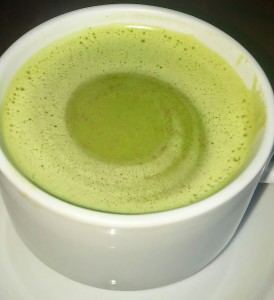
matcha cup2

Matcha is green tea– but not like the green tea most of us are used to.  You don’t steep it; it doesn’t involve a tea bag.  It is finely ground Japanese green tea leaves that you dissolve into hot water and drink.  It’s perfect for when you want something with a little more body and depth than regular tea.  You get all the health benefits of green tea…multiplied.

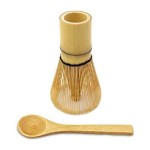
There are traditional ways of making a cup of matcha that involve a bamboo scoop and whisk:

bamboo

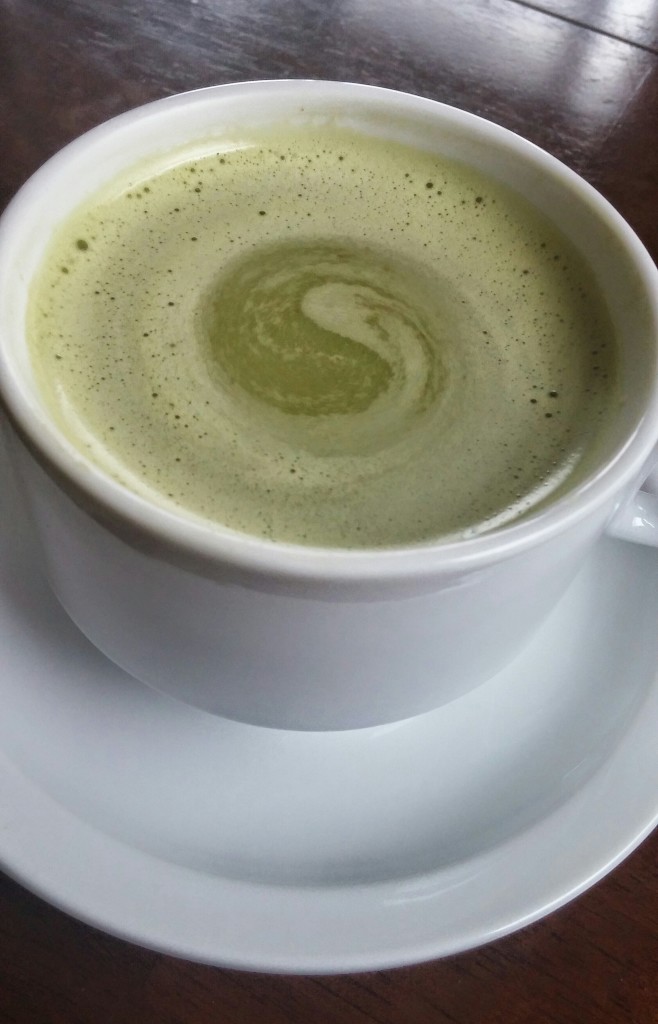
I don’t have these things but I’ve created my own tradition:  What I love to do is blend up 1 teaspoon of matcha with 2-3 tablespoons of coconut milk, 1 medjool date and about a cup or so of hot water.   The Vitamix smoothly incorporates everything and leaves a little frothy top layer.   Tip:  Use the thick coconut milk from a can, not the thinned out drinkable type.

matcha cup


Isn’t it gorgeous?!

Matcha tea leaves are shade-grown resulting in more chlorophyll than regular green tea and a brighter green hue.


Matcha isn’t cheap but it’s an indulgence that I think is worth it.  The first time I ever had matcha was while visiting Seattle about 10 years ago.  They had it in a cafe and I fell in love with its richness and flavor.  Back in RI I could only find one brand at Whole Foods and it was this tiny container for something like $25– I don’t remember exactly but I do know I didn’t buy it and then unfortunately forget about it for years.  Now, there are several tea brands that sell matcha and it’s not quite as pricey.

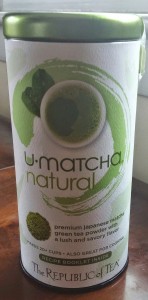
This is the one I have from The Republic of Tea:

U-Matcha can

And now for what you’ve all been waiting for….the health benefits of matcha!  It’s more potent than your usual green tea.  Because you are ingesting the whole, ground tea leaf rather than steeped tea leaves, you are going to get more of the nutrients found in tea:

  • L-theanine (an amino acid):  Can help with focus and concentration while also promoting a sense of calm.  Think of monks drinking green tea and meditating.  🙂
  • Antioxidants:  Contributes to combating inflammation and oxidation.
  • EGCG: A phytochemical that is associated with a decreased incidence of many types of cancer and also supports brain and heart health.
  • Caffeine:  Less than in a cup of coffee and with the combination of the L-theanine promotes a calm-alertness and mental clarity.

There are SO many health reasons to drink green tea…plus it can be a super mood booster. 💚

I can’t think of any benefits to the Shamrock Shake unless you’re looking for 790 extra calories and 112 grams of sugar ?!?!  (in a large)  OK, well perhaps as a very occasional treat… and consider ordering the small.

And if you absolutely MUST have green beer for St. Patrick’s day:  Avoid the artificial food dyes and try one of these 5 Peculiar (and natural!) Ways to Turn Your Beer Green  from TIME– number 3 being matcha!

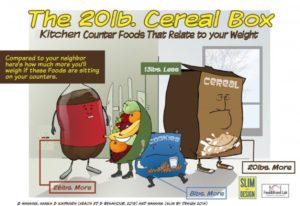
cereal

Keep boxed cereal or bottled soda on your counter?🥤 How about cookies? 🍪

According to this study, you likely weigh more than your skinny neighbors who keep fruits on the counter. 🍎

“It’s your basic See-Food Diet — you eat what you see,” said lead author Brian Wansink, professor and director of the Cornell Food and Brand lab and author of Slim by Design: Mindless Eating Solutions for Everyday Life.

Look around your kitchen and see what you’ve got sitting out in plain sight.

Your habits may be impacting your health in a way you never realized.

If you see fruit– good for you! If you see highly processed foods– you may want to make some changes if you are trying to lose weight.

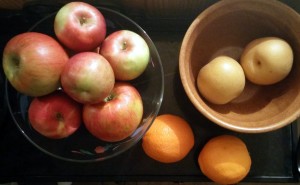
A random shot of my counter is going to definitely include a few types of fruit.  Right now I’ve got a full bowl of apples, a couple of oranges and a couple of asian pears. 🍎🍊🍐

1021150642-1

Bananas– always!  🍌

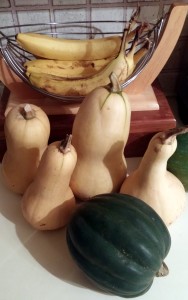
I also keep squash on the counter.  It wouldn’t be unusual to see a few potatoes and sweet potatoes too but I’m out.

1021150643b

Over here I’ve got some bone broth going in the slow cooker from the bones of the chicken I oven-roasted last night.  I let it cook for about 24 hours before jarring up the broth for the freezer.  More on bone broth in the future!

1021150645

What you won’t find on my counters is any soda, boxed cereals or packaged cookies.

➡️ If it’s not there, you won’t eat it (or less likely!)  Simple as that.

Make things easier for yourself by not keeping certain less-than-healthy foods where you see them every time you walk by the kitchen.

This one little change could make a big difference.

Create a new habit if you don’t already have it:  Buy some fresh fruit! 

🍇🍉🍊🍋🍎🥭🍌🍏🍐🍑🍈

A few ideas to consider include:  apples, bananas, cantaloupe, clementines, grapes, grapefruit, honeydew melon, kiwi, lemon, limes, mango, nectarines, oranges, papaya, peaches, pears, pineapple and pomegranate.

Fruits are gorgeous out on the counter (prettier than bags of processed carbs and plastic bottles of dyed sugar-water, right?)… and a nutrient-dense choice.

Surround yourself with the things that support your intentions and skip the stuff that doesn’t.

Book called Food A Love Story, cover has Jim Gaffigan and a hot dog.

Food and laughing.  🍽️ 🤣 Two of my very favorite things in life.  If you share similar interests I have a book you need to read.

I had never heard of Jim Gaffigan but he’s my new favorite comedian.  Imagine Jerry Seinfeld going on about nothing but the intricacies of food and eating.  This book is totally hilarious and leaves you wondering how someone thinks up this great stuff.

With all the seriousness and stress so often involved with eating right, this book is a breath of fresh air that WILL cause you to laugh out loud.  We all need to lighten up a little and laugh more, don’t you think?

Sometimes when I don’t have a book on my reading list I go exploring for one.   My favorite place is at the bottom of the staircase of my library where the “New” books are stocked.  I know the precise section where the food/eating/nutrition/health/wellness/diet books are found and that’s where I check out what looks interesting.  That’s how I came across Food: A Love Story by Jim Gaffigan.  Not my usual type of reading but I like food and I like funny so I picked it up and am happy I did.

Jim writes about things like how prior to ranch dressing nobody had ever eaten a raw vegetable and how an outdoor barbecue to him just means “Let’s make the food more accessible to insects.”  He’s got some incredibly funny insight into everything from McDonald’s to Whole Foods Market to Donuts to Chinese food.  Just about anything to do with food takes on an entertaining spin in this book.

👍🏼👍🏼Two thumbs up from me- highly recommended for many giggle-out-loud moments.

The library is also an underused resource for education.  I have gone to several fascinating talks on topics like Wickford History and Wild Animal Rehabilitation– where they brought in live owls and falcons.  When I found out there was going to be a talk on Edible Wild Plants I signed right up.  This talk was given by Brett Mayette who is amazing and has reminded me that there is another side to food that I don’t know enough about.  As much as we have available to us, we have very low diversity in our diets compared to our ancestors who had to forage for food.  There are so many wild plants growing in abundance all around us that are nutrient-dense but we just don’t eat them because we are simply used to buying our food from a store.

Dandelion and violets.🌻 The idea of gathering nutritious foods right in my yard fascinates me.  I have a memory of my stepmother telling my sister and I that dandelions are edible and she proceeded to pluck one from the lawn and eat it as we stood by grossed out.  Well, apparently she knew exactly what she was talking about.  (this is the same woman who drinks the water in the bottom of the pot after steaming or boiling veggies.  Smart lady.)  And there is a whole world of healthy seaweed too– they are rich in  vitamins and trace minerals that can contribute to better health.  Brett left me making a major note-to-self to read up on edible wild plants and seaweeds!

According to the University of Maryland Medical Center, dandelions are full of vitamins A,B,C and D and a source of minerals such as iron, potassium and zinc.

Throughout May, dandelions and violets were everywhere in my yard.  I’ve tried a few.  🙂 Once I got over the initial fear of poisoning myself, I realized they taste pretty good.  The violets are sweet.  The dandelions have a slight honey taste.  And the greens are bitter but in a good way and are supposed to be super for digestion.  We don’t eat enough bitter anymore.  Plus it feels primal to pick food, which (to me) is cool.  I spent some time squatting down picking flowers and their leaves to make this little bowl and you know what?  It’s work.  It makes you appreciate how much effort is involved with food gathering.  It’s kind of frightening if you think about the idea of something happening to our food supply and everyone having to figure out how to hunt and gather their own food.
Which reminds me of Mr. Gaffigan (who does NOT like fruits, vegetables or seafood) talking about blueberry picking:  “Picking blueberries is not like picking pumpkins.  It’s not like, “Hey I got one.  Let’s get the hell out of here.”  With blueberries you are never done.  Even after three hours you tell yourself things like Uh, I got four.  We could make a muffin.  There’s got to be a machine to do this!”…  🙂

Dandelions and violets on salad greens.I am desperately hoping my blueberry bushes actually produce blueberries this year!

I can’t find a website for Brett Mayette but I did find this article from last August called Where the Wild Things Are if you’d like to learn more about him and his wild plant walks and cooking demos.  He’s clearly passionate for what he’s doing and you’ll catch that infectious energy just listening to him.

There is so much we can learn and benefit from by incorporating edible wild plants into our diets.  Thanks for all you do Brett!


Pot of beef stew.

It’s almost my 1 year anniversary as an ex-vegan.

My first bite of meat was homemade beef stew and it was amazing.  I could feel the nourishment immediately and my conclusion still stands that I feel better eating meat.

Over the past year we’ve made this beef stew a few times, especially in the cold months.  It’s become one of my favorite meals.  There was a time when I would have cringed at the thought of eating *gasp* “red” meat with all its “artery-clogging saturated fat.”  🙂  I’ve since changed my perspective on this.

“Artery-clogging saturated fat”– funny how saturated fat always seems to be found in that phrase.  That is just one more tidbit unfortunately ingrained into newly forming dietitian brains in school that turned out to be highly questionable.  Sure, animal products are a source of saturated fat, however it’s not usually mentioned that the majority of the fat found in beef and pork is actually mostly monounsaturated (even in chicken skin!)  That’s right; the same “heart-healthy monounsaturated fat” famously found in olive oil.   Another thing many people don’t understand is that fats found in food are made up of a blend of monounsaturated, polyunsaturated and saturated fat– but are typically labeled simply as one or the other based on the dominant type.  So, there is actually saturated fat in your precious olive oil just as there is monounsaturated fat in your “unhealthy” butter.  It’s just one more thing that nutrition science has oversimplified but which ended up confusing people even more.


And is saturated fat really that unhealthy anyway? Saturated fat has got to be one of the hottest controversial topics in the nutrition community, particularly over the past few years.  There have been research studies bringing it’s perceived danger into question, several books challenging the dogma and many, many medical professionals speaking out about it.  The debates rage on between the experts.  As desperately as I want definitive answers, what I’m coming to accept is that we simply do not know.

Despite most everything we were taught about the link between saturated fats and heart disease, you’ve got to wonder based on things like:

2010 Meta-Analysis evaluating the association of saturated fat with cardiovascular disease:  A meta-analysis of prospective epidemiologic studies showed that there is no significant evidence for concluding that dietary saturated fat is associated with an increased risk of CHD or CVD. More data are needed to elucidate whether CVD risks are likely to be influenced by the specific nutrients used to replace saturated fat.

2014 Meta-Analysis of association of fatty acids and coronary risk:  Current evidence does not clearly support cardiovascular guidelines that encourage high consumption of polyunsaturated fatty acids and low consumption of total saturated fats.

I could talk about saturated fat for days, for some reason it totally fascinates me.  I guess I just love a good controversy and I have spent more mental energy learning (obsessing would be a better term) about the topic than I care to admit.   I’ve read enough of the literature to convince me not to worry about saturated fat in my diet anymore– in the context of a healthy, whole foods diet I believe it to be perfectly fine.  However, eat a lot of it in a diet high in refined carbohydrates and highly processed foods and then you may have problems.  This is just what I believe is right for my body.  Understanding that there are various opinions and choosing what works in your situation is crucial.

Now let’s move on to making some lovely healthy saturated-fat rich beef stew!

0124151818

Beef stew, homemade by Chris, was my first taste of meat (aside from fish) after about 14 years.  I still remember the night.  And how good my body felt after eating it.  A big pot of it takes some preparation and planning but it provides many meals for the week.  It freezes well too.

Real Food Ingredients:  Local grass-fed beef, bone broth, carrots, celery, onion, potatoes, red wine, spices.

Let me be clear that this is not a recipe with measurements or exact steps!  Just guidelines.. but that’s all you really need.

You will need to thaw out your beef ahead of time.  I’ve only seen frozen meat available from our local farms.

0124151219b


This is from Watson Farm in Jamestown, RI.  Stew beef and shanks are what we used.  A good reason to use the shanks is to take advantage of the nutrient-dense bone marrow which seeps into the stock as it cooks.  You can also use other cuts like short ribs.


0124151217


Chop up your veggies.

A few carrots, celery, onion and potatoes or any others you want to include.


These are the spices we used but it changes each time.  Remember, there is no “recipe” here– just cooking!

0124151443


Dried garlic, Italian seasoning blend, celery seed, chili powder.  Red wine too!


Now that you’ve got the ingredients out, the first thing you do is brown your beef in a little olive oil.  Add some salt and pepper to the beef.  The stew beef was cut into chunks; the shanks were browned whole.  Cook on medium-high heat for a few minutes on each side, until they turn brown.

01241514450124151448


01241514380124151441


Remove the browned beef and add some red wine to deglaze the pot.

Deglazing the pot.

Add veggies to the wine/oil, add spices as desired and mix.  Then add bone broth a little at a time and finally the cooked meat.  Add 2 bay leaves and any additional spices if desired.

Pot of beef stew.

Cover and bring to a simmer until you generate steam when removing the lid. Place covered pot in 300 degree oven for 3 hours:

01241515110124151514


How delicious does this look??  Remove the bay leaf and bones.  The meat should generally fall off the bone but will need to be cut or pulled into smaller chunks.

0124151814a0124151818b


A balanced meal:

Bowl of beef stew with a salad.


I just spent a good chunk of last week and weekend watching as many of the speakers from The 2015 Diabetes World Summit that I could.  It was quite fascinating with 40 presentations including many MDs, NDs and RDs, most not of the typical mainstream variety, but instead taking a functional medicine approach which totally resonates with me.   I think more than any specific information, what I got out of it the most was that it made me realize that I need to relax a bit into the fact that there is disagreement in the nutrition community regarding the ideal way to eat.  This is hard for someone like me who works with people who want to know exactly what to eat and who wants to give them the most evidence-based, up-to-date nutritional information.

There are various paths to health. Everyone’s got their own point of view, many certainly believing quite strongly about theirs being the right one!  But  there is no denying that there are some major disagreements among health professionals.  On one extreme you’ve got the vegan or near-vegan route.  Dr. Fuhrman and others of similar mindset strongly believe in a diet with minimal animal products.  This clearly can work, as their patients have had immense success eating this way.  On the other hand, you’ve got a quickly growing number of doctors and dietitians who take a more ancestral, paleo or low-carb approach, each with excellent results as well.  Some may shun dairy while others include pasture raised dairy products like butter, cheese and yogurt.  There isn’t complete agreement about eating grains or beans either.

However, there are things that everybody DOES agree on:  Avoiding highly processed foods like refined grains, sugars and oils.  And eating more fruits and vegetables.  Maybe it’s time to focus more on what everyone has in common and not obsess over the differences.

All that being said, the bottom line is…  nobody knows exactly.  We may never figure it out.  Experts on both sides of nutritional controversy can easily show pages of research to defend their stance.  It’s surprisingly easy to back up just about any personal belief with some sort of scientific data.  It’s beyond frustrating when you want real answers, trust me, I know.   Instead of making ourselves crazy with all the back and forth, what about loosening up and accepting the fact that there is uncertainty?  What about going with what truly feels right for you and your body?   There is no cookie-cutter, one-size-fits-all diet for everyone.

What’s more, health is about so much more than just what we eat.  There’s no way we can focus only on food and not other aspects of life like:  sleep, physical activity, relationships and managing stress.  They are all intertwined and all relate to health.