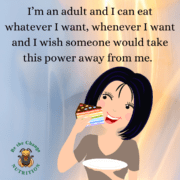
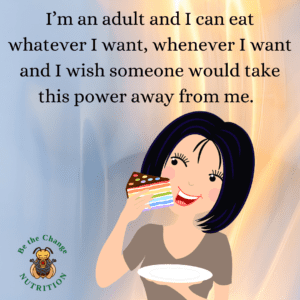
Woman eating cake with quote: I'm an adult and I can eat whatever I want, whenever I want and I wish someone would take this power away from me.

Let’s be honest: that quote is both hilarious and heartbreakingly accurate.

As a registered dietitian, I meet people every day who feel overwhelmed by their own freedom. The fridge beckons. The snacks whisper. Suddenly, dinner is popcorn with a side of ice cream.

🔓 Adulting: Where You’re the Boss and the Boss Is Tired

Most adults don’t lack food access—they lack bandwidth. Between work emails, late-night scrolling, and existential dread, cooking feels like a chore and eating becomes reactive instead of intentional.

We’re not hungry. We’re scattered.

🧠 Unlimited Choice Can Feel Like Unstructured Chaos

Without some gentle guardrails, “freedom” starts looking like an endless buffet of nutritional confusion. Decision fatigue sets in. Our brains crave predictability, especially around food. And those tiny choices—what to eat, when, how much—start stacking up like unread emails until we hit decision burnout.

This is where mindful eating comes in.

🥢 Mindful Eating: Reclaiming Peace at the Plate

Mindful eating isn’t a diet. It’s awareness. It’s noticing your food, your hunger cues, and your emotions—without judgment and without the TV blaring reruns of chaos.

Here’s why it matters:

✔️ Slows down the frenzy: When you eat slower, you notice satisfaction earlier.

✔️ Reduces autopilot munching: Goodbye, mindless cracker attacks. Hello, intentional bites.

✔️ Builds connection: You tune into your body, emotions, and even gratitude.

You don’t need to lock up your snacks. You need a moment to pause and ask:

Am I hungry, or just tired?

Is this delicious, or just there?

🌿 A Few Mindful Practices to Try:

👉 Put the phone down. (Yes, even mid-scroll.)

👉 Sit down to eat—even snacks.

👉 Check in with hunger before and after.

👉 Appreciate textures, flavors, even memories tied to your food.

Mindful eating gives structure to freedom—and makes that cereal-for-dinner moment feel a little less like chaos, and a little more like choice.

📆 Structured Freedom: Dietitian-Approved Adulting

You don’t need someone to take the power away—you need someone to help wield it wisely. My motto? Structure without shame. Here’s what that might look like:

⭐ “Default meals” you love and that nourish you (think: go-to lunches you don’t overthink)

⭐ Snack boundaries, not bans (i.e., “fruit first, then chips” vs. “no snacks ever”)

⭐ Self-check-ins, not guilt spirals (asking: “How do I want to feel after this?”)

This isn’t a diet. It’s adult snacktime…with a blueprint.

✨ Final Thoughts from Your Friendly RD

You can eat whatever you want. That’s the blessing and the curse of being an adult. But you deserve to feel good, too—physically, emotionally, energetically.

If you’re craving a little help navigating all this, know this: structure isn’t control. It’s compassion. And it’s okay to want a little guidance. That’s what dietitians are for…

…with the ultimate goal of YOU cultivating the inner trust and confidence to be at peace with making your own eating decisions!
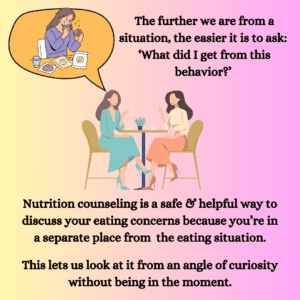
woman talking with a dietitian

In the moment, all you may feel is that you’re spiraling out of control. 

And then the shame sets in. You vow you’ll never do that again. 

You promise yourself, “Next time will be different.” And yet, the cycle continues.

But here’s the gentle truth:

If we only focus on resisting the behavior without understanding the ‘why’ behind it, we’re missing the message. These patterns aren’t random. They’re messengers– signals pointing to unmet needs or unhealed parts of ourselves.

So instead of restricting, what if we paused? What if we got curious?

Ask yourself:
– Was I running on empty– physically or emotionally?
– Was I looking for comfort, distraction or relief?
– Was I denying myself something I truly enjoy, creating a sense of scarcity or rebellion?

These aren’t excuses. They’re clues to learning about yourself.

Every unwanted eating behavior holds a kind of brilliance.

Whether driven by biology (like blood sugar dips or chronic hunger) or by psychology (like stress, loneliness or perfectionism)– it’s all worthy of compassion and reflection.

Instead of beating yourself up, try asking: What was I needing in that moment?

Because behind every behavior is a need.  And every need deserves to be met with kindness.

Unless you address the root cause of unwanted eating behaviors, they will tend to repeat themselves.

You don’t have to decode it all on your own.

Nutrition counseling creates a nonjudgmental space to explore your patterns, rebuild trust with your body and reconnect with your inner wisdom.

So let’s get curious and reflect rather than restrict and resist. 

Figuring out the reason will help you find a solution.

There is freedom in understanding, not in trying to control.

“Nothing ever goes away until it teaches us what we need to know.” -Pema Chödrön

logo and note that i'm celebrating 10 years!

Wow, can you believe it?

I am thrilled to be celebrating an incredible milestone this June…

Ten amazing years of providing nutrition counseling services at Be the Change Nutrition in North Kingstown, Rhode Island!

Ten years ago I took a leap of faith and started my private practice. After gaining experience working as a registered dietitian in a physical therapy rehab clinic, a cardiology office, as a virtual RD for FitDay, a nutrition writer for Livestrong and at a local nutrition private practice, I decided it was time to set out and do my own thing.  As I celebrate this ten year mark, I find myself reflecting on the lessons learned, all the wonderful people I’ve met and the growth I’ve experienced– both personally and professionally.

Over the past decade my passion for helping people lead healthier, happier lives has only grown stronger. It’s been an absolute joy and a privilege to witness the transformative power of good nutrition firsthand, seeing my clients gain energy, confidence, self-awareness, improved health and a newfound love for nourishing their bodies.

I want to take a moment to express my deepest gratitude– to my clients, my colleagues, my mentors, my family and everyone who has supported me along the way. Your trust, encouragement and dedication have made this adventure so meaningful.

Here are 10 powerful lessons I have learned from guiding others in their health journeys:

🫶 Self-compassion is key: People often come to me with the belief that they need to hate and criticize themselves into change– but I’ve seen that the most successful transformations happen when my clients give themselves grace and self-care instead of guilt, shame and self-loathing.

🪜 Small steps lead to big results: Change isn’t about drastic overhauls; it’s about sustainable shifts and consistency. Nutrition isn’t about chasing perfection; it’s about progress, patience and building long-term, practical habits that feel good and support lasting well-being.

✨ Nutrition is not one size fits all: There is no one perfect way to eat. What works for one person may not suit another. Generic diets often fail because they don’t account for personal preferences, making individualized advice more practical and sustainable. Getting to know each client and providing them personalized nutrition is essential.

🍪 There are no ‘good’ or ‘bad’ foods: Any food can fit into a healthy diet. It’s all about creating balance, not restriction. Labeling foods as good/bad can lead to an unhealthy relationship with food and eating. Focusing on moderation, variety and nourishment allows for a more positive approach to health. Overall dietary habits are what matter the most.

📝  Meal plans aren’t helpful: Everyone thinks they need one, but in reality, few actually stick to them. Clients need guidance, but not a strict diet plan. Instead, it’s more useful to help them build the knowledge and confidence to make flexible, independent choices about food, so they can customize their nutrition in a way that works for their lifestyle.

💪 Weight loss does not necessarily equal happier and healthier: The scale isn’t the ultimate measure of success. And with up to 70% of body weight being determined by genetics, there is only so much that is controllable. Dig deeper and ask WHY weight loss is a goal. Improved strength and stamina, restful sleep, better digestion, mood balance, increased energy, elevated self-esteem, optimized metabolic health markers and a commitment to self-care matter far more than any number on a scale.

🥰 Food should be nourishing, not punishing: Helping clients build a positive relationship with food has been one of the most rewarding aspects of my practice. Food is more than just fuel; it also carries emotional, cultural and social significance that impacts eating habits. Connect with the body through trust, respect, kindness and honoring its cues. Food is meant to nourish, satisfy and bring pleasure, not be a source of fear, confusion or stress.

🤗 Behavior change is the real challenge: Knowledge isn’t usually the problem– people generally know that they should eat healthier. Working with clients to navigate emotional eating, unhelpful habits and motivation struggles is just as important as teaching them about macros and micronutrients.

🎯 A supportive partner is a game changer for success: Having the accountability of meeting regularly with a dietitian helps staying consistent with healthy changes far more achieveable. Instead of feeling stuck, clients gain practical solutions to overcome obstacles. Rather than having vague goals like ‘eat healthier,’ dietitians help set specific strategies that lead to measurable success.

💞 Health goes beyond diet: Health isn’t just about the food on your plate; it’s about how you feel, how you move, how you rest and how you show up for yourself.  Movement, stress management, sleep and mental wellness all play crucial roles in overall well-being. Nutrition is so much more than just ‘eat this, not that’– it’s about balance, mindset and creating a lifestyle that aligns with whatever your personal values may be. And it’s about finding joy in the process!


Here’s to the next decade of helping others embrace healthy living and become their happiest, healthiest selves!

Thank you for being a part of my life. ❤️

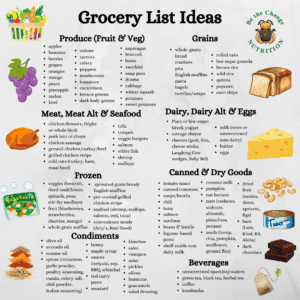
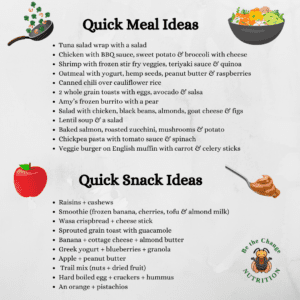
grocery list ideas, broken down by category

 You wouldn’t believe how often I hear:

“I don’t know what to buy when I go to the grocery store.”

So, here you go: A printable grocery list!

I put together a list of foods by category to provide some IDEAS.

 I also included some quick meal and snack examples using foods from the shopping list.

There are dozens of other meals/snacks you can create by combining items on the list.

list of quick meal ideas

 Stock your pantry, fridge and freezer with as much VARIETY as you can– You’ll have that many more options when it comes to preparing something to eat.

🤔 Do you need to buy everything on the list? No!
👉🏻 It’s meant to give you IDEAS and inspiration. Don’t feel you need to buy things you don’t like.

🤔 Are there things not included on the list that you can buy? Of course!
👉🏻 Shop with the 80/20 rule in mind (same with when you eat), meaning aim for 80% of your foods to be wholesome, nutrient-dense choices and 20% to be fun, pleasurable, foods that you eat just because you truly just love them! 💗

Happy shopping🛒

Print your Grocery List with Meal Ideas HERE

Girl with cup of tea looking out window with the quote: Every day is a fresh start..The first day of 2025… Exciting!!
I am all for the fresh start that a new year brings.
And for the hopes of self-improvement, self-care, healthier habits, growth, positive change, etc.

But here’s what I find so interesting:
We can have that “New Year” inspiration ANY time we want it…

Life is a journey that frequently gets out of balance for all of us. There are meals we regret eating and entire days when we feel awful about our habits. Often this can spiral and we get discouraged.

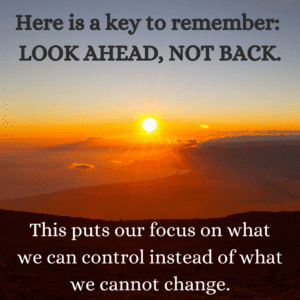
Sunrise with quote: Look ahead, not back. This puts our focus on what we can control instead of what we cannot change.

Dwelling on what has happened brings up feelings of shame, anger, guilt, inadequacy, disappointment, etc. These are powerful emotions that make you feel stuck and keep you from changing direction.

Instead, look ahead! You don’t even have to wait until tomorrow.

👉🏻Use this tip for whenever you have ventured off of your wellness path and need to get back on:

Come up with a  behavior consistent with your health values that you can do as soon as possible. Mindlessly overate potato chips in front of the computer? Just think ahead to your next meal. Decide what that will look like. Plan it out the way you want it to be and consider how you want it to make you feel. 

Every new BREATH is a fresh start too! You can reset your intentions with your next exhale.😮‍💨

This kind of attitude produces feelings of hope, compassion, optimism and a chance to start again.
You will feel better immediately because you’re taking what you’ve learned from the past, letting it go, and looking ahead to what you CAN control and change.

Whenever you’re feeling stuck, remember that you always have the next moment to choose your fresh start.🥰

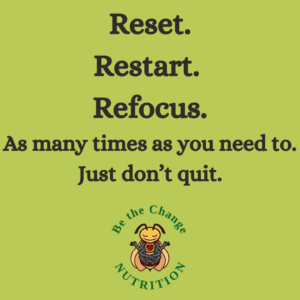
Reset. Restart. Refocus. As many times as you need to. Just don't quit.

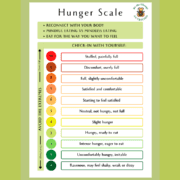
printable hunger scale.

Years of dieting can cause a disconnection from your internal signals.

A Hunger Scale is a tool to help you connect to your hunger & satiety cues.

It’s a way to increase awareness, which is the first step towards behavior change.


3 Ways a Hunger Scale can be helpful:


1️⃣ Do you go too long without eating, often finding yourself at a 0-2?

Use it to check in with your body earlier to notice signs that you need to eat.


2️⃣ Do you tend to overeat to the point of feeling uncomfortable (8-10)? 

Use it to check in with your body while you are eating to learn when you’ve had enough.


3️⃣ Do you find yourself mindlessly reaching for food between meals?

Use it as a pause button to check in with your body & identify what’s triggering the urge to eat.

The scale can help you decide if you need food or if you are actually comfortable and could respond differently.


 Aim to stay within 3-7 most of the time.

That being said, there are going to be times when you may need or want to eat when you aren’t hungry and that’s ok.

There are going to be times when you eat beyond a 7 and that is ok too.

There are many factors involved besides hunger/fullness when it comes to eating.

Look at it as a tool to get curious & gain insight into your habits and behaviors.

At first you may not know how your body feels or what it needs.

Practice and it will get easier and easier.


💗 Reconnect with your body and eat for the way you want to feel!💗


Print your FREE Hunger Scale here!

Did you know that most health insurance plans will cover appointments with a Registered Dietitian?  😃

Are you trying to lose weight but can’t seem to change your habits? 😩  

Or maybe you know that your health issues would improve if you changed up your diet? 🍽️

👩‍⚕️  Many people hear from their doctors that they should lose weight– but most doctors aren’t taught to discuss diet and nutrition with patients.  While doctors do wonderful work, the majority of doctors do not have the time to spend with you to discuss HOW to go about losing weight or manage your health concerns through diet.

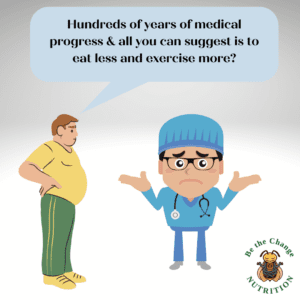
Man asking doctor: Hundreds of years of medical progress and all you can suggest is to eat less and exercise more?

Typically the most you’ll hear about what to do about your weight is depicted in the cartoon above. 

The “eat less and exercise more” message sounds great in theory, but honestly, how is it working for you?

🆘 This is where a Registered Dietitian comes in. 

A dietitian will take an assessment of your eating habits and come up with a plan tailored to YOU.  This plan will focus on habit changes designed to get you where you want to go in respect to your health and weight goals.  Having a plan is half the battle.  The other half is the accountability and support that follow-up visits provide.  Here is where your progress is monitored– and if you’re struggling, you’re going to leave the session knowing exactly what you need to do to get moving in the right direction again. 👍

If you’ve been stuck trying the same tactics and they aren’t working, consider having a trained set of eyes look at your diet and eating patterns and work with you to make positive changes in your life.  You don’t have to figure these things out alone.  And if your insurance will pay for it– how can you not take advantage of that benefit?  😍

Insurance plans vary with many covering an unlimited number of sessions while others cover a set amount.  A few have co-pays and certain plans will only cover specific diagnoses.  Call the number on your card or go online to find out the details of your individual plan.  Or reach out to me and I will look into your plan for you.

Looking forward to seeing you soon!


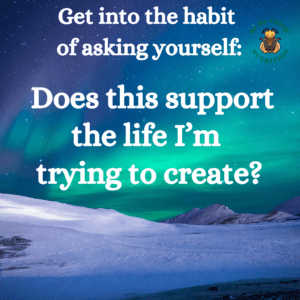
Motivational quote saying: Get in the habit of asking yourself, Does this support the life I'm trying to create?

Are you living in alignment with the person you want to be? 

In other words, do your habits and behaviors match your values?  We all have values in life.  These are our internal beliefs about how we want to live.  They can get hidden, pushed down and altogether forgotten about in our busy, often chaotic lives.  Bringing them into awareness helps you make choices based on what is important to you.   But first– you have to know what is important to you.

The clearer you are about your values, the less confusing it is to make decisions and the more natural it feels to make the changes in your life that you want to make.  Knowing your values gives you a reason, a motivation and a road map to live your life the way you envision.  When your actions aren’t in accordance with your core values, there is a sense of disconnect and your life feels out of balance.

Health is (of course!) one of my values.  So are:  joy, love, peace, patience, gratitude and kindness (just to name a few).  These are all things that are important to me and so I practice making them the building blocks of my world.  Health– staying physically and mentally as strong as I can as I age, is a huge one for me.  I want to prevent injuries, go out and run on the trails, maintain my strength and my independence, and keep my brain functioning for as long as possible.  Because these things are so meaningful to me, I work hard at balancing my life to prioritize eating and exercising in ways that feel good to me.  And when I eat too many of the wrong things for my body or don’t run or stretch for too many days, I feel off-balance and unhappy.  Health as a core value redirects me right back into the habits that help promote who I truly want to be.

Health is likely a value to you too, if you’re reading this!  Acknowledge that and own it– and take a look at your other values and notice how they connect with your health goals.  If kindness and love are your values, is your self-talk reflecting that?  Are you honoring and respecting your appetite?  How about joy– are you allowing yourself to enjoy the foods that bring you pleasure?  Patience and peace– do you slow down, connect with your body and trust that health is an ongoing journey?  Gratitude– can you feel thankful for all the wonderful things about your life? 

So much to ponder, but as 2020 winds down, think about your values and ask yourself if they are guiding you. Be aware of the difference between listening to your own heart versus voices of others saying you should do this or that.  Pay attention to what is truly important to you and let 2021 head into a new direction if you need it to.

Motivational quote about listening to your heart about what is important.

Sometimes a new client *thinks* they want a meal plan.

It’s easy to believe that if you have what, when and how much to eat all written out for you, you can just do it and reach your goals.

The concept makes perfect sense.

Except for that one part “do it.”

While intentions are there, in reality, people don’t follow meal plans.

And for the same reason that they don’t follow diets for long.

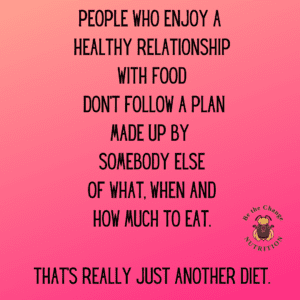
Meal plans are somebody else’s version of what to eat for each meal, when to eat and how much to eat.

They don’t address YOUR unique life routine, preferences, challenges and the reasons why you haven’t been able to achieve your health goals.

You’ll need guidance, but not a meal plan.

We’ll talk about planning out your meals, how to better balance them, ideas of when and what to eat, when and if to include snacks, how to listen to your body, eating to feel good and have energy, changing any unwanted eating habits, new recipes to try if you want them and whatever else you need to get you on the path towards your goals.


Take a look at how being given a meal plan differs from nutrition counseling:

Meal Plan

Nutrition Counseling

-Too much change too fast. It’s an entire diet overhaul which is far too much to change at once, overwhelming and not sustainable.

-Implements smaller changes to your diet and builds on those successes to keep you going for the long haul. No complete diet overhauls.

-3 new meals/day for the week equals 21 new meals to buy ingredients for, prepare and cook–all completely different from what you are used to eating. Yikes– not realistic.

We take your diet from where it is and plan out improvements. As your dietitian, I review your eating habits with you and we come up with strategic changes that are achievable and realistic.

Rigid and impersonal: No account for food likes/dislikes, daily routine/schedule, time and effort necessary for food shopping, prep, cooking, etc.

Flexible and customized:  Important factors such as what you enjoy eating, your work/life schedule and how to meal prep and cook all come into play.

-Doesn’t teach you how to eat.  What if you are out of an ingredient, have leftovers in the fridge that you want to use up, are out to eat or simply do not enjoy eating the specific food on your plan for that meal?

-Teaches you how to eat!  And how to trust yourself, create your own balanced meals, eat intuitively, choose what makes you feel satiated and allows the freedom to incorporate whatever foods you like into your life.

Can you see the difference between what nutrition counseling offers versus being given a meal plan?

In a sense we are coming up with a plan for your meals, only not in the way you might have envisioned.

Nutrition counseling is much more likely to result in a lifestyle change that you can feel good about and want to maintain.

Making healthy habit changes means starting where you are and going from there, at whatever pace is comfortable for you.

YOU have a say in what to change.

You’re more likely to implement changes when you are involved in making them, not being told what to do.

If you’re still feeling like you need a meal plan, you’re in luck! Thanks to the internet, you have your choice of millions to choose from right at your fingertips. 😂

Have at it but ask yourself if you really want to keep searching for meal plans (diets!) for the rest of your life… or would you rather become empowered and learn how to eat in a way that is nourishing, enjoyable and sustainable? 💞


Weight loss is a great goal. People come to see me for all kinds of reasons, and almost always, weight loss is either the main reason or part of it. But sadly, I see too many people who are not living their best life because they are held back by their body image issues.

You could have 5lbs you want to lose or 50lbs. It doesn’t matter– when you feel uncomfortable in your skin it makes you frustrated and miserable. I get it; you want to change your body to feel better. And yes, there are dietary and lifestyle adjustments you can make that can help you do that. Those are the kinds of changes you’ll be working on here for sure. But aside from food and movement, there is another dimension to your weight loss journey that is equally as important: your mindset surrounding it.

Ask yourself WHY you want to lose weight. How would your life be different? There is always something deeper there, something you want from the weight loss that is not the actual weight loss itself. When somebody tells me they want to lose weight, what I really hear is some version of “I want to feel better about myself and in my body.”

You want to feel better about yourself and your body. Think about that concept— do you actually need to wait until you physically change your body to feel that way? Your initial response might be YES! But, truly the answer is no. To prove my point, there are plenty of unhappy thin people who see their bodies as fat and flawed, just as there are many people in larger bodies who feel energetic, confident and perfectly happy in their skin. It’s really a mindset thing more than a body shape thing.

Wait, I’m not saying to just give up on your weight loss goals! I’m saying, put the number on the scale aside for now and set your sights on other ways to measure your progress and success. Like maybe the things you are hoping for after the weight loss? Things like feeling more confident in your body, experiencing the freedom to do the things that make you happy and being more accepting of how you look. So while you are busy putting your nutrition changes into effect and waiting for the weight loss to happen, envision who you feel you will be once you lose weight and then… BE that change. Yes, I’m saying to have these things now.

This is what Be the Change Nutrition is about. It’s about you BEING the person you want to be. With every cell in your body, practice feeling, thinking, behaving and living your life like that person. Act like that person. Believe you are that person. Not once you lose weight, but right now. Another way to put it is “act as if” or “fake it til you make it.” It’s the law of attraction– you’re more likely to be successful with your weight loss goals if you think, feel and live like you have already reached them!

To give a few examples of how to feel better about yourself and in your body you could:

  • Stop comparing your body to other bodies. I’m guessing you’re zoning in on a select few, like celebrities, models or Instagram pics that aren’t even real. Or maybe it’s that one person at yoga class. Instead, take a broader look around at people: at the grocery store, at the park, your family and friends, etc and notice all the different body types and the unique beauty that every person has. Comparing is not helpful and it will only make you feel bad.
  • Wear clothes that fit, that are comfortable and that you like. Ever notice how you can put on a favorite outfit and feel like a new person? Or wear something too tight, baggy or uncomfortable and all you can think about is how icky you feel? Buy and wear clothes that you like and that fit the body you have now. Maybe treat yourself to a pair of new shoes/sneakers/boots, a fun necklace, a pretty lipstick, etc– whatever gives you a little boost.
  • Let go of your food rules. No foods are off-limits. It’s when you ban certain foods or deny your hunger that you lose control. Allow all foods and then choose when and if you really want them. Relaxing your food rules lets you create a healthier relationship with your body’s cues and builds trust in yourself. It changes your mindset from “I can’t have that” to “I don’t want that” and food loses power over you.
  • Eat for the way you want to feel. Keeping this goal in mind will help guide your food choices. Pay attention to what types of foods satiate you and digest well. Learn which foods don’t. Listen to your body. Notice if you eat to change an unwanted emotional state like boredom, sadness, loneliness, anxiety, etc. In most cases, food doesn’t make you feel better– it only briefly numbs you out. Instead of mindlessly eating, take a pause to check in with yourself and ask what you really need to do to feel better.
  • Have an attitude of gratitude. Thank your body for all it can do. Do you have eyesight? Hearing? Legs to move you around? Good health? You might not always have the things you may take for granted. Appreciate and accept the body you live in. When you cultivate gratitude, you get a warm and fuzzy feeling inside and you are also more likely to take better care of yourself. Be thankful for all the food you have– it’s hard to believe when most of us live in a world of excess, but there are people who don’t have enough to eat.
  • Do something every day that makes you feel good in your body. When do you feel best? For a lot of people this is when they are doing some sort of movement: walking, running, yoga, dancing, lifting weights just to name a few. Being IN your body through motion, stretching and even meditation/breathing can be one of the most effective practices you can do to feel more confident and comfortable in your skin. Being out in nature is also very healing.
  • Have a food plan. Taking the time to plan and prepare your meals means you’re not constantly stressed about what to eat. There is comfort in knowing what you are going to eat at your meals and snacks each day– the decision is already made and you’re not scrambling to figure out what to do when you get hungry. Have a few go-to quick and easy meal ideas on hand for those days when planning and prepping doesn’t happen. Keep a grocery list and shop regularly for what you need.
  • Stay patient and persistent. If your body has weight to lose, it will happen because you are caring for it and being kind towards yourself, not because you are trying to change it.

Hopefully you get the idea. These things have nothing to do with your body size or weight and they have everything to do with what goes on inside your brain and the behaviors you choose. It’s up to you to create your own reality and that starts with your mindset. You will need to leave your comfort zone. But through practice and repetition, you’ll find that your new ways transition into your new comfort zone. Once you start being the change that you want to see, you’ll realize that your life IS changing and you don’t need to wait to achieve these things in the future. You can have them right now. It’s always your life, your body and your choice. 

If you want to change, then Be the Change 🙂