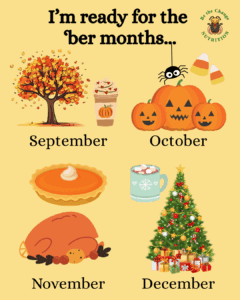
The 'ber months and some tasty food graphics to go along with each.

🍂 I’m Ready for the ’Ber Months: A Dietitian’s Cozy Guide to Seasonal Wellness

September. October. November. December.

The ’ber months are here—and I’m ready.

Ready for cooler, crisper weather. For cozy hoodies, UGGs and comfort food. For the shift from iced matcha to warm chai. But also? I’m ready to help you feel nourished, grounded and joyful through it all.

Because let’s be real: the ’ber months can be a whirlwind of celebrations, stress and abundant goodies. And while pumpkin spice gets all the hype, your wellness deserves a little seasonal spotlight too.

🍁 What Does “Ready” Look Like?

Being ready doesn’t mean being perfect. It means being intentional. Here’s how I help clients embrace the ’ber months with balance and delight:

🤗 Comfort Food, Reimagined
Nachos for dinner? Yes, please. But let’s layer them with fiber-rich beans, roasted squash and a sprinkle of cheese. Or cozy soups that sneak in veggies without sacrificing flavor. Comfort and nutrition can absolutely coexist.

🎃 Mindful Indulgence, Not Restriction
You don’t need to “earn” your holiday treats. We focus on tuning into hunger cues, savoring flavors and ditching the guilt.

📅 Planning Ahead (Without the Pressure)
From navigating potlucks to flexible meal planning for your workweek, I help you prep with confidence—not overwhelm.

✨ ’Ber Month Magic: More Than Just Food

Wellness isn’t just what’s on your plate. It’s how you feel in your body, your schedule and your relationships. So this season, I invite you to:

🤗 Catch and replace self-critical phrases with neutral or compassionate ones.

🚲 Move in ways that feel joyful, not punishing.

📖 Say yes to rest, even when the calendar says go-go-go.

 Let’s Make This Season Nourishing

If you’re craving support, seasonal recipes, or just someone to help you navigate the chaos with a little more calm—I’m here. The ’ber months are a beautiful time to reconnect with what makes you feel good. Let’s make it delicious.
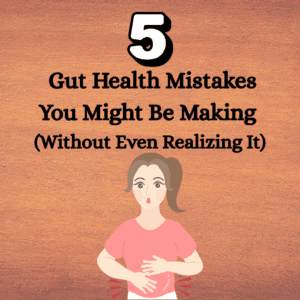
Girl holding tummy with title: 5 Gut Health Mistakes You Might Be Making (Without Realizing It)

Gut feeling off?

A dietitian can help decode the signals your digestive system is sending.

From bloating to irregularity to food sensitivities and microbiome support, we translate science into simple sustainable strategies so your gut can thrive, not just survive.


🧠 5 Gut Health Mistakes You Might Be Making (Without Even Realizing It)

Gut health isn’t just about kombucha and probiotics—it’s about the everyday habits that quietly shape how we feel, digest, and thrive. If your belly’s been feeling off, your energy’s dipping, or your mood’s riding a rollercoaster, your gut might be waving a little white flag.

Let’s unpack five common gut health missteps that even the wellness-savvy can fall into—and how to gently course-correct without spiraling into perfectionism.


1. 🥢 Eating Too Fast (Your Gut’s Not a Drive-Thru)

I get it—life’s busy, and scarfing down lunch between meetings or while wrangling kids feels efficient. But your gut? It prefers a slow dance over a speed date.

  • Why it matters: Eating quickly can lead to poor digestion, bloating, and missed satiety cues. Your brain and gut need time to sync up.
  • Try this: Pause before eating. Take a few deep breaths. Chew slowly. Bonus points for putting your fork down between bites—it’s not just grandma’s advice, it’s legit gut wisdom.

2. ☕ Coffee on an Empty Stomach (A Morning Ritual with a Hidden Cost)

Coffee lovers, don’t panic—I’m not taking away your sacred brew. But sipping it solo, before food, might be stirring up more than just energy.

  • Why it matters: Coffee is acidic and can stimulate stomach acid production. Without food to buffer it, this can irritate your gut lining and spike cortisol (hello, stress).
  • Try this: Pair your coffee with a small breakfast—think a banana with nut butter or a slice of toast with avocado. Your gut will thank you, and your energy might feel more stable too.

3. 🥤 Skimping on Fiber or Water (Your Gut’s Dynamic Duo)

Fiber gets all the gut health glory, but without water? It’s like trying to run a smoothie shop with no blender.

  • Why it matters: Fiber feeds your good gut bacteria and keeps things moving. But without enough water, it can backfire—leading to constipation and discomfort.
  • Try this: Aim for a mix of soluble and insoluble fiber (think oats, berries, leafy greens), and drink water consistently throughout the day. Your gut flora will throw a party.

4. 🍬 Artificial Sweeteners (Sneaky Saboteurs)

They promise sweetness without the sugar crash—but some artificial sweeteners might be messing with your microbiome.

  • Why it matters: Certain sweeteners (like sucralose or aspartame) can disrupt gut bacteria balance and may even contribute to bloating or cravings.
  • Try this: Opt for natural sweeteners like honey, maple syrup, or monk fruit in moderation. And read labels—“sugar-free” doesn’t always mean gut-friendly.

5. 😵‍💫 Chronic Stress (The Gut-Brain Connection is Real)

Stress isn’t just a mental game—it’s a full-body experience, and your gut feels it deeply.

  • Why it matters: Ongoing stress can alter gut motility, increase inflammation, and throw off your microbiome. It’s like your gut’s living in fight-or-flight mode.
  • Try this: Build in micro-moments of calm—walks, breathwork, journaling, or even dancing in your kitchen. Your nervous system and gut are in constant conversation, so speak kindly.

💡 Final Thoughts: Progress Over Perfection

Gut health isn’t about rigid rules—it’s about tuning in, making small shifts, and noticing what helps you feel more like you. If you’ve been making one (or all) of these mistakes, no shame—just awareness. Your gut is resilient, and every gentle change adds up.


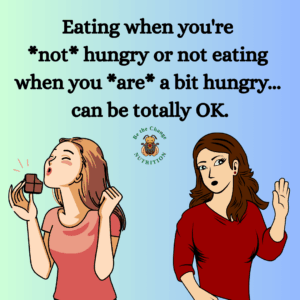
girl enjoying chocolate just because and another girl saying no thanks.

Sometimes eating isn’t about hunger. And that’s completely fine.

Are you confused yet?

Let me try to clear the air:
🍫 Eating when you’re *not* hungry can be OK.
🥗 Not eating when you *are* hungry can also be OK.

Wait… what?

Yup. While we often hear “listen to your hunger cues,” real-life eating isn’t always a straightforward, one-size-fits-all situation. Just like most rules in life, there are exceptions—and getting in touch with those gray areas can actually help you feel *more* confident about your eating decisions, not less.

🔍 Eating When You’re Not Hungry: Practical, Not Problematic

Welcome to the world of “practical” or “preventive” hunger—aka eating based on what your body *might* need, rather than what it’s yelling for in the moment.

Here’s what that might look like:
– Grabbing a snack before running errands so you’re not hangry in aisle 4.
– Eating lunch early because you’re heading into a meeting marathon.
– Refueling with protein and carbs post-workout—because your muscles are cheering for repair.
– Having dessert after dinner simply because… chocolate. Need I say more?

It’s not about ignoring your hunger cues; it’s about *anticipating* them. Choosing to eat in these moments helps you feel grounded, prepared, and well-fueled—not reactive and ravenous.

🤔 Slightly Hungry but Choosing Not to Eat: Also Valid

Now let’s flip it.

Sometimes you feel a nudge to nibble—but decide to wait. That doesn’t make you bad at “intuitive eating”—it makes you intentional. I’m talking about a very low level of hunger or a craving here.  Obviously if you’re truly hungry and in need of food you should EAT.  You always have the right to eat whenever you want to, but it’s also OK to sit with an urge and not respond to it.

For example:
– Skipping the candy dish because lunch is coming and you want to nourish yourself with higher quality food. (And deciding you’ll have some candy after you eat if you still want it.)
– Not eating right before bed because you are so tired and aren’t even sure if you are really hungry or just really tired.
– Passing on the bread the server put on the table because although you’re getting hungry, you want to fully enjoy the meal you ordered and you know if comes with a more enjoyable carbohydrate source.

In all these cases, it’s not about restriction—it’s about preference, self-awareness, and honoring how you want to feel afterwards.

🧠 The Sweet Spot: Pairing Knowledge with Intent

Whether it’s eating without physical hunger or pausing even when you feel a bit peckish, you’re blending nutrition wisdom with real-life nuance.

You’re allowed to enjoy food purely for taste. You’re allowed to pause and check in before acting on a craving. You’re allowed to eat proactively to avoid a slump later.

It’s not “right” or “wrong”—it’s about what feels aligned *for you* in that moment.

🥄 Final Thought: You’re In Charge

You always have the right to eat—and the right to wait. The goal isn’t perfection, it’s self-awareness.

So next time you find yourself asking, *“Should I eat this even though I’m not hungry?”*
Or, *“I’m kind of hungry but do I need something now?”*

Just know that either path can be valid. And that’s a pretty freeing way to live.


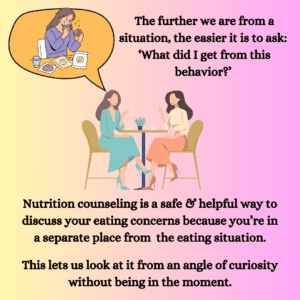
woman talking with a dietitian

In the moment, all you may feel is that you’re spiraling out of control. 

And then the shame sets in. You vow you’ll never do that again. 

You promise yourself, “Next time will be different.” And yet, the cycle continues.

But here’s the gentle truth:

If we only focus on resisting the behavior without understanding the ‘why’ behind it, we’re missing the message. These patterns aren’t random. They’re messengers– signals pointing to unmet needs or unhealed parts of ourselves.

So instead of restricting, what if we paused? What if we got curious?

Ask yourself:
– Was I running on empty– physically or emotionally?
– Was I looking for comfort, distraction or relief?
– Was I denying myself something I truly enjoy, creating a sense of scarcity or rebellion?

These aren’t excuses. They’re clues to learning about yourself.

Every unwanted eating behavior holds a kind of brilliance.

Whether driven by biology (like blood sugar dips or chronic hunger) or by psychology (like stress, loneliness or perfectionism)– it’s all worthy of compassion and reflection.

Instead of beating yourself up, try asking: What was I needing in that moment?

Because behind every behavior is a need.  And every need deserves to be met with kindness.

Unless you address the root cause of unwanted eating behaviors, they will tend to repeat themselves.

You don’t have to decode it all on your own.

Nutrition counseling creates a nonjudgmental space to explore your patterns, rebuild trust with your body and reconnect with your inner wisdom.

So let’s get curious and reflect rather than restrict and resist. 

Figuring out the reason will help you find a solution.

There is freedom in understanding, not in trying to control.

“Nothing ever goes away until it teaches us what we need to know.” -Pema Chödrön

Full vs satisfied emojis

Eating is not just about feeling FULL.

It’s about feeling SATISFIED! 😄

🌟There’s a difference.

Full = a physical sensation.
Your belly could feel full but you may not be satisfied.

Satisfied = a mental sensation.
It’s about feeling GOOD after eating! You feel nourished. You may or may not feel full, but you do feel satisfied and are not feeling like you still need something more.

💫 Shooting for satisfaction means you’re less likely to overeat or be preoccupied with food between meals.

👇Tips for feeling satisfaction after eating:

🍽️ Eat a combo of protein, carbs and fat…
Not necessarily all the time, but it does promote satiety and satisfaction.

🍽️ Ask yourself what would really taste good to you…
Maybe you have a “balanced” meal that would fill you up but to make it more satisfying you decide to add some flavors like goat cheese, salsa, guacamole, fresh herbs or butter.
Or you decide some chocolate or a brownie would really round out the meal. Have it! 😋

🙂 Allowing pleasure with food = Satisfaction = Nourishment =
A healthy relationship with eating!

We need both NUTRIENTS AND PLEASURE with our food choices…
Aim for a combo/balance of BOTH! ⚖️

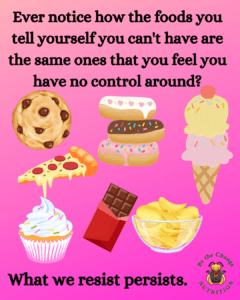
Picture with delicious foods saying Ever notice how the foods you tell yourself you can't have are the same ones you feel you have no control around?

A mindset shift can lead to behavior change.

Acknowledge that you have the freedom to eat anything you want.

(Because… you do.🤷)
✳️ Unless you have an allergy!

Then, practice paying attention (✨mindfulness✨) and notice whether you really desire the food or not.

Once you give yourself full permission, over time, something shifts.

🌟Food loses its power over you.🌟

The mindset of “forbidden” foods can make you crave them more, leading to overeating, feeling out of control and becoming trapped in an unhealthy cycle of restriction and bingeing.

Telling yourself you cannot have it DOES.NOT.WORK. 🙅‍♀️


Instead, try these two steps:


Step 1: Allow all foods.

There are no good or bad foods. Yes, foods differ in their nutritional value, but any food can have a place in a balanced diet. We need to include foods that bring us vitamin P (pleasure!) and that truly leave us satisfied, along with those that are nutrient-dense. Once you realize that no food is off-limits, habituation eventually sets in and you won’t have such an intense response to those “forbidden” foods anymore.


Step 2: Ask yourself these 2 questions: “Do I really want this?” and “What quantity will make me feel good?” 

Pause and check in with yourself, keeping your deepest intentions and values in mind. This self-awareness is crucial and helps you make a mindful decision, avoiding mindless eating. Sometimes you might really want it… and other times you might choose not to have it. But you might want it tomorrow. Once you realize it’s a choice and that you have complete freedom to decide, you’ll find you’re back in control. You’ll notice that you don’t actually want certain foods as often as you thought or you don’t need as much of them as you thought. You will lose the all or nothing mentality and you’ll learn to enjoy an amount that feels good with no guilt.


The key is a mindset shift– from restriction to freedom of choice. This can result in lasting, positive behavior change around eating.

It takes time and practice, but this approach can help you regain a healthy relationship with food.

You will get there.💗

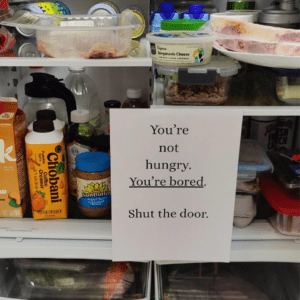
sign in fridge that says You're not hungry. You're bored. Shut the door.

😂 It’s not a bad idea.

But you don’t need a sign in your fridge–

Instead, get in the habit of asking yourself if you’re truly hungry every time you wander into the kitchen looking for a distraction.

🤔 Is grabbing something to eat really what you’re looking for?

🤔 Or is it just an urge that you can either sit with or deal with through an alternate action?

🥱 Can you eat when you’re feeling bored? Of course you can!
But make it a mindful, conscious decision that you feel good about.

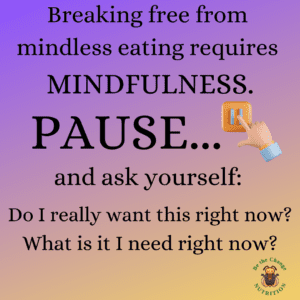
🔑 The key to stopping any mindless behavior is mindfulness (aka paying attention).

Mindfulness is the opposite of autopilot. It generates self-awareness and autonomy. You always have a choice. Insert a pause right before automatically reaching for food. This pause is what gives you the power to act or not act in response to your thoughts and feelings.

Mindfulness comes up a lot in nutrition counseling.

(Balance too!) 🙂

🥺 Many of my clients struggle with unwanted eating behaviors like grazing between meals when not hungry or eating after dinner out of habit.

There’s nothing necessarily wrong with doing these things…

➡️ But for a lot of people, they don’t feel like they are in control, these habits are getting in the way of their health and/or weight loss goals– And that doesn’t feel good to them.

💫 When it comes to changing eating habits, introducing mindfulness is essential.

It is the first step towards behavior change.

👁️ All mindfulness really means is: PAYING ATTENTION.

Behavior changes can’t happen without this.

You can’t change what you’re not noticing.

⏸️ Pause before automatically reaching for food.

Check in with your body.
⬇️⬇️⬇️⬇️⬇️⬇️⬇️

Am I hungry? 🤔
What am I feeling right now? 🥱
Do I really want to eat this? 🤨
What sounds good to my body right now? 🧐
How much of it do I need to feel the way I want to feel? 🥰
If I’m not hungry, what is it that my body is calling for? 🤯

💫 You’re interrupting a habitual behavior by bringing in awareness and creating an opening for a different response.

The PAUSE is where mindfulness happens. 👀

And mindfulness is how change happens. 🪄

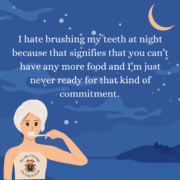
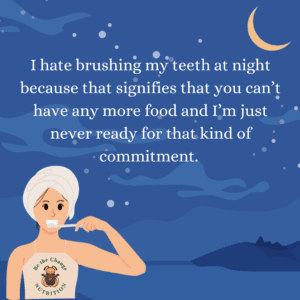
girl brushing her teeth

Is brushing your teeth after dinner to prevent eating more food later in the evening a good tactic?

It depends…

👍🏻 Yes if you struggle with mindless snacking and eating out of boredom when you truly are not physically hungry and truly do not want to eat at night but can’t seem to break the habit.
✅ Bonus tip: Floss too to really signal the end of eating for the day.

👎🏻 No if you are trying to fight real hunger signals from your body. Maybe you had a light day of eating or your dinner was small. Or hey, maybe you’re just hungry– hunger isn’t always consistent day to day. It’s okay to be hungry later at night and it’s okay to have something to eat if you need it! 💖

Personally, I’m in the habit of brushing my teeth shortly after dinner because I don’t typically get hungry later. BUT– there are days when, for whatever reason, I’m hungry. Rather than lie in bed feeling uncomfortable and unable to sleep, I’ll have a snack. And I’ll feel so much better! (And then I’ll brush my teeth again!)

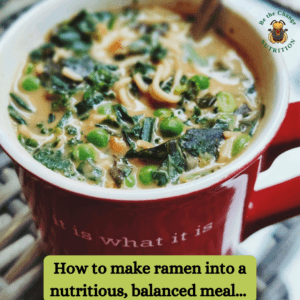
Mug of ramen noodles with spinach, peas and peanut butter.

 There are always ways to nutritionally improve any of your favorite foods– even ramen!

🍜 Tips to Making a Healthier, Balanced Ramen Noodle Soup:

🍤🫘 Add a protein source like chicken, tofu, tempeh, edamame, shrimp or hard boiled eggs. Consider black beans, chickpeas, lentils, cannellini beans or peas too– while these aren’t quite as high in protein, they still provide health promoting plant-based protein plus the benefits of fiber.

🥬🍄 Mix in some frozen spinach for antioxidants and additional vitamins, minerals and fiber. Thaw first by rinsing in a colander– or add it frozen to your hot soup to cool it quicker. Try cauliflower rice, peppers, mushrooms, carrots or mixed veggies for additional nutrients.

🥄🥜 Stir in a big spoonful of peanut butter, almond butter, cashew butter or sunflower seed butter for healthy fats and satiety– this makes your soup creamier and absolutely delicious.

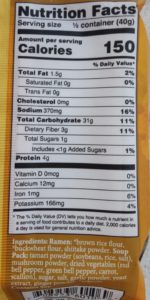
🧂🤏 Use less of the seasoning packet if you’re looking to reduce sodium in your diet. Ramen seasonings vary in sodium content so check your label. If it’s got 20% or more of the recommended daily value it’s considered high-sodium. You can still use the whole packet; it’s just smart to be aware of how many high-sodium foods you’re eating over the course of your day.

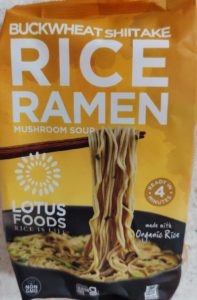
🔎 👀 Read the ingredients to see what you’re getting. I like the Lotus brand that makes ramen from whole grains like brown rice, millet and buckwheat vs enriched wheat flour and oil, so you get a little more fiber…

Rice ramen noodle packet by Lotus FoodsNutrition facts panel for Lotus Foods ramen noodles.

🤫 They’re at Job Lot now for $1!

 Remember: Protein, fat and fiber help keep you full longer. If satiety is a goal, add these to your carb-rich meals and snacks to turn down your hunger hormones.


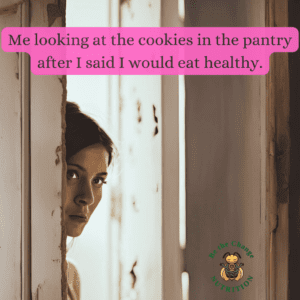
    Woman peeking into an open door with the words: "Me looking at the cookies in the pantry after I said I would eat healthy."

    If this is you, here’s my advice:

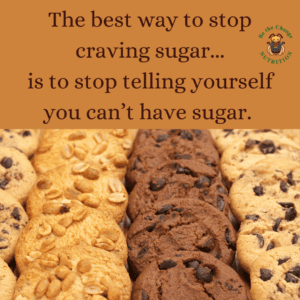
    🍪 Stop telling yourself you can’t have something you really want. (You’ll only want it more!) What we resist persists. Give yourself full permission to eat it and it will lose its power over you. Food freedom and a healthy relationship with eating may take a little time but you will get there.

    🍪 Make sure you nourish your body with nutritious, wholesome, satiating foods FIRST. It’s crucial that you take care of yourself with the right foods so you’ll be satisfied with a moderate portion of a treat AFTER. When you’re truly hungry, going for the cookies straight away is likely going to lead to overeating them and not feeling so great.

    🍪 Examine your definition of the word healthy. Individual foods are not healthy or unhealthy. Not eating a cookie doesn’t make you healthy just as eating a cookie does not make you unhealthy. Health is about much more than what you eat. Look at the bigger picture and how that cookie fits into your diet and life as a whole.

    🍪 Ask yourself if you really want them! Sometimes we tend to eat something just because it’s there. It will be there tomorrow too. Remind yourself of this. If you really want it, pause and ask yourself how much of it you need to feel satisfied. Make a mindful decision, enjoy your choice, feel good about it and carry on with your day.


    If sugar feels addictive, there is usually something else going on: Read about it here.

    You don’t need to eliminate every gram of sugar in your diet to reach your health goals, however there are guidelines for how much added sugar you should be eating: Check out it here.


    Cookies with the quote: The best way to stop craving sugar is to stop telling yourself you can't have sugar.