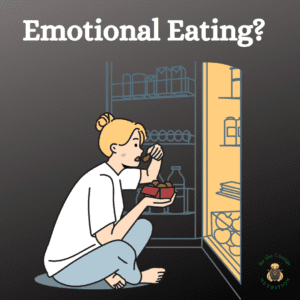
Woman emotional eating in front of the fridge. 

Emotional eating is not bad or wrong! 🤗 It’s normal and OK.

Your body is sending you a message that something is going on.

It’s OK to have this as an option.

🚩 But there can be negative consequences if food is your one and only way to respond to your emotions.

Reasons for emotional eating. It's ok to do but you need other options.

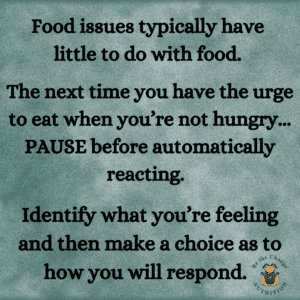
➡️ If you want to break “emotional eating” you need to practice the PAUSE.

This pause between the stimulus (emotion) and response (eating) is where you’ll find your freedom to choose:

1. Notice what you are feeling. Identify it. Feel it. 😟

2. Take a few deep breaths and PAUSE. ⏸️

3. Think about what you need right now and CHOOSE your response. 🤔

❣️ Maybe you choose to just feel whatever you’re feeling, knowing that it will pass.

❣️ Maybe you choose to turn to food. Here’s how: Be intentional about what you want to eat. Put an amount that you feel will satisfy you on a plate or in a bowl, sit down with it and slowly enjoy it, allowing it to soothe you. This is completely the opposite of mindlessly grabbing a bag or box of whatever and zoning out in front of the TV. Instead, it becomes a conscious choice.

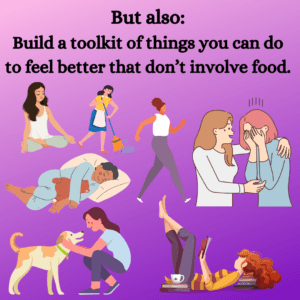
Alternatives to emotional eating.

❣️Maybe you decide that food isn’t going to help you feel better so you choose an alternative response. This is where knowing what you like to do and having a list of options comes in handy.


🌟 A lot of people identify as “emotional eaters” when in fact, they haven’t eaten enough or the right types of foods earlier in the day. So, when stress arises and the urge to eat hits, it’s easy to believe that it’s because of the emotion…. When it’s really got more to do with undernourishment.

💗 At Be the Change Nutrition, I help you untangle your unwanted eating behaviors and come up with a strategy to change them and get you feeling back in control of food again. 💗


Girl reading book called Just Eat It.

                                                          Just Eat It. 🍩

I love reading about the science of how food affects our bodies AND anything having to do with the psychological aspects of eating.

  The two are definitely intertwined.

Having an understanding of each is crucial to being a dietitian in private practice working with people looking to manage everything from diabetes to digestive distress to disordered eating.  This book perfectly combines food science with intuitive eating and it’s absolutely packed with tons of important information and practical tips.

👍🏻👍🏻 Two thumbs up for Just Eat It by Laura Thomas, PhD.

I highly recommend this book for anyone who wants to get off the dieting roller coaster, stop obsessing over food and figure out how to just eat normally again.  If you struggle with a poor body image or orthorexia (an unhealthy preoccupation with healthy eating) this is a must read.

Just Eat It explains how the messages we’re exposed to about food and our bodies can cause disordered eating habits and a negative body image.  There are reasons why our relationship with food is so unhealthy and why so many people hate their bodies and stress over everything they’re eating.  It’s basically been taught to us.

It’s something we’ve learned and now it’s something we have to unlearn.

Quote: The biggest lie of diet culture is that you will be happy when you reach this elusive body standard.

You will not find any meal plans or diet dos & don’ts in this book. 😮‍💨

Just Eat It emphasizes the importance of self-compassion and mindfulness– Along with how to work at these things to help you go from disordered eating to intuitive eating and feeling good about yourself.

You’ll read about giving yourself permission to eat (and addressing all the fears that come with that).  You’ll learn the steps to take to help you trust your body to guide you towards what, when and how much to eat.

She explains how by taking foods off a pedestal they lose a lot of their allure.  When you stop restricting them, they actually become less exciting and tempting.  A few more valuable things you’ll learn are:  The biology of how fullness & satiety work, how to tune in to your body cues & feel your fullness, how to pay attention to the way different foods make you feel, how hunger hormones work and how to differentiate between emotional & physical hunger. You’ll find out how to deal with your (irrational) inner food critic and rewire your brain. She also debunks several nutrition myths that may be preventing you from properly nourishing yourself.

I loved this book so much because it aligns with a lot of what I work on with my clients at Be the Change Nutrition.  Yes, we talk about food, but creating a healthy relationship with food & your body involves so much more and that’s what you’ll find in this book.

Quote: What could we achieve if we weren't obsessing about our bodies?

If you’re not living your happiest, healthiest life because of your food and body issues…

🍩Just Read It! 🍩 

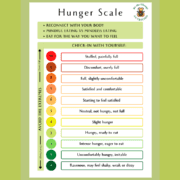
printable hunger scale.

Years of dieting can cause a disconnection from your internal signals.

A Hunger Scale is a tool to help you connect to your hunger & satiety cues.

It’s a way to increase awareness, which is the first step towards behavior change.


3 Ways a Hunger Scale can be helpful:


1️⃣ Do you go too long without eating, often finding yourself at a 0-2?

Use it to check in with your body earlier to notice signs that you need to eat.


2️⃣ Do you tend to overeat to the point of feeling uncomfortable (8-10)? 

Use it to check in with your body while you are eating to learn when you’ve had enough.


3️⃣ Do you find yourself mindlessly reaching for food between meals?

Use it as a pause button to check in with your body & identify what’s triggering the urge to eat.

The scale can help you decide if you need food or if you are actually comfortable and could respond differently.


 Aim to stay within 3-7 most of the time.

That being said, there are going to be times when you may need or want to eat when you aren’t hungry and that’s ok.

There are going to be times when you eat beyond a 7 and that is ok too.

There are many factors involved besides hunger/fullness when it comes to eating.

Look at it as a tool to get curious & gain insight into your habits and behaviors.

At first you may not know how your body feels or what it needs.

Practice and it will get easier and easier.


💗 Reconnect with your body and eat for the way you want to feel!💗


Print your FREE Hunger Scale here!

Is this you? 👇🏻

You’re hungry.

You enjoy a delicious dinner.

You finish your plate.

You refill your plate with more food.

You’re FULL.

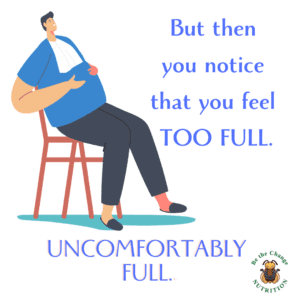
Man feeling too full.

You wonder why you ate so much…

AGAIN. 🙄

Let me introduce you to a little tip that can help.

Quote: The better you understand the delay between eating and the feeling of satiety, the more confident you'll get at choosing the right amount of food for your body.

Doesn’t it feel nice when you eat just the right amount of food?

When you reach that point where you’re no longer hungry, yet you’re not uncomfortably overfull.

It’s easier said than done.

Most of us have eyes bigger than our stomachs.

Let’s face it, food is delicious and brings us great pleasure.

We are extremely fortunate to have access to such abundance.

But the problem with this is:

Our waistlines are expanding and we have astronomically high rates of diet-related diseases because of overeating.

The key is to be able to enjoy enough food to satisfy without going overboard. ⚖️ (Balance!)

This is not easy for most people, but with some appetite awareness and mindful practice it can be an achievable goal.


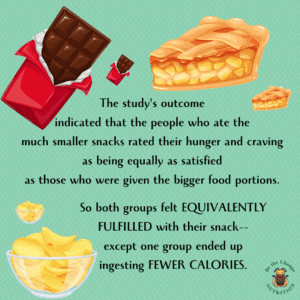
Check out this study where subjects were given snacks in either a small portion or a much larger portion size.

The snacks included chocolate, apple pie and potato chips.

These are all very tasty foods that are also easy to overeat.

We’ve all been there!

Study outcome showing that both groups felt equally fulfilled with different sized snacks.

Something to think about, hmmm? 🤔

Each group ate their snack and then waited 15 minutes. ⏰

✨There is a delay of about 15-20 minutes for your brain to register that your body has had enough.✨

  ➡️This is good to know because if you are aware of this you can consciously decide to stop eating before it’s too late.

We all know that feeling of wanting to continue eating, thinking we need more, or maybe simply just wanting more, only to realize later that we overdid it and should have stopped eating much earlier.

✨We can feel satisfied after eating less food than we think we need.✨

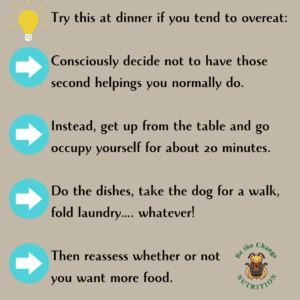
Strategy for overeating.

👉🏻 Chances are good that by then your stomach will have sent the signal to your brain that it’s had plenty & the desire for eating more will have faded.

✨You may be surprised to learn that you didn’t need as much as you thought you did.✨


You can also try this if you tend to over-snack in between meals!

Consciously decide to have a smaller snack than you normally would.

Give yourself 15-20 minutes to begin to digest and metabolize your food.

Then reassess your need for more food. 🤔


Be patient with yourself because like learning anything else new, this takes practice.

You’re essentially trying to change a habit (overeating) and that’s not easy to do.

You might find it tremendously hard to stop eating until you get that too-full feeling if that’s what your body is used to experiencing.

But each time that you are able to eat a little bit less, you are reinforcing the fact that you really do not need such large quantities of food to feel satisfied.   You will gain confidence.  It WILL become easier and easier with each success you have. 💪🏻

We never repent of having eaten too little. – Thomas Jefferson

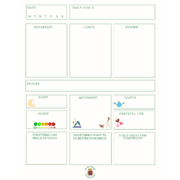
Free printable food journal.

The first step towards change is 👀AWARENESS 👀of your behaviors.

✨You need to know and understand your habits in order to form new ones.✨

Keeping a wellness journal like this for a few days (or longer) can give you valuable information.

Journaling makes you MINDFUL of everything you’re eating & drinking, how you’re sleeping, your movement and your mood.

All of these are interconnected and contribute to your health. 🍴💧💤🏃🏻‍♀️😬☺️

Reflect after a few days.

Are your meals and snacks balanced? 🍗🍠🥦🥑

How are your moods and energy levels and how do they affect your eating? 😢🙂🤪

Same with sleep. 🥱

What kind of activity are you doing to move your body? 🏌🏻‍♂️🤾🏻‍♂️🚴🏻🏋🏻

Are you eating fruits and vegetables daily? 🍎🍌🥗🥕

How much added sugar are you consuming? 🍭🍫🍰🍦

Do you find yourself reaching for food when you’re not even hungry? 🧐

You will notice what’s going well 😀along with what you’re not happy with. 🙈

I’ve also included space for setting personal goals for your day & remembering something you have to be thankful for.🙏🏻

There is also room for acknowledging an accomplishment, identifying something you want to improve upon and brainstorming ideas for what you want to eat tomorrow.

And don’t forget, your dietitian is always here to help you in your wellness journey.

💗💗💗💗💗

Print your free Food and Wellness Journal sheet here!

3 ice cream cones.

Happy Summer! 😎

It’s officially ice cream season. 🍦🌞

Uh-oh. 🤪

“But I love to go out for ice cream in summer…”

I’ve been hearing this one since the beginning of May. 😅 

You want it because it is delicious but you also believe that it’s a “bad” thing to do. 

So you wind up in a conundrum. 😯 Relax.

🥰 Don’t feel torn about eating ice cream if that’s what you really want to do. 🥰

Stop beating yourself up and feeling as if you should not have had it once you’ve eaten it.  Enough with the regrets and the guilt! 

But how do you do this?

While I can’t give you an answer to exactly how much and how often you “should” have it, I can offer some advice for how to find that happy balance when it comes to eating it and feeling good about your decision. 👇

When faced with ice cream, it helps to ask yourself some questions…


🍦 Question 1:  Do I really want this?  Is it really worth it right now?  🤔

Because sometimes, when you pause and check in with yourself… you don’t.

You might like the idea of ice cream– but right now, today, in this very moment, you’re actually feeling quite content without it.  Maybe you’ll wait until next time.   It’s not now or never.  There will be plenty of other opportunities.

Or, you might decide that ice cream sounds delicious and it would make you really happy today.  So you make the conscious decision to enjoy some.  Own your choice without feeling bad about it.  Feeling bad kind of ruins the whole point of the ice cream experience.

Don’t make this about whether you should or should not.  Instead look at it as, you can, but do you really want to?  There is no right or wrong.  It is always your choice.   🤗


🍦 Question 2:  What is the minimal amount that will do it? 🤔

If you’re used to restricting ice cream or if you’re very hungry, you may overestimate how much you need to feel good.  If you’ve been practicing mindfully allowing all foods and aren’t starving, you’ll have better judgment.

We tend to think we need more to feel satisfied than we really do. 

How often do you regret eating too much ice cream?🥴

And how about eating too little? 😄 I thought so.

➡️ Tip: Order a small (or even a kiddie size).  I’ve been to enough local ice-cream shops to know that these are actually a very decent sized serving! If you’re used to ordering larger sizes, conduct a little experiment where you get the smaller size and then see how you feel after.  I bet you feel satisfied and happy with your decision. 😘

🍦🍧🍨🍦🍧🍨🍦🍧🍨🍦🍧🍨🍦🍧🍨

This can’t be about denying yourself.  It will not work.  If you look at it that way, you’re going to want it more.  It has to be about a 💫choice💫.  Give yourself the permission and freedom to have it. 

Flip your mindset from “I shouldn’t” or “I can’t” to “I can have ice cream if I really want it.”

When you reframe how you look at it, you just may have the groundbreaking realization that you might actually feel better not having ice cream than having ice cream. 🤯

I think most of us have a pretty good understanding of how detrimental excessive sugar can be for our body.  Does that mean having the occasional ice cream cone is going to ruin your health, cause a disease or kill you? 😵 Of course not. 

But everything we eat has an effect on our bodies, for better or worse, and over time our choices add up.

We are all free to make our own choices! 💓Do what makes you happy and what supports your values and goals.

Empower yourself by making mindful decisions and owning them.  Ice cream can fit into a balanced, healthy lifestyle if it makes you happy.  It’s the guilt and self loathing that are really damaging. 💗


Real ice cream is awesome… And so is this version of ice cream made from frozen bananas!🍌🍌🍌

How to make banana ice cream.

Happy Valentine’s Day! 💗

Some say it’s a stupid holiday created by the devious floral🌹, candy🍫, jewelry💍 and greeting card💌 industries. 

Maybe they do take advantage, but I say if there is a day that has to do with 💖love💖 and chocolate🍫, I can’t help but be all for it.

Have you ever thought about how 💕LOVE💕 relates to our 🍴eating habits🍴? 

Self-love, to be more precise. 

🤗 Often I hear: “When I eat better and lose weight, then I’ll be able to love myself.” But that’s not how it works at all.

Instead of working only on changing your outside, you need to also tend to what is going on inside.  The attitude you decide to take (yes, it is a choice) towards yourself will hugely impact your eating behaviors.

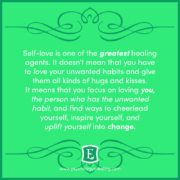
Choose to love yourself. For who you are, not what your body looks like. You are in 100% control of calling a truce on your internal battle and just deciding to do it. Realize this is who you are going to be for the rest of your life! You can either accept, appreciate and work on loving who you are or be miserable because of your self-chosen self-hatred. 🤷‍♀️

When we love who we are, doing positive things for ourselves comes more naturally.

When we don’t feel so great inside, we have a tougher time taking the actions we know will nurture and support our health.

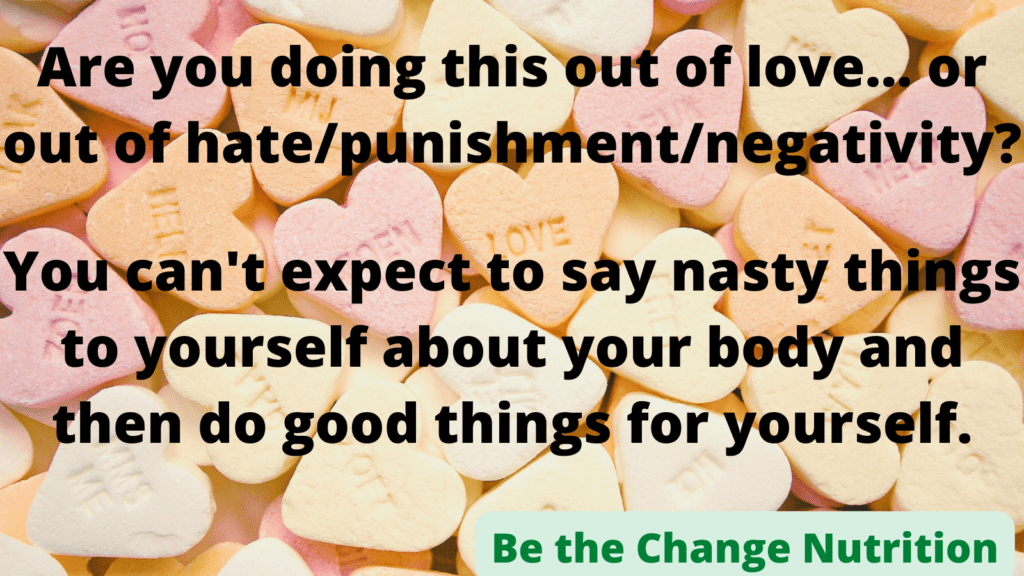
candy hearts with quote: Are you doing this out of love or out of hate, punishment and negativity? You can't expect to say nasty things to yourself about your body and then do good things for yourself.

If you notice you’re talking to yourself in a way you’d never talk to your child, friend, parent, etc., let that be a wake-up call that you have some work to do!

Start questioning your thoughts if they aren’t loving, hopeful and good. 

Begin experimenting with encouraging messages to yourself to replace your destructive thoughts.  Reprogram your beliefs to change your behaviors.  Catch yourself criticizing your body and immediately say something kind.  Really.  I know it sounds goofy😜, but do it and see what you notice.  It will be life changing.🌟

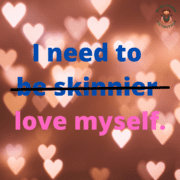
Message about needing to love myself, not be skinnier.

When you don’t love yourself and don’t believe in yourself, it’s going to be a lot harder to eat well.  Why would you bother to take good care of someone you think of as a useless, fat failure? 😔

Often, this self-talk has been going on for so long and is so automatic that you may not even realize you are doing it. 

Start paying attention to your thoughts.  If you have been talking to yourself this way for years and are not able to lose weight or eat the way you want to eat… could your lack of self-love be influencing your behaviors? 💡

👀 I have noticed an interesting commonality in the people who succeed in achieving behavior change:  They are patient, kind, gentle and loving with themselves. 🥰 They are able to connect with who they are and eat in accordance with that person that they want to be.  💞 They trust themselves, value themselves and make time to do things that nourish their souls (this is not selfish; it is crucial!).  This attitude and practice of self-care leads to a new perspective on food and eating habits.

Practicing self-love doesn’t mean eating only salad 🥗with wild salmon 🐟 and sprouts 🌿.  It doesn’t mean you don’t ever eat something with low nutritive value 🥨🍦🍰🍸🍟🧁😋. Know that you can still choose to eat things like Valentine’s Day chocolates or your mom’s homemade pizza if those things make you happy. 

The difference being who you are as an eater. Stuffing food down in a frenzy because you think you don’t deserve to enjoy it and then feeling guilty and hating yourself after is not helpful.  Slow down, pay attention and eat with awareness.

Loving yourself allows you to give yourself permission to savor all food in a mindful way.  Loving yourself helps you strive for that balance of wholesome, nutritious and delicious foods that your body needs to feel its best.  You’re better equipped to make healthy eating choices when you remember that you’re on a journey and you accept and love who you are at this moment in time.

If you’ve been struggling with unwanted eating behaviors and feeling stuck unable to make changes, be careful how you talk to yourself (because you are listening.) 

You’re not going to get where you want to go with self-judgment and self-attack.

Acceptance, trust, kindness, gratitude, hope, respect, confidence– this is how you’ll get there.

Let go of your urgency and desperation to change yourself… in order to change yourself.  

Practice loving yourself now, as you are… and then notice change happens.  💗


You aren’t alone if you don’t feel great about your body.  

It’s so easy to be self-critical and get hung up on perceived flaws. Poor body image can be all-consuming. 😰 Focusing on what you don’t like has a way of negatively affecting your outlook on your whole day.

Changing these thoughts takes practice, just like changing any other unwanted habit.   If you’ve lived for years repeating to yourself how fat your thighs are, it’s going to take effort and time to alter that automatic pattern of thinking.

But you can do it. Your body is where you live. It only makes sense to treat it with kindness. 🤗

Speak to it and care for it with love and gratitude and your world will change.

🤔 But how to start changing thoughts of judgment?

🥰 Begin with thoughts of gratitude.

➡️ What you focus on expands.

Shift your perspective to see the good… and you will see more and more good things.

It’s up to you to tune your radio dial to a new frequency. Here’s what I mean:

1️⃣ Stop zeroing in on what you hate.  Do not analyze, obsess over or poke at the parts that bother you. You have to make the decision that you’re going to stop. Understand that what you’re focusing on is not helpful. Putting your attention on these things brings up feelings like anger, anxiety, shame and frustration. Not only are these unpleasant ways to feel, but you’re activating stress hormones that over time can contribute to issues like weight gain, poor sleep, digestive problems, difficulty concentrating, anxiety and depression.

See how what you focus on expands?

2️⃣ Instead– What are you grateful for?  Notice what you like about yourself but also look at what you don’t love from a new perspective: an attitude of gratitude. The legs you see as too short, too skinny, too fat– they let you walk, run, pedal, skate, dance and get you where you want to go. The arms you wish had no flab– they carry bags of groceries and hug your loved ones (BTW, that flab is relaxed muscle). Go through everything and find a reason to thank them all, your eyes, ears, nose and toes. Your lungs, brain, heart and bones. This resets your mindset back to what is really important in life.

See how different you feel when you shift your focus to gratitude? 🙏

😁 Gratitude creates “positive vibes” which are magnetic and will attract more happiness. 

It’s a practice that staying consistent with day after day will change you.

It’s impossible to feel both judgmental and grateful simultaneously.

You choose how you would like to see things and how to think. 

Your thoughts will alter your reality. 

Feeling gratitude instead of criticism towards your body will impact your daily life choices. 

When you’re living in a body you accept and appreciate, you’ll be more at peace with food and eating.

You’ll make taking care of yourself a priority.  It’s hard to do these things when you’re battling yourself.

Thoughts of gratitude create a change in attitude.💖

All you have to do is decide to. 🥰

There are different reasons we overeat.

Each has its own unique resolution and today I want to talk about one very common cause of overeating: Mindlessness.

⚠️ Mindless overeating happens when we’re distracted while eating.

For example:

  • Watching television 📺
  • Driving 🚗
  • At a party 🥳
  • Staring at our phone 📱
  • Working or web-surfing on our computer 💻

👉 The underlying cause of mindless eating is lack of awareness.

You may think you are overeating because of a lack of willpower, but it’s not about willpower at all.

It’s about slowing down and paying attention. 👀

Pay attention to your eating when you eat and notice what happens.

You engage your brain and your senses in what you’re doing. This makes it possible to tune in to your body and decide when you’ve had enough.

Paying attention enables you to experience the satisfaction that eating brings. If you’re doing other things, you’re not fully registering that you’re actually eating– and this leads many people to over-consume.

👉 Mindful eating basically means “Eating when you eat.”

This concept can help you lose weight and improve your health. 💗
Mindful Eating Tips:

PAUSE. Check in to see if you are hungry before automatically eating. 

You can do this by taking a couple of deep breaths to relax first. Take a moment to ask yourself if you are experiencing true hunger or if you want to eat for other reasons (boredom? stress?) If you are not truly hungry, ask yourself what you are feeling and what you can do to make yourself feel better. If you determine that you are hungry…

CHOOSE CONSCIOUSLY. Take a mindful minute to figure out what would satisfy you right now.

Something warm? cold? salty? chewy? sweet? creamy? crunchy? hydrating? carb-rich? protein-rich? fat-rich? Eat for the way that you want to feel– satisfied, nourished, content, etc.

APPRECIATE. Be grateful and thankful for your food.

Most of us take for granted how much we have available to us when this was not always the case and for some people still isn’t. Think about food as nourishment and how it is giving your body energy and nutrients to thrive.

CREATE an atmosphere. 

Eat sitting down, by a window, outside, with candles or with a friend– whatever you like to make eating more enjoyable.  If you do watch television, read or use the computer while eating– stay mindful of your food in addition to the distraction.  Focus on the experience and be present to fully enjoy your food. If you consistently find yourself overeating, you may want to turn off the TV and put away your phone.

SLOW DOWN. Put your fork (or spoon or sandwich, etc) down between bites.

Wait until you are done chewing and have swallowed before picking it up again. This can be hard! Most of us already have out next bite loaded on our utensil or in our hand before we’re done chewing our current mouthful. What’s the rush, LOL? Also, remember that there can be a 20 minute delay between when you have had enough and when your brain realizes this. It is easy to overeat and not recognize it until it is too late. Discover the point at which you feel satisfied but not stuffed.

👍 The cure for mindlessness is mindfulness. Simple, yes. Easy– not at first. Like anything new, it takes practice.

There will be times when you eat too fast, too much or make poor food choices…. it’s OK! Eating is not about perfection and every day will be different. But by reminding yourself to pause, you’re bringing yourself into the present moment and giving yourself the space and the freedom to choose your actions. 🙏


I see way too many of you being way too hard on yourselves. 😥

Most of us want to change ourselves for the better, which is fine. Striving for self-improvement can be healthy. But there’s a big difference between doing positive things to be a better version of yourself (self-care) and fighting yourself by engaging in behaviors like denying your appetite, eating foods that don’t satisfy you or forcing yourself to exercise in ways you don’t enjoy (self-control).

There is a lot of self-loathing going on and not enough self-acceptance. 💔

And so I was thinking about this self-control vs self-care mentality among my clients and there is an unmistakable correlation between the type of mindset someone has and their progress with making healthy behavior changes…

Did you hear that? 💡  If you want to see breakthroughs in your journey, then take a look at the mindset you’ve created.  It could be getting in your way.

Are you caring for yourself or are you trying to control yourself? 🤔

It’s not your fault if you have a controlling “diet mentality”– thanks to messages we’ve received since childhood from television, magazines, the internet and even family and friends who mean well– it’s no wonder we think we aren’t good enough because we don’t look a certain way.  😢  And the answer, we’re told, is to go on a diet or ‘eat this/not that’ or exercise furiously to burn those calories.

🤗 Consider that type of thinking as flawed, distorted and damaging to your soul.  If you’ve been thinking that way, reexamine those thoughts and ask yourself if they have been helpful in getting you where you want to go.

From what I observe…

A diet mentality doesn’t encourage anybody to become happier or healthier or to make better eating choices.

Think of someone you know who has a positive relationship with their body and with food. What messages are they giving themselves?  Are they constantly on the lookout for the next cleanse or diet plan?  Do they  feel guilty if they eat a piece of birthday cake? 🍰  Are they waking up at 5am to torture themselves on the treadmill for an hour before work? 

OR– Are they eating foods that bring them pleasure and that make them feel satisfied?  Do they allow themselves to savor their favorite treats moderately with joy instead of shame?  Are they moving their body in ways that make them feel amazing and alive?

💃🏃‍♀️🧘‍♀️🏄‍♂️🏋️‍♂️🚴‍♀️🤸‍♀️

There was an interesting study,  Chocolate Cake.  Guilt or Celebration?  that compared weight change and perceived behavior control between two groups of people with opposing attitudes towards eating cake– those who saw eating cake as a celebration and those who associated eating cake with guilt.  Those in the guilty group reported less perceived control over their eating.  Their guilt did not play a useful role in keeping them from making certain food choices like many of us think it might.  Also, they were less successful at losing weight than those who connected cake with celebration.  Hmmm.

The angle from which you view things really does have an effect on your behaviors and habits.  If you find yourself stuck with a self-control instead of a self-care attitude, noticing this is the first step towards changing it.

Question your thoughts, call a cease fire on your internal battle and then begin reprogramming the things you tell yourself to create a new, more positive story in your mind.  💖

Once you can learn to not see food as your enemy you will notice it loosens its grip on you.

Being gentler, more accepting and kinder with yourself will lead you to better self-care habits.  🥰 

You are much more likely to make the effort to care for someone (you!) if you can first embrace who you are, as you are, right now.  ♥