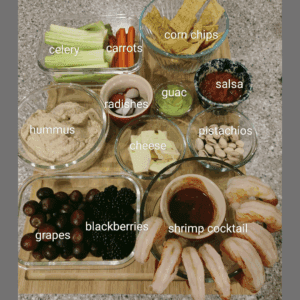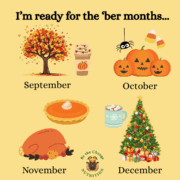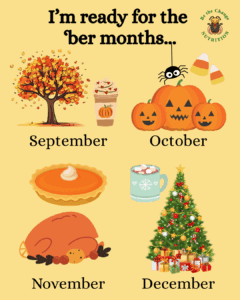
The 'ber months and some tasty food graphics to go along with each.

🍂 I’m Ready for the ’Ber Months: A Dietitian’s Cozy Guide to Seasonal Wellness

September. October. November. December.

The ’ber months are here—and I’m ready.

Ready for cooler, crisper weather. For cozy hoodies, UGGs and comfort food. For the shift from iced matcha to warm chai. But also? I’m ready to help you feel nourished, grounded and joyful through it all.

Because let’s be real: the ’ber months can be a whirlwind of celebrations, stress and abundant goodies. And while pumpkin spice gets all the hype, your wellness deserves a little seasonal spotlight too.

🍁 What Does “Ready” Look Like?

Being ready doesn’t mean being perfect. It means being intentional. Here’s how I help clients embrace the ’ber months with balance and delight:

🤗 Comfort Food, Reimagined
Nachos for dinner? Yes, please. But let’s layer them with fiber-rich beans, roasted squash and a sprinkle of cheese. Or cozy soups that sneak in veggies without sacrificing flavor. Comfort and nutrition can absolutely coexist.

🎃 Mindful Indulgence, Not Restriction
You don’t need to “earn” your holiday treats. We focus on tuning into hunger cues, savoring flavors and ditching the guilt.

📅 Planning Ahead (Without the Pressure)
From navigating potlucks to flexible meal planning for your workweek, I help you prep with confidence—not overwhelm.

✨ ’Ber Month Magic: More Than Just Food

Wellness isn’t just what’s on your plate. It’s how you feel in your body, your schedule and your relationships. So this season, I invite you to:

🤗 Catch and replace self-critical phrases with neutral or compassionate ones.

🚲 Move in ways that feel joyful, not punishing.

📖 Say yes to rest, even when the calendar says go-go-go.

 Let’s Make This Season Nourishing

If you’re craving support, seasonal recipes, or just someone to help you navigate the chaos with a little more calm—I’m here. The ’ber months are a beautiful time to reconnect with what makes you feel good. Let’s make it delicious.

Girl holding tummy with title: 5 Gut Health Mistakes You Might Be Making (Without Realizing It)

Gut feeling off?

A dietitian can help decode the signals your digestive system is sending.

From bloating to irregularity to food sensitivities and microbiome support, we translate science into simple sustainable strategies so your gut can thrive, not just survive.


🧠 5 Gut Health Mistakes You Might Be Making (Without Even Realizing It)

Gut health isn’t just about kombucha and probiotics—it’s about the everyday habits that quietly shape how we feel, digest, and thrive. If your belly’s been feeling off, your energy’s dipping, or your mood’s riding a rollercoaster, your gut might be waving a little white flag.

Let’s unpack five common gut health missteps that even the wellness-savvy can fall into—and how to gently course-correct without spiraling into perfectionism.


1. 🥢 Eating Too Fast (Your Gut’s Not a Drive-Thru)

I get it—life’s busy, and scarfing down lunch between meetings or while wrangling kids feels efficient. But your gut? It prefers a slow dance over a speed date.

  • Why it matters: Eating quickly can lead to poor digestion, bloating, and missed satiety cues. Your brain and gut need time to sync up.
  • Try this: Pause before eating. Take a few deep breaths. Chew slowly. Bonus points for putting your fork down between bites—it’s not just grandma’s advice, it’s legit gut wisdom.

2. ☕ Coffee on an Empty Stomach (A Morning Ritual with a Hidden Cost)

Coffee lovers, don’t panic—I’m not taking away your sacred brew. But sipping it solo, before food, might be stirring up more than just energy.

  • Why it matters: Coffee is acidic and can stimulate stomach acid production. Without food to buffer it, this can irritate your gut lining and spike cortisol (hello, stress).
  • Try this: Pair your coffee with a small breakfast—think a banana with nut butter or a slice of toast with avocado. Your gut will thank you, and your energy might feel more stable too.

3. 🥤 Skimping on Fiber or Water (Your Gut’s Dynamic Duo)

Fiber gets all the gut health glory, but without water? It’s like trying to run a smoothie shop with no blender.

  • Why it matters: Fiber feeds your good gut bacteria and keeps things moving. But without enough water, it can backfire—leading to constipation and discomfort.
  • Try this: Aim for a mix of soluble and insoluble fiber (think oats, berries, leafy greens), and drink water consistently throughout the day. Your gut flora will throw a party.

4. 🍬 Artificial Sweeteners (Sneaky Saboteurs)

They promise sweetness without the sugar crash—but some artificial sweeteners might be messing with your microbiome.

  • Why it matters: Certain sweeteners (like sucralose or aspartame) can disrupt gut bacteria balance and may even contribute to bloating or cravings.
  • Try this: Opt for natural sweeteners like honey, maple syrup, or monk fruit in moderation. And read labels—“sugar-free” doesn’t always mean gut-friendly.

5. 😵‍💫 Chronic Stress (The Gut-Brain Connection is Real)

Stress isn’t just a mental game—it’s a full-body experience, and your gut feels it deeply.

  • Why it matters: Ongoing stress can alter gut motility, increase inflammation, and throw off your microbiome. It’s like your gut’s living in fight-or-flight mode.
  • Try this: Build in micro-moments of calm—walks, breathwork, journaling, or even dancing in your kitchen. Your nervous system and gut are in constant conversation, so speak kindly.

💡 Final Thoughts: Progress Over Perfection

Gut health isn’t about rigid rules—it’s about tuning in, making small shifts, and noticing what helps you feel more like you. If you’ve been making one (or all) of these mistakes, no shame—just awareness. Your gut is resilient, and every gentle change adds up.


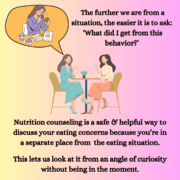
woman talking with a dietitian

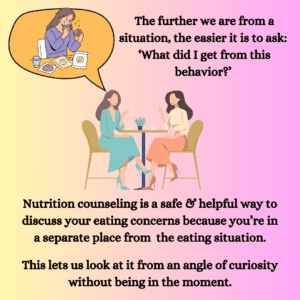
In the moment, all you may feel is that you’re spiraling out of control. 

And then the shame sets in. You vow you’ll never do that again. 

You promise yourself, “Next time will be different.” And yet, the cycle continues.

But here’s the gentle truth:

If we only focus on resisting the behavior without understanding the ‘why’ behind it, we’re missing the message. These patterns aren’t random. They’re messengers– signals pointing to unmet needs or unhealed parts of ourselves.

So instead of restricting, what if we paused? What if we got curious?

Ask yourself:
– Was I running on empty– physically or emotionally?
– Was I looking for comfort, distraction or relief?
– Was I denying myself something I truly enjoy, creating a sense of scarcity or rebellion?

These aren’t excuses. They’re clues to learning about yourself.

Every unwanted eating behavior holds a kind of brilliance.

Whether driven by biology (like blood sugar dips or chronic hunger) or by psychology (like stress, loneliness or perfectionism)– it’s all worthy of compassion and reflection.

Instead of beating yourself up, try asking: What was I needing in that moment?

Because behind every behavior is a need.  And every need deserves to be met with kindness.

Unless you address the root cause of unwanted eating behaviors, they will tend to repeat themselves.

You don’t have to decode it all on your own.

Nutrition counseling creates a nonjudgmental space to explore your patterns, rebuild trust with your body and reconnect with your inner wisdom.

So let’s get curious and reflect rather than restrict and resist. 

Figuring out the reason will help you find a solution.

There is freedom in understanding, not in trying to control.

“Nothing ever goes away until it teaches us what we need to know.” -Pema Chödrön

Woman walking with the title: 6 Boredom Busters

Walking’s great for your body and mind– but why does it have to feel like a chore?

(🤫Psst: It doesn’t!)

If you feel boredom is literally stopping you in your tracks, you’re definitely not the only one.

Walking doesn’t have to be just a means of getting from point A to B (or worse, ‘burning calories’), it can be a chance to connect with yourself, lift your mood and spark your imagination.

Here are 6 creative ways to refresh your route & your spirit:

1. The Meditative Walk: Follow Your Breath
Start simply by counting your breaths as you walk. See how high you can get before your mind drifts. Gently bring your attention back to counting when you notice your mind wandering. Can you get to 50? 100?

2. The Gratitude Walk: Send Love on the Go
As you walk, think of people in your life you’re grateful for. Visualize them, send them well wishes or mentally thank them. It’s like dropping little love notes into the wind– and often, this practice makes you feel better too.

3. The Planning Walk: Imagine the Next 24 Hours
Use the time to map out your day. What needs your attention? What are you looking forward to? What’s on the menu? Let your walk double as a gentle check-in with your intentions and you’ll return feeling one step ahead.

4. The Sensory Stroll: Tune Into the World Around You
Engage all your senses one by one. What can you hear– birds, an airplane, traffic? What do you see– sunlight on the sidewalk, a crooked fence, wildflowers? What can you smell– bacon, cut grass, rain on asphalt? What do you feel– the wind in your hair, your feet hitting the pavement, warm sunshine on your neck?

5. The Mind Eavesdrop: Let Your Thoughts Speak
Imagine your thoughts are part of a radio show playing in the background. What are they chatting about today? How are those thoughts shaping your mood or behaviors? Are they even true? (Spoiler: often… not so much.) Just observe. No need to fix anything– just listen in with curiosity.

6. The Bored Walk: Let Boredom Be the Point
Here’s a radical idea: Don’t distract yourself or try to change boredom. Just… feel it. In a world of constant stimulation, letting your mind wander– without music or a screen–can be its own kind of nourishment. What if boredom is your brain’s way of sorting things out and quietly resetting?


Whether you’re tuning into your senses, observing your thoughts, or simply embracing the quiet, these tiny mindset tweaks can transform a walk into something that is healing for both your body and soul.

So lace up, step out, and see where your feet–and your mind–take you.

Sunrise over the ocean with Good Morning! Do not let your scale determine how your day goes.

“Ignore the scale and make the process your goal.”
~ Harley Pasternak

Your weight is the least interesting thing about you!

The number on the scale doesn’t define who you are, yet many people tie it to their self-worth, allowing it to influence their emotions– and ultimately, their eating habits– in an unhealthy way. 

You don’t need a scale to track your progress. Is that number truly what matters? Instead, focus on the shifts in your thoughts, emotions and behaviors and how you speak to yourself and care for yourself. Because what you’re really striving for is a happier, healthier life.

Bring your attention to: How am I taking care of myself? How am I talking to myself? How am I treating myself? These questions reveal far more about your well-being than a number on the scale ever could.

Forget about the scale and measure progress with things like:

✔ Am I more in tune with my hunger and satiety cues?
✔ Am I eating a wider variety of foods?
✔ Am I choosing foods that nourish both my body & my cravings?
✔ Am I eating without guilt?
✔ Am I noticing how different foods affect me?
✔ Am I making more mindful eating decisions?

The scale is not what it’s all about.

If you choose to weigh yourself, do so and continue on with your day. Remember, weight naturally fluctuates and weight loss isn’t a linear path. What matters most is the overall trend, not a data point on a single day. If stepping on the scale brings stress or frustration, give yourself permission to take a break from it.

Don’t let a number hold any power over your happiness or self-esteem.💗

grocery list ideas, broken down by category

 You wouldn’t believe how often I hear:

“I don’t know what to buy when I go to the grocery store.”

So, here you go: A printable grocery list!

I put together a list of foods by category to provide some IDEAS.

 I also included some quick meal and snack examples using foods from the shopping list.

There are dozens of other meals/snacks you can create by combining items on the list.

list of quick meal ideas

 Stock your pantry, fridge and freezer with as much VARIETY as you can– You’ll have that many more options when it comes to preparing something to eat.

🤔 Do you need to buy everything on the list? No!
👉🏻 It’s meant to give you IDEAS and inspiration. Don’t feel you need to buy things you don’t like.

🤔 Are there things not included on the list that you can buy? Of course!
👉🏻 Shop with the 80/20 rule in mind (same with when you eat), meaning aim for 80% of your foods to be wholesome, nutrient-dense choices and 20% to be fun, pleasurable, foods that you eat just because you truly just love them! 💗

Happy shopping🛒

Print your Grocery List with Meal Ideas HERE

Stanley water cup and True Lemon packets.

I always ask my clients what they drink & how much… And sometimes drinking more water goes on their to-do list!

👉 We are about 60% water! 💦

Adequate hydration is essential for:
💦 Transporting nutrients in the body
💦 Lubricating joints
💦 Digesting food
💦 Regulating body temperature
💦 Supporting kidney and bladder health
💦 Eliminating wastes through sweat, urine and bowel movements

🥤 It’s important to be well hydrated, but be careful not to take it too far by forcing yourself to drink excessively. This can dilute your electrolytes and cause central nervous system issues (and even death–although it’s rare).

Fluid recommendations from The National Academy of Sciences for generally healthy adults:
💦 15.5 cups/day for men
💦 11.5 cups/day for women

This includes water from food, which contributes about 20% of daily hydration.

Not taking food into account, our fluid needs are about:
💦 11 cups/day for men
💦 9 cups/day for women.

☕🍵And yes, coffee and tea count!!
(Keep caffeine under 400mg/day)

💧 Dehydration can cause: headaches, lack of energy, constipation, kidney stones and urinary tract infections.

🥵 Any activity or hot weather that causes you to sweat means that you need to drink more fluids to replace what you lose.

🟡 The color of your urine is a good way to check your hydration. It should be a pale yellow. Dark yellow or amber may indicate you need to drink more.

🥰 And lastly, don’t forget the obvious:
Pay attention and listen to your thirst!

💙Drink enough
💙Not too much
💙 Mostly water

Bonus tip:

🍋If you’re prone to kidney stones, try adding True Lemon to your water (or fresh lemon or lime juice).  Lemon and lime juice contain citrate which may help prevent kidney stones. I always have samples here at my office if you’d like to try it.

Full vs satisfied emojis

Eating is not just about feeling FULL.

It’s about feeling SATISFIED! 😄

🌟There’s a difference.

Full = a physical sensation.
Your belly could feel full but you may not be satisfied.

Satisfied = a mental sensation.
It’s about feeling GOOD after eating! You feel nourished. You may or may not feel full, but you do feel satisfied and are not feeling like you still need something more.

💫 Shooting for satisfaction means you’re less likely to overeat or be preoccupied with food between meals.

👇Tips for feeling satisfaction after eating:

🍽️ Eat a combo of protein, carbs and fat…
Not necessarily all the time, but it does promote satiety and satisfaction.

🍽️ Ask yourself what would really taste good to you…
Maybe you have a “balanced” meal that would fill you up but to make it more satisfying you decide to add some flavors like goat cheese, salsa, guacamole, fresh herbs or butter.
Or you decide some chocolate or a brownie would really round out the meal. Have it! 😋

🙂 Allowing pleasure with food = Satisfaction = Nourishment =
A healthy relationship with eating!

We need both NUTRIENTS AND PLEASURE with our food choices…
Aim for a combo/balance of BOTH! ⚖️

Picture with delicious foods saying Ever notice how the foods you tell yourself you can't have are the same ones you feel you have no control around?

A mindset shift can lead to behavior change.

Acknowledge that you have the freedom to eat anything you want.

(Because… you do.🤷)
✳️ Unless you have an allergy!

Then, practice paying attention (✨mindfulness✨) and notice whether you really desire the food or not.

Once you give yourself full permission, over time, something shifts.

🌟Food loses its power over you.🌟

The mindset of “forbidden” foods can make you crave them more, leading to overeating, feeling out of control and becoming trapped in an unhealthy cycle of restriction and bingeing.

Telling yourself you cannot have it DOES.NOT.WORK. 🙅‍♀️


Instead, try these two steps:


Step 1: Allow all foods.

There are no good or bad foods. Yes, foods differ in their nutritional value, but any food can have a place in a balanced diet. We need to include foods that bring us vitamin P (pleasure!) and that truly leave us satisfied, along with those that are nutrient-dense. Once you realize that no food is off-limits, habituation eventually sets in and you won’t have such an intense response to those “forbidden” foods anymore.


Step 2: Ask yourself these 2 questions: “Do I really want this?” and “What quantity will make me feel good?” 

Pause and check in with yourself, keeping your deepest intentions and values in mind. This self-awareness is crucial and helps you make a mindful decision, avoiding mindless eating. Sometimes you might really want it… and other times you might choose not to have it. But you might want it tomorrow. Once you realize it’s a choice and that you have complete freedom to decide, you’ll find you’re back in control. You’ll notice that you don’t actually want certain foods as often as you thought or you don’t need as much of them as you thought. You will lose the all or nothing mentality and you’ll learn to enjoy an amount that feels good with no guilt.


The key is a mindset shift– from restriction to freedom of choice. This can result in lasting, positive behavior change around eating.

It takes time and practice, but this approach can help you regain a healthy relationship with food.

You will get there.💗

A FREE printable handout that I use in my practice to educate clients on:

✅Fiber needs/recommendations

 ✅Health benefits of fiber

✅Soluble VS insoluble fiber

✅Good sources of fiber

✅Tips to boost fiber intake

Handout with fiber needs, fiber benefits and fiber sources.

Fiber handout with fiber sources and tips to boost fiber intake.

Click here to print your free Fiber Facts & Tips